300 Teamsters, a Town of 1,300: Union's First Cannabis Grow-House Strike Enters Week Four
Workers at Ascend Wellness's Barry, Illinois cultivation plant walked out June 25 over $18-an-hour wages, $1,000-a-month insurance and a fired bargaining-committee member. The company calls its final offer strong and its facility open, while asking shareholders, mid-strike, to approve its path to a major US exchange.
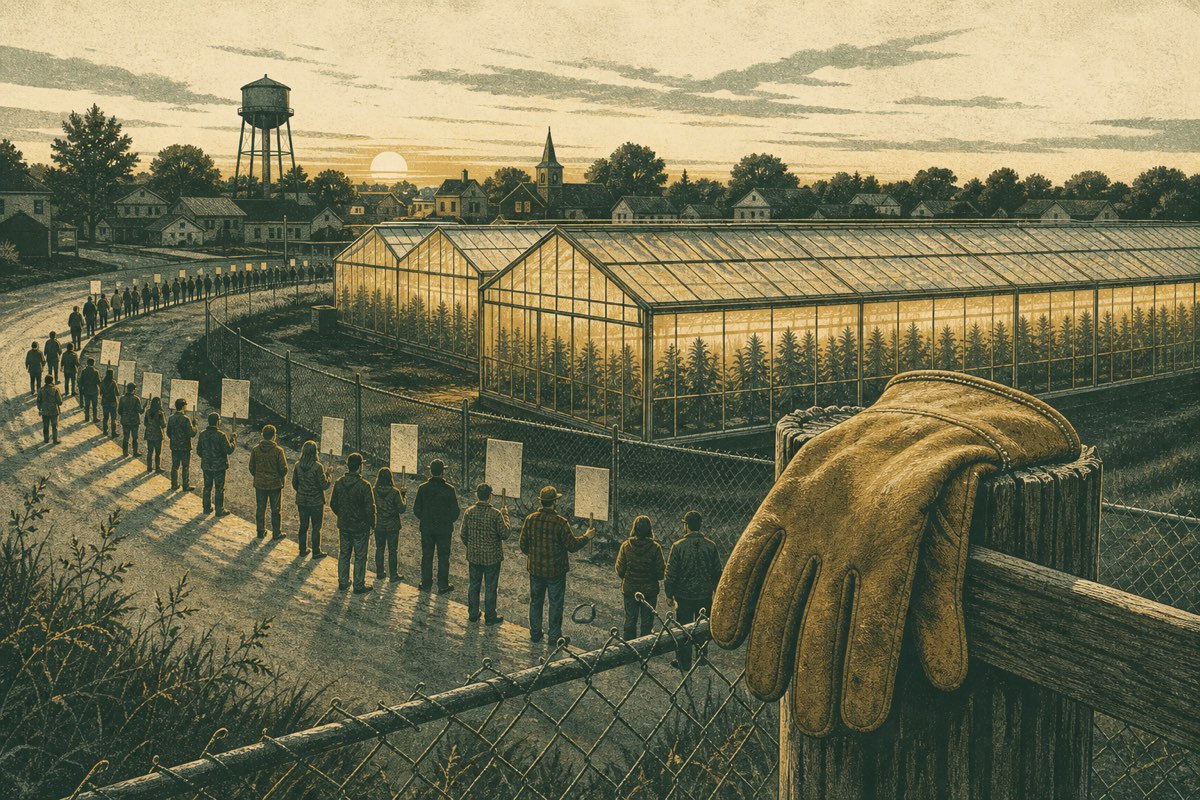
At 2 a.m. on June 25, Cory Hill walked out of the grow house. Hill is a cultivation technician at Ascend Wellness's plant in Barry, Illinois, a Pike County town of roughly 1,300 people, where the 75,000-square-foot facility and its greenhouse addition employ more than 300 union workers, a workforce equal to nearly a quarter of the town. Ten months earlier, Hill had celebrated winning a union election. Now he was on the wrong side of the fence at two in the morning, at the start of what the International Brotherhood of Teamsters calls its first strike ever at a cannabis cultivation facility. "It's kind of like a David and Goliath story," he said that day. Then he started counting: Day 1. (S3, S4, S5)
By his Day 21 post, something had moved, Ascend had scheduled three days of negotiations in Springfield, according to Hill's running tally, the first substantive talks since the walkout. As the strike enters its fourth week, more than 300 members of Teamsters Local 916 remain out, drawing $1,000 a week in strike pay, picketing through a heat wave, and testing whether the labor playbook that organized the country's warehouses works on its newest agricultural industry, in the middle of Illinois's $2 billion cannabis market, against a company that chose this same month to begin its climb toward a major US stock exchange. (S6, S7, S8, S13)
The dispute is a first-contract fight. In August 2025, 282 cultivation, extraction, packaging and quality-assurance workers at Barry voted to join Local 916, the third group of Ascend employees the local had organized. The union had already organized Ascend drivers and manufacturing workers, who were bargaining when that August win was announced; about ten months separated the later election from the June 2026 walkout. In March, the union filed federal labor charges: one alleging Ascend illegally fired a member of the union's own bargaining committee during negotiations, another alleging bad-faith bargaining. On June 8, the unit voted 92 percent to authorize a strike. Seventeen days later they used it. (S1, S9, S10, S11, S16)
The economics driving it are simple and small. Starting pay at Barry runs about $18.30 an hour in cultivation, $19.50 in the vault, $17.30 in post-harvest, according to a four-year worker who spoke to trade press. Union president JP Fyans says some workers pay more than $1,000 a month for family health coverage. "After more than a year at the bargaining table, our members have had enough of this company's delay tactics," Fyans said. "Ascend's executives have no problem paying union-busting attorneys to drag out negotiations, but when workers demand a fair contract, they suddenly claim they can't afford it." (S1, S8, S9)
Ascend tells a different story, and it deserves its full weight. "Ascend Wellness Holdings values and respects the employees at our Barry facility and has bargained in good faith throughout this process," said Matthew McKenna, the company's vice president of public affairs. "Our last, best and final offer includes a strong economic package and remains on the table while the union reviews it. We are disappointed employees were not given the opportunity to vote on the proposal and continue to urge the union to allow a ratification vote." The facility, he added, "remains open and continues to operate", and no reporting so far documents actual product shortages at Illinois dispensaries. (S3)
The legal record is genuinely mixed. The federal charge over the fired bargaining-committee member remains open at the National Labor Relations Board, an allegation, not a finding. The separate bad-faith-bargaining charge is listed as closed, with no public disposition. And the union's affordability math is contestable: a business agent's estimate that Ascend earns $9 million a week roughly matches the company's total revenue, $116.9 million in the first quarter across 51 locations in seven states, but that same quarter produced a $29.5 million net loss. Both things are true at once: the workers are paid little, and the company is losing money. That is the entire cannabis industry in one sentence. (S8, S10, S11, S12)
“It's kind of like a David and Goliath story. We're the little guy here and we're going after the big giant.”
— Cory Hill, cultivation technician, Ascend Wellness Barry / Teamsters Local 916
What gives the standoff its edge is the timing. On July 13, day 19 of the strike, Ascend announced a special shareholder meeting for August 28 to approve a reverse stock split of between 1-for-10 and 1-for-50, which chief executive Sam Brill called "a necessary step on our path to a listing on a major U.S. exchange." The company is running the industry's new uplisting playbook while its largest single worksite pickets outside the fence, a juxtaposition the union has not needed to embellish. (S13)
Organized labor has been circling cannabis cultivation for years; what it lacked was a win at scale. The benchmark is recent: a 45-day Teamsters strike at Green Thumb's Rise operation in York, Pennsylvania, ended last November with a first contract, the longest successful work stoppage in the industry's history, by the union's count. Barry is bigger, and the union knows it. "This is one of the largest multistate cannabis operators in the country," said Jesse Case, director of the Teamsters Food Processing Division. "These workers deserve the same standard that Teamsters at Ascend dispensaries enjoy, and we won't stop until we get it." On July 2, Illinois State Senator Doris Turner walked the picket line, where supporters had driven in from Iowa, Wisconsin, Minnesota and Missouri. (S1, S6, S14)
The picket line's voices are the story's texture. Linda Lopez, a kitchen associate, on day one: "We deserve more and that's why I'm here striking. I'm striking for my rights and what I believe in." Kayla Wasson, through the July heat wave: "We're striking for a purpose, and that purpose is for a better life for our family." Local 916 vice president Kyle Bollinger has layered workplace-safety allegations onto the wage fight, workers describing broken CO2 sensors and pesticide applications with too little re-entry time, claims the union says will become additional federal charges and which Ascend has not publicly addressed. Nor has the company commented on the specific firing at the heart of the open NLRB charge. (S3, S6)
Barry is also the sharpest expression of a broader Illinois pattern. Teamsters Local 777 has organized hundreds of cannabis workers around Chicago and ratified a first contract at Dispensary 33 in March; Local 916, based in Springfield, represents more than 4,000 workers statewide, and the Barry unit was its third group of Ascend employees, the local had previously organized Ascend drivers and manufacturing workers. Cannabis was sold to Illinois as a jobs program; six years and $2 billion in annual sales later, the people holding those jobs are unionizing at a pace the industry's investors have barely priced in. (S1, S15, S16)
- The Springfield negotiation session, three days of talks reportedly scheduled around day 21; whether they produce a ratifiable offer is the whole game.
- The open NLRB discharge charge, a finding against Ascend would convert an allegation into real bargaining power.
- August 28, Ascend's shareholder vote on the reverse split, with the strike either settled or in its third month.
- Whether Illinois dispensary shelves show it, the union's supply-chain warning has not yet materialized in reported shortages.
In Barry, the strike is less an industrial dispute than a town holding its breath, picket-line potlucks, a band at the one-week rally, workers from the same few streets taking care of each other in the heat. Hill keeps posting his count. Whether the Springfield talks produce a contract will test the union's bargaining strength at a large cultivation facility. The outcome could influence labor negotiations across the industry. (S4, S6)
Correction (September 8, 2026): The article incorrectly placed more than a year of bargaining after the August 2025 union election. Earlier groups were already negotiating; that election preceded the strike by about ten months. The first-strike description applies to the Teamsters, not all cannabis cultivation workers. (S1, S16)
- [1]Teamsters (IBT) — Cannabis Teamsters launch ULP strike (June 25, primary union statement)
- [2]Cannabis Business Times — Teamsters launch ULP strike at Ascend Wellness
- [3]WGEM — day-one picket coverage + full Ascend statement (Matthew McKenna)
- [4]Quincy Herald-Whig — 2 a.m. walkout, Barry context, wage and insurance figures
- [5]Muddy River News — facility history and statewide supply-chain angle
- [6]KHQA — one-week heat-wave rally; strike pay; Sen. Doris Turner on the line
- [7]Muddy River News — July 3: no new talks scheduled, sides 'very far apart'
- [8]MMJDaily — second-week report: wage rates by role; union revenue estimate
- [9]PRNewswire (Local 916) — 92% strike-authorization vote (June 8, primary)
- [10]NLRB — case 14-CA-383335 (open discharge charge, primary record)
- [11]NLRB — case 14-CA-383336 (closed bad-faith-bargaining charge, primary record)
- [12]PRNewswire (AWH) — Q1 2026 results: $116.9M revenue, $29.5M net loss (primary)
- [13]Cannabis Business Times — Ascend reverse-split vote for planned US-exchange uplisting (July 13)
- [14]Teamsters (IBT) — GTI York 45-day strike, the prior benchmark (Nov 2025)
- [15]Illinois IDFPR — Illinois cannabis sales exceeded $2B in 2024 (primary)
- [16]Teamsters release via Cannabis Business Times — August 29, 2025 organizing win and earlier bargaining groups (primary union statement)
Comments are open to verified operators. Sign in or create a free account to weigh in.

Vireo Paid $21 Million for a Florida Grow Its Landlord Bought for $14.9 Million in 2025
The Palatka buyout follows Vireo's $88.5 million purchase of its New York grow from Innovative Industrial Properties, financed with a 15% seller note now refinanced at 8.5% and a $41 million loan from Chicago Atlantic, the lender CEO John Mazarakis co-founded.
Nebraska's First Legal Cannabis Crop Is Weeks From Harvest. No Lab Is Licensed to Test It.
All four licensed growers asked the Medical Cannabis Commission to defer $36,500 a year in proposed fees until a supply chain exists. The interim chair says they were warned to plan on storage. The commission takes up its rules on Nov. 16.