Cannabist Reached US Bankruptcy Protection Through a Canadian Side Door
Cannabis companies have long faced barriers in federal bankruptcy court. On May 9, Judge Brendan Shannon recognized The Cannabist Company's Canadian insolvency without a written opinion, giving a company with about $220 million in funded debt a Chapter 15 route to protection.
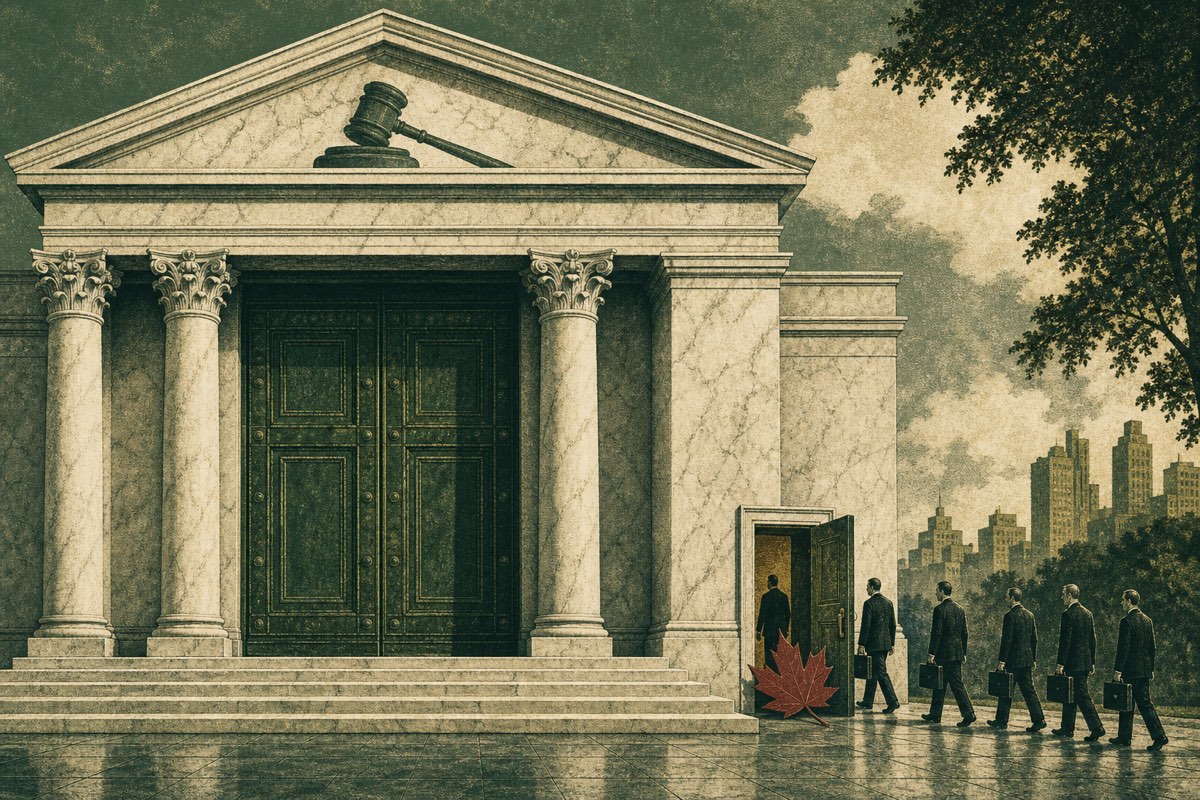
The order that opened a new cross-border route looks like nothing at all. On May 9, 2026, in Wilmington, Judge Brendan L. Shannon of the US Bankruptcy Court for the District of Delaware signed Docket No. 82 in Case No. 26-10426, a recognition order of the kind Delaware enters routinely for Canadian insolvencies. There was no written opinion. The lone objection had been resolved before the hearing. The milestone was specific: the first US recognition of a foreign insolvency proceeding involving a cannabis company. (S8)
The company was The Cannabist Company Holdings Inc., the multistate operator once known as Columbia Care, one of the original names in American cannabis, with 58 facilities and 43 dispensaries across its footprint when it sought protection. Its collapse was conventional: too much debt, taken on too confidently. Between 2019 and 2024 the parent raised roughly C$340 million in equity and $320 million in secured debt from Canadian capital markets. It reported a $105.1 million net loss for 2024 and $124.2 million more through the first nine months of 2025. On December 31, 2025, it missed an interest payment; by January 30 that was an event of default, and five forbearance extensions later the company was out of road. David Hart, the chief executive promoted in January 2024 to arrest the slide, had already exited Florida and shed assets chasing $10 million in savings; it wasn't nearly enough. (S3, S10)
What was not conventional was where it went next. Cannabis companies have faced substantial barriers in bankruptcy because of federal marijuana prohibition. Courts dismissed cases including In re Rent-Rite in 2012, In re Arenas in 2015, In re Way to Grow in 2019 and In re Burton in 2020. But exclusion was not absolute: in January 2023, the court in In re Hacienda denied the US Trustee's motion to dismiss a Chapter 11 case involving a former cannabis manufacturer that had ceased operations. Cannabist's milestone concerned recognition of a foreign proceeding, not the first protection ever extended to a business with cannabis ties. (S8, S12)
Cannabist's lawyers at Weil, Gotshal & Manges found the seam. On March 24, 2026, the two Canadian holding companies at the top of the corporate tree, entities that hold no cannabis licenses and touch no plant, commenced proceedings under Canada's Companies' Creditors Arrangement Act in the Ontario Superior Court of Justice. The next day they filed Chapter 15 petitions in Delaware, asking the US court to do something modest on its face: recognize the Canadian proceeding and extend its protections to the American assets underneath. (S4, S8)
Chapter 15 is the Bankruptcy Code's cross-border chapter, the US court assists a foreign restructuring rather than running its own. That distinction became the case's signature line. "Simply put, Chapter 15 is not Chapter 11," the company's briefs argued: the main event was in Ontario, under a legal system with no prohibition on cannabis insolvencies, and Delaware was being asked only for comity. At the first-day hearing on March 26, the US Trustee objected to stretching the stay over non-debtor cannabis subsidiaries. Judge Shannon overruled it, shielding the US operations and some 70 leases and contracts while the Canadian process ran. (S7, S9, S10)
“Simply put, Chapter 15 is not Chapter 11.”
— The Cannabist Company's briefs, Weil, Gotshal & Manges, to the Delaware bankruptcy court
The structure was the argument. The debtors were holding companies with what restructuring lawyers began calling space between the filer and the plant; the subsidiaries actually growing and selling cannabis in eight states never entered a US courtroom as debtors at all. That space, plus a Canadian forum whose orders US courts routinely honor, was the whole trick, and every distressed operator's counsel in the country watched it work. (S1, S8)
The money at stake explains the effort. Alongside the roughly $179 million in senior secured notes sits a $40.4 million East West Bank mortgage over properties in New York, Maryland and New Jersey, and $51 million in IRS claims under Section 280E, the tax provision whose relief arrived, for the rest of the industry, only with April's rescheduling of medical cannabis. The company has been selling itself in pieces, including before its CCAA filing: Virginia went for $130 million on February 5 (after Cannabist paid a $3.3 million break-up fee to walk away from Curaleaf's $110 million bid), Ohio is under contract to Holistic Industries for $47 million, Delaware to the Millstreet affiliate for $16.5 million. New York's license was surrendered; Pennsylvania is winding down for lack of a buyer. (S3, S4, S10)
The fight that could have stopped all of it came from East West Bank. On May 1 the mortgage lender filed the sole formal objection to recognition, invoking Section 1506 of the Bankruptcy Code, the public-policy escape hatch. Granting recognition, the bank argued, "would be in violation of federal law, specifically the CSA, because the stated purpose of the Canadian Proceeding is to monetize cannabis-related assets and distribute the resulting proceeds." The objection raised the federal-law conflict that has repeatedly obstructed cannabis bankruptcy cases. This time it never reached a ruling: the objection was resolved consensually before the hearing, and the recognition order went in clean. (S2, S8)
The dog that didn't bark was the US Trustee. The office that has repeatedly sought dismissal of cannabis filings submitted no written objection to recognition, only informal comments, resolved in advance. Mark Salzberg and Katherine Catanese, restructuring partners at Squire Patton Boggs, called the silence one of the case's mysteries in a widely read analysis: "We do not know why," they wrote, and the Trustee retains every right to object later, when the debtors ask the US court to bless asset sales or distributions. (S1)
The restructuring bar has been careful not to over-claim. "This is the first time a US bankruptcy court has recognized a foreign insolvency proceeding involving a cannabis company," Salzberg and Catanese wrote, while cautioning that a cross-border filing "needs to be meticulously planned and well thought out." Morrison Foerster's analysts noted the decision's precedential value "may be limited" because recognition was consensual rather than litigated. Duane Morris put it most plainly: Cannabist opens a door without guaranteeing it stays open, a less comity-minded judge, a live Trustee objection, or a debtor closer to the plant could shut it. (S1, S7, S8)
Charles Alovisetti, an attorney at the cannabis firm Vicente LLP, offered the industry's epitaph for the era that produced the case: "Many of these big cannabis companies took on significant amounts of debt and a lot of them have run into issues servicing the debt." Of Cannabist itself: "I think they're just trying to do an orderly wind down." (S3)
There is also a counter-current. On May 13, four days after the recognition order, Trulieve announced a proposed re-domestication from British Columbia to Delaware, citing April's Schedule III order. The healthiest operators are betting that rescheduling makes American corporate homes safe again; distressed operators have a potential cross-border route where their structure and circumstances support it. How rescheduling will affect direct Chapter 11 access for cannabis operators remains an unresolved question. (S2, S7)
- Q3 2026, Ohio ($47M, Holistic Industries) and Delaware ($16.5M) sales expected to close, a prospective test of whether the US court's assistance extends to consummating cannabis asset sales.
- Pending, definitive agreements for the six remaining markets (Colorado, Illinois, New Jersey, Massachusetts, Maryland, West Virginia) under the non-binding memorandum of understanding.
- Watch the US Trustee, it reserved its public-policy arguments; an objection at the distribution stage could require a ruling on the cannabis public-policy issue in this case.
Somewhere in the industry's next downturn, a distressed operator's board will ask its lawyers the question Cannabist just answered: can a Canadian cannabis restructuring obtain recognition in a US bankruptcy court? The answer is yes, on the facts of this case, with non-plant-touching parents and settled objections. Judge Shannon signed no opinion explaining the recognition. Which means nobody can be entirely sure how far the route extends, or when a contested case might close it.
Correction (September 8, 2026): Earlier language overstated cannabis companies' exclusion from US bankruptcy courts. Cannabist's milestone was recognition of a foreign insolvency proceeding; the Hacienda Chapter 11 case had already survived a dismissal motion in 2023. The article now makes that distinction and clarifies that the Virginia sale preceded the CCAA filing. (S8, S12)
- [1]MJBizDaily — Salzberg & Catanese (Squire Patton Boggs): cannabis companies gain bankruptcy access (guest analysis)
- [2]MJBizDaily — US bankruptcy judge signs off on cannabis MSO's request for protections (May 14)
- [3]MJBizDaily — Major marijuana MSO files for US bankruptcy protections (April 3)
- [4]The Cannabist Company — strategic transactions + CCAA initiation press release (March 24, primary)
- [5]FTI Consulting Canada — official CCAA Monitor site for The Cannabist Company (primary)
- [6]CourtListener — Judge Shannon's May 9, 2026 recognition order, Docket No. 82 (primary document)
- [7]Duane Morris — 'Simply Put, Chapter 15 Is Not Chapter 11' client alert (June 15)
- [8]Morrison Foerster — Cannabist Chapter 15 recognition analysis with prior-dismissal case history (May 26)
- [9]Harvard Law School Bankruptcy Roundtable — Weil Gotshal team on the recognition (May 12)
- [10]ElevenFlo — docket-sourced case profile: capital structure, IRS 280E claims, timeline
- [11]Akerman — provisional stay extended to US cannabis subsidiaries (March 30)
- [12]US Bankruptcy Court, Central District of California — In re Hacienda, January 20, 2023 opinion denying dismissal (primary)
Comments are open to verified operators. Sign in or create a free account to weigh in.

Kentucky Now Has a Dispensary in All 11 Regions. 28 of Its 79 Licenses Have Changed Hands
Cresco Labs' Sunnyside opened in Prestonsburg on Oct. 12, completing the map. The state's own license roll shows only one of four Mountain region dispensaries cleared to operate, and 28,000 cardholders are about a third of what the industry's trade group calls a healthy market.
Curaleaf Erased a $31.8 Million Verdict by Arguing Its Own Cannabis Deal Was a Crime
A Michigan grower's 16,300-pound harvest is now the test case for every cannabis contract in four states. Neal Katyal has asked the full Sixth Circuit to rehear it, and NORML warns the ruling lets buyers walk when prices fall.