A Box Labeled 'Phone Cases,' 40 Pounds of Pesticide: Feds Charge Employees at a Licensed Oklahoma Grow
An unsealed indictment in Muskogee charges one worker at a Seminole County medical marijuana farm with smuggling unregistered pesticides from Hong Kong and a second with unlawful pesticide distribution. The case lands as Oklahoma's licensed grower count has fallen nearly 69% since September 2023 and its governor campaigns to shut the program down.
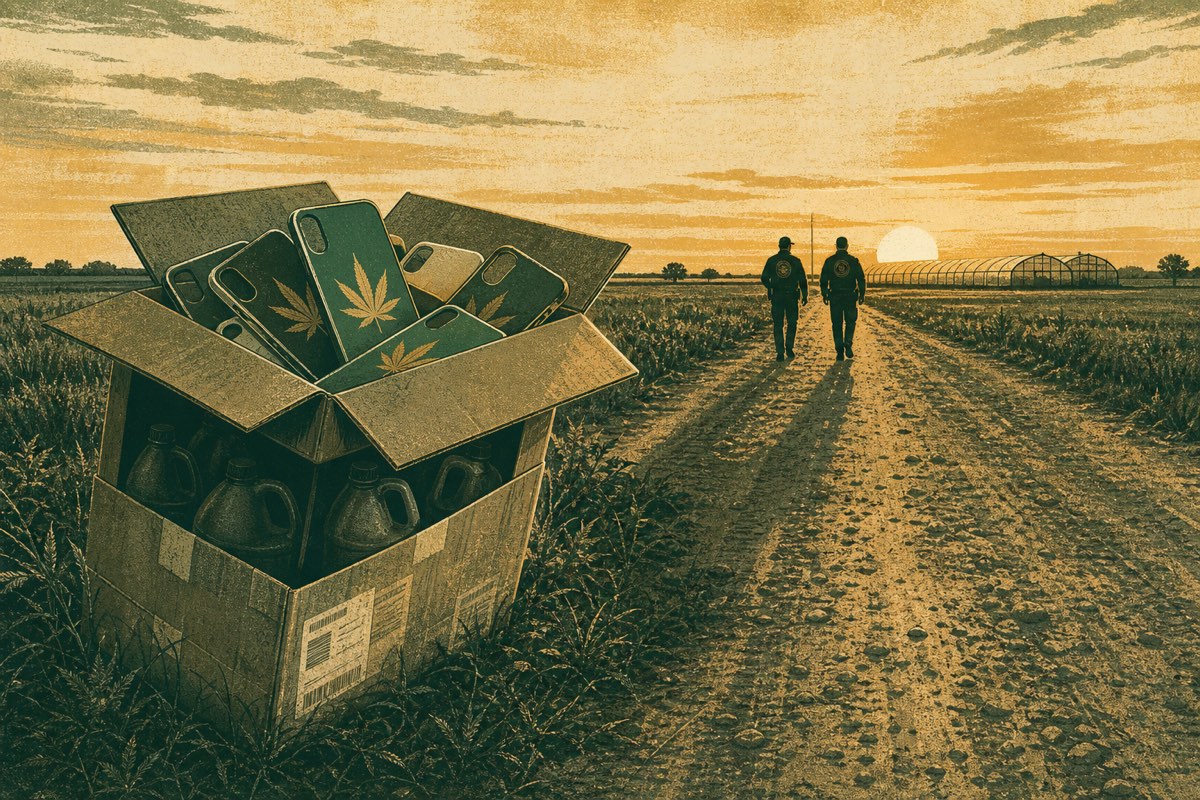
The package that arrived at 11985 NS 3580 on March 19, 2025, said it held plastic cell phone cases. The DHL paperwork from Hong Kong, reference number 1689470152A, listed phone cases, polyvinyl chloride data lines and stainless steel latch fitments. Federal investigators say what the box actually held was roughly 40 pounds of unregistered, misbranded pesticides, bound for a state-licensed medical marijuana farm on a rural stretch of Seminole County, Oklahoma. Agents executed a search warrant at the property that same day and carried out about $20,000 in cash.
Sixteen months later, on July 9, the US Attorney's Office for the Eastern District of Oklahoma unsealed a grand jury indictment against two of the farm's employees. Jin Zhao Chi, 44, faces federal felony counts of conspiracy to smuggle goods and smuggling, plus a misdemeanor under FIFRA, the federal pesticide statute, for unlawful distribution and sale of unregistered pesticides. Dian Lin Jiang, 65, faces a single FIFRA misdemeanor. The charges are allegations, and both defendants are presumed innocent. (S1, S2, S4)
The case is small, two employees, four counts, an unnamed pesticide. Its significance is the reach of customs and pesticide enforcement into a state-licensed grow. Prosecutors allege Chi imported unregistered and misbranded pesticides from Hong Kong in February and March 2025. The pesticide-distribution allegations reach further back: Chi's alleged conduct began in June 2022, and Jiang's ran from April 2022 to May 2023. (S1, S2)
The investigation was a customs-and-environment operation, not a drug bust: the EPA led it jointly with US Customs and Border Protection, the Department of Homeland Security and Homeland Security Investigations. The EPA's enforcement chief made the intended audience unambiguous. (S2, S3)
“We will not tolerate anyone profiting from polluting our lands and poisoning our citizens with dangerous, illegal Chinese pesticides smuggled into the American Heartland.”
— Jeffrey A. Hall, Assistant Administrator, EPA Office of Enforcement and Compliance Assurance
"These illegal pesticides are often used in sophisticated criminal enterprises like illicit marijuana grows," Hall added, pointedly, about a farm that holds a state license. Whether it still does is unclear: the Oklahoma Medical Marijuana Authority did not respond to trade-press questions about the site's permit status, and related enforcement records remain sealed. The indictment never names the pesticide involved. (S1, S3)
Why pesticides on cannabis draw this kind of federal muscle is no mystery to anyone in cultivation. Unregistered foreign agrochemicals have a documented history in illicit grows, and some common offenders are uniquely dangerous on a crop that gets inhaled: the fungicide myclobutanil, sold as Eagle 20, converts to hydrogen cyanide when heated. The indictment alleges no specific chemical, but the reason a 40-pound box was worth mislabeling is the reason regulators test for this class of contamination at all. (S6)
To understand why federal agents were watching a Seminole County farm at all, start with what Oklahoma built. After voters legalized medical cannabis in 2018, the state issued licenses with no caps, no residency teeth and some of the cheapest land and labor in the country, for a stretch, the hottest medical market in America, with 9,402 licensed growers recorded in December 2021 and reported sales of $945 million that year. The same openness, congressional testimony and state officials contend, attracted out-of-state and foreign-linked operations that used medical licenses as cover; a September House Homeland Security hearing was bluntly titled "Invasion of the Homeland: How Illegal, Chinese-Owned Marijuana Farms Have Consumed Rural America." A licensing moratorium followed, then the purge. (S7, S9, S11, S13)
The charging papers are narrow but precise. The smuggling conspiracy Chi allegedly joined ran only from late February 2025 to the March 19 delivery, but the FIFRA counts reach back years: Chi allegedly distributing and selling unregistered pesticide from June 2022 into early 2025, Jiang from April 2022 to May 2023. To whom, the indictment doesn't say, and the unnamed Hong Kong co-conspirators suggest the case may not be finished growing. The $20,000 seized at the farm is listed for forfeiture. (S1, S3, S4)
The indictment landed in the middle of the most aggressive enforcement stretch in Oklahoma cannabis history. The day before it was announced, Attorney General Gentner Drummond's Organized Crime Task Force said a two-day operation had shut down five illegal grows around Woodward, more than 30,000 plants and 200-plus pounds seized, six people deported. April raids in Tulsa and Claremore took nearly 59,000 plants. The licensed market is contracting just as fast: 1,885 growers held permits on July 1, down 68.8 percent from 6,037 in September 2023, while patient counts fell by nearly 19,000 in a year. Reported annual sales were $945 million in 2021; Oklahoma Voice reported more than $670 million for 2025, citing the OMMA dashboard. Governor Kevin Stitt, term-limited and unsparing, used his final State of the State to ask voters to shut the whole program down: "This industry is plagued by foreign criminal interests and bad actors." (S1, S5, S7, S11, S12, S13)
Licensed operators tell a different story about the crackdown, that it sweeps up legitimate businesses along with bad actors. In federal lawsuits filed last fall, including Craft Buds LLC v. State of Oklahoma, operators allege the state is "engaged in a scheme and pattern and practice to destroy legally operating businesses." In April, a judge handed the state a pointed loss: Cedric Gardens, one of Oklahoma's largest cultivators, won back a license OMMA had suspended. "We proved that there was no public safety threat," said Dana Kurtz, the company's attorney, adding that regulators suspended the license "without any evidence" and without checking the state's own track-and-trace data. (S1, S8)
There is also a political overlay worth naming. The case fits a national narrative about Chinese-linked grow operations, the subject of a September congressional hearing titled "Invasion of the Homeland", and Stitt has leaned on that framing hard. Trade press has noted the rhetoric sometimes outruns the record; reporting by Investigate Midwest found farmland data the governor cited pointed mostly to other countries. In Seminole County, what the government has alleged so far is specific and narrow: a mislabeled box, an unregistered chemical, two employees, and a licensed farm that federal agents watched closely enough to meet the package on arrival. (S1, S9)
For the industry outside Oklahoma, the jurisdictional lesson is the point. Operators spent the spring assuming rescheduling had settled their federal relationship, file with the DEA, keep state compliance tight, exhale. Seminole County is a reminder that the drug statutes were never the only federal exposure: customs law, environmental law and pesticide registration all reach a licensed grow with no marijuana-specific theory required. State testing catches contamination after the fact; FIFRA reaches the supply room before the sprayer comes out. (S2, S3)
The indictment leaves a larger question: whether the farm at 11985 NS 3580 keeps its license, and how many of Oklahoma's 1,885 remaining growers now have someone checking the labels in their supply rooms, in English, against the EPA registry, before the next box arrives.
Correction (September 8, 2026): This article misstated the grower-count comparison and sales figures. OMMA recorded 6,037 growers in September 2023 and 1,885 in July 2026, a 68.8% decline; reported sales were $945 million in 2021 and more than $670 million in 2025. The article also now distinguishes the defendants' charges and removes an unsupported enforcement-first assertion and unverified arraignment, bond and trial details. (S1, S11, S12, S13)
- [1]US Attorney's Office, E.D. Oklahoma — press release announcing the unsealed indictment (primary)
- [2]EPA — news release with enforcement chief Jeffrey A. Hall statement (primary)
- [3]Indictment, United States v. Chi and Jiang, E.D. Okla. (CourtListener, primary document)
- [4]MJBizDaily — pesticides lead to federal charges for Oklahoma cultivation employees (July 16)
- [5]The Lawton Constitution — arraignment, bonds, trial date + statewide raid and licensing statistics
- [6]ACS Laboratory — myclobutanil/Eagle 20 converts to hydrogen cyanide when heated (testing context)
- [7]MJBizDaily — Stitt calls to recriminalize Oklahoma's $600M medical cannabis industry (Feb)
- [8]MJBizDaily — Cedric Gardens wins back suspended license; Kurtz quotes; Craft Buds lawsuit
- [9]House Homeland Security subcommittee — Sept. 2025 hearing testimony on Chinese-linked grows (context)
- [10]OMMA — mandatory recall of Greenleaf Labs-tested products (March 19, primary)
- [11]Oklahoma Medical Marijuana Authority — archived licensing and tax data (primary)
- [12]Oklahoma Voice / The Journal Record — 2025 medical marijuana sales reported from the OMMA dashboard (March 9, 2026)
- [13]The Journal Record — 2021 medical marijuana sales and industry forum (November 2, 2022)
Comments are open to verified operators. Sign in or create a free account to weigh in.

Vireo Paid $21 Million for a Florida Grow Its Landlord Bought for $14.9 Million in 2025
The Palatka buyout follows Vireo's $88.5 million purchase of its New York grow from Innovative Industrial Properties, financed with a 15% seller note now refinanced at 8.5% and a $41 million loan from Chicago Atlantic, the lender CEO John Mazarakis co-founded.
Nebraska's First Legal Cannabis Crop Is Weeks From Harvest. No Lab Is Licensed to Test It.
All four licensed growers asked the Medical Cannabis Commission to defer $36,500 a year in proposed fees until a supply chain exists. The interim chair says they were warned to plan on storage. The commission takes up its rules on Nov. 16.