New York Wired Its Cannabis Debt List Into Metrc. Now a Late Invoice Means Cash at the Door.
Since Sept. 15, a store more than 30 days late on a supplier bill is flagged on the shipping manifest itself, and the state's old reporting portal closed to new reports on Oct. 23. Suppliers call the notice window too short; one state adviser says the real debt is about double what regulators can see.
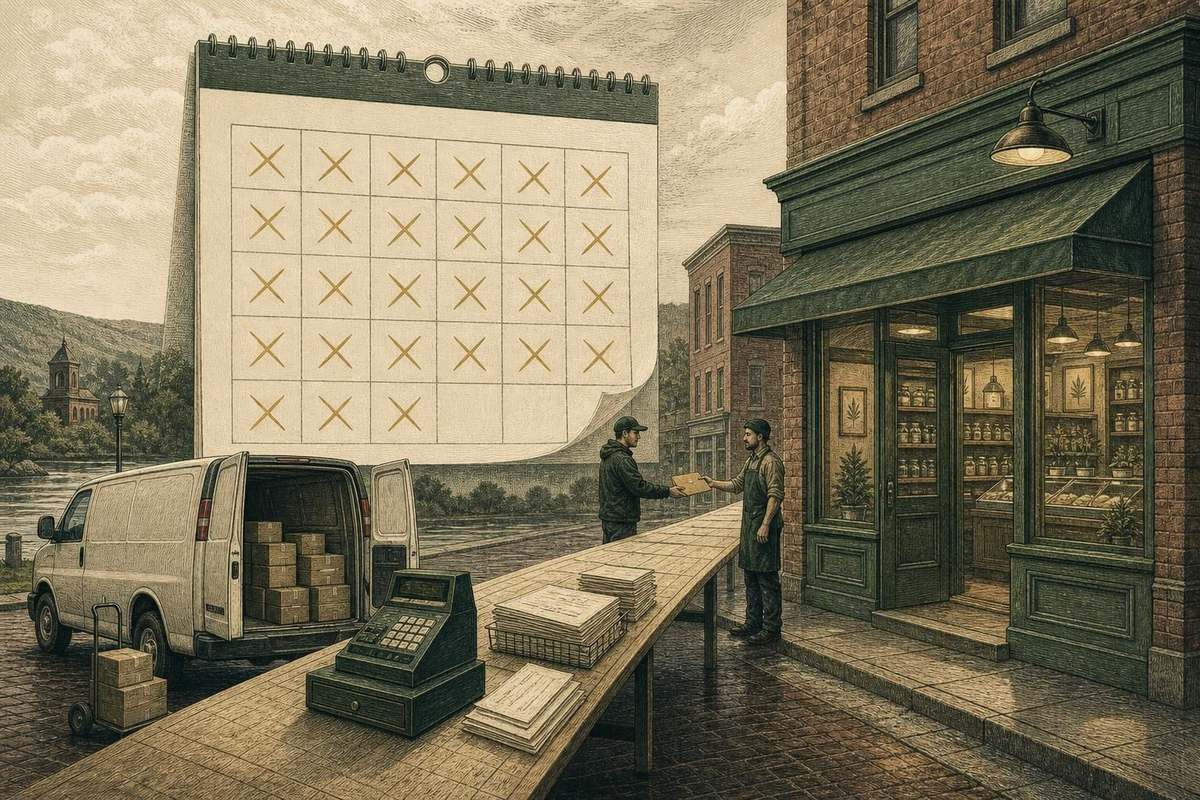
On the afternoon of Sept. 10, in a meeting room at Monroe Community College's downtown campus in Rochester, Joe Belluck asked a question that sounds simpler than it is. The chair of the state's Cannabis Advisory Board wanted to know why the Office of Cannabis Management was policing unpaid invoices between distributors and stores at all, when in other industries a late bill is a private dispute between two businesses. (S1)
John Kagia, the office's executive director, answered that it was an existential issue, according to the meeting's minutes. He pointed to California, where the largest distributor had filed for bankruptcy over $220 million in unpaid bills and taken farmers down with it. Without the state in the middle, he said, a retailer could run up a debt with one distributor, move to the next and repeat the cycle, and many distributors were too afraid of losing customers to report anyone. (S1)
Five days later the answer was built into software. Since Sept. 15, New York's list of retailers who are late paying suppliers has lived inside Metrc, the state's track-and-trace system. When a distributor creates a shipping manifest to a store on the list, the payment-terms field locks to cash on delivery and the screen reads, "Recipient is on the COD List, Terms must be COD." Thursday, Oct. 22, was the last day the state's old portal accepted delinquency reports for earlier deliveries. From Oct. 23, every new report runs through Metrc. (S2, S3)
Outside Rochester, in Victor, Jayson Tantalo has stopped writing the big orders. The co-founder of Flower City Dispensary and vice president of the New York Cannabis Retail Association told MJBizDaily he used to place $40,000 orders with a single supplier and now splits them up and buys more often, and he is telling other owners to do the same. The catch is the price. "It's a volume game," he said. "The more you buy, the cheaper it gets." (S4)
The rules themselves are not new. Under 9 NYCRR 124.2, a supplier may sell to a retailer on credit but the retailer must pay in full within 30 days of delivery. If it doesn't, the supplier must send written notice of default within seven calendar days after the due date and report the store, which then cannot buy on credit from anyone until the balance is paid. The Cannabis Control Board can suspend, cancel or revoke a license over violations. What changed is enforcement: the list used to run on email and survey forms, and now it sits on the manifest. (S5, S2, S6)
The Metrc bulletin that set up the change, NY_IB_0025, shows how mechanical it now is. Each transfer carries a single invoice number and a payment term chosen from a drop-down. Once the store accepts the delivery in Metrc, that invoice becomes eligible to be reported if it goes unpaid past the credit term, after the supplier has sent its notice of default. Stores that were on OCM's list before Sept. 15 were carried over automatically, and suppliers were told not to re-enter the old cases; payments on those older debts still go through the legacy portal, which stays open for that one purpose. Retailers, for their part, must pay in cash, a term the state defines to include business checks and electronic transfers but not credit cards. (S2, S3, S5)
How big the hole is depends on whom you ask. At the Rochester meeting, OCM's market analysts walked the board through the list by license type, dollars owed, invoices and days delinquent, according to the minutes. Vicente LLP, a cannabis law firm that summarized the presentation, reported the headline numbers: 87 retailers, roughly 12% of the retail base, owing about $3.89 million to 44 suppliers, an average of about $45,000 per store across nearly 10 invoices, and an average delinquency of about 281 days. Those figures do not appear in the published minutes. (S1, S7)
The board members who sell to those stores think the real figure is larger. Allan Gandelman, who co-leads the board's industry and markets subcommittee, said the numbers were drastically underreported and estimated that the true volume of payments more than 30 days late was closer to double what OCM could see. He called it scary to see so many CAURD licensees, the conditional retail licenses New York reserved for people with past cannabis convictions, on the list. He also said some suppliers were disregarding the list and still extending terms, which leaves smaller suppliers that follow the rules losing accounts to better-capitalized rivals. (S1)
Taxes make the squeeze worse for both sides of the counter. Peter Shafer, the subcommittee's other co-lead, told the board that suppliers owe tax every three months whether or not they have been paid, so they end up fronting both the product and the tax on it. Retailers, he said, end up choosing between paying suppliers and paying the state, and Gandelman noted that the penalties for skipping taxes are far stiffer than those for paying a distributor late. (S1)
OCM's case for the change rests on fairness as much as solvency. Patrick McKeage, the agency's chief operating officer, told MJBizDaily the Metrc integration is meant to stop side deals. "If someone can get preferential treatment and terms from a distributor, that sets up an unfair market," he said. Suppliers that fail to report overdue payments risk suspension or revocation of their own licenses. The structure copies New York's alcohol law, which also fixes credit terms and bars further credit to listed retailers. (S4, S7)
“If someone can get preferential treatment and terms from a distributor, that sets up an unfair market.”
— Patrick McKeage, Chief Operating Officer, New York Office of Cannabis Management
The people closest to the invoices see a calendar problem. Eric Steenstra, a partner at the Indigenous-owned cultivator and distributor Skyworld, said the company used to call late customers and work out payment plans. Now the seven-day window forces its hand. "I don't know how they came up with seven days to notify, but it's too short," he said, noting that a mailed check can take 10 days to arrive. (S4)
Osbert Orduña, chief executive of The Cannabis Place, said the 30-day clock ignores how long product sits on a shelf, typically 45 to 60 days in his telling, so stores must pay before the inventory pays for itself. He also described $120,000 in mailed checks that were stolen and altered and took 11 months to recover. "The help they need is not a COD list," he said. "That's the final nail in the coffin for the New York cannabis industry." (S4)
Nabis, a distributor that says it serves about 700 New York retailers, is betting the other way. Smrita Choubey, its general manager for the Northeast, said invoices across the industry are typically paid 65 to 95 days after delivery. "Asking an industry to pay in one month when they're used to three, there's going to be a sector of retailers that won't have enough cash flow to keep products in their stores," she said. The company dropped minimum delivery fees so a store can reach a $1,000 order across more than 50 brands instead of meeting individual brand minimums of $5,000 or more, and it expects about a third of retailers to cycle on and off the list. (S4)
Smaller drops cost distributors money too. Choubey said vehicle insurance alone runs about $35,000 per vehicle, which is why brands set high minimums in the first place. Nabis is also rolling out a tool that reads a store's point-of-sale data and drafts editable reorders, an attempt to turn frequent small purchases into a routine rather than a chore. Orduña, for his part, said his business sees misapplied payments 10 to 15 times a month, the kind of error that, under a 30-day clock, can put a store on the list while it is still arguing about whose ledger is right. (S4)
The market around those invoices is not shrinking so much as stalling. OCM's dashboard showed $1.24 billion in year-to-date retail sales at the control board's Sept. 3 meeting, and its market staff counted $3.9 billion in reported retail sales since the program began. Earlier this year Kagia had said the state was on track for $2.6 billion in 2026, MJBizDaily reported; the pace since has trailed that projection. The same September deck announced that the state had begun paying for licensees' Metrc inventory tags, the system now carrying the debt list. (S8, S1, S9)
A store that thinks it was listed in error can file a dispute through the "COD Standing" screen in its own Metrc account, under 9 NYCRR 124.2(f), and OCM will review the facts, its retailer guide says. A store that pays in full can get back on credit before the next list is published only if the supplier reports the payment, asks to sell on credit again and the retailer owes no one else. (S5)
Belluck's question from the Rochester meeting has now been answered twice, once by Kagia and once by the software. For Tantalo in Victor, the answer arrives as smaller orders, more deliveries and thinner discounts, the cost of never letting an invoice reach day 31. (S1, S4)
- [1]NY Office of Cannabis Management - Cannabis Advisory Board meeting minutes, Sept. 10, 2026 (Rochester)
- [2]Metrc Support Bulletin NY_IB_0025 - Delinquency tracking, cash on delivery (COD), effective Sept. 15, 2026
- [3]NY Office of Cannabis Management - Cannabis Control Board release, Oct. 1, 2026 (C.O.D. reporting transition)
- [4]MJBizDaily - New York cannabis retailers shrink orders as payment enforcement tightens
- [5]NY Office of Cannabis Management - Retailer's Guide to the C.O.D. List
- [6]NY Office of Cannabis Management - C.O.D. List supplier instructions
- [7]Vicente LLP - New York Cannabis Advisory Board meeting: COD reporting moves to Metrc
- [8]NY Cannabis Control Board - meeting deck, Sept. 3, 2026
- [9]MJBizDaily - New York cannabis retailers owe $3.9 million as sales stall
Comments are open to verified operators. Sign in or create a free account to weigh in.

Two-Thirds of Missouri's Cannabis Operators Told the DEA No. Their Own Lawyers Disagree About Whether That Was Smart.
Only about a third of MoCannTrade's 90-plus members applied for federal registration, none have been approved, and Treasury still has not said whether registering is what buys you out of Section 280E. Missouri is the control group.

The DEA Told Nicole Huff to Fire Two Employees by Labor Day. She Told the DEA No.
Rescheduling handed state medical operators federal legitimacy and 21 C.F.R. § 1301.76 along with it. An Aberdeen, Mississippi dispensary owner is now headed for an administrative law judge in Washington over two workers with nonviolent felonies and a year of clean reviews.