Hochul Ends New York's Cannabis Labor-Peace Mandate the Day the Judge Weighing It Dies
Chapter 369 repeals the 2021 union-neutrality requirement at once, but a deal with legislative leaders strips the AFL-CIO-seated wage board meant to replace it. A Brooklyn retailer's fully briefed federal challenge now waits for a new judge, and organized labor gets neither the mandate nor its replacement.
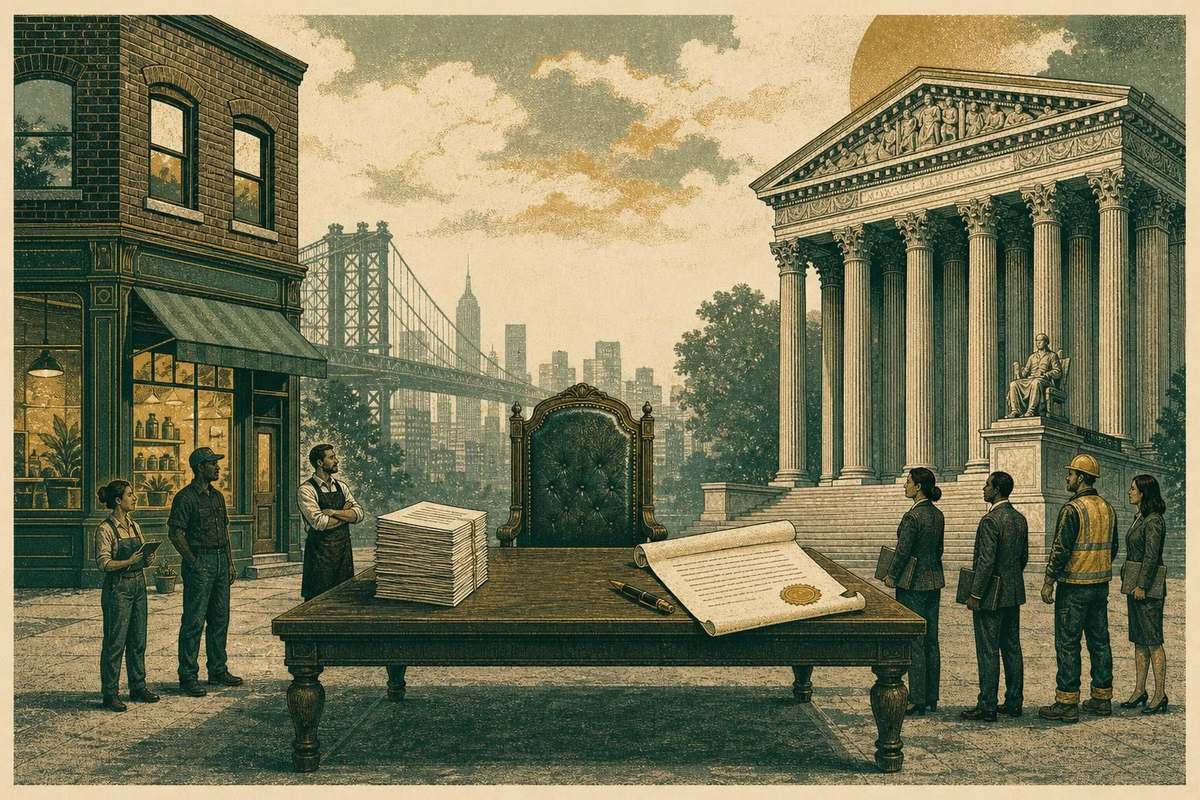
Joanne Wilson built Gotham, a cannabis store on Kent Street in Brooklyn, as what she calls the first "cannabis concept store," and she built its pay sheet to match: a $25 base hourly wage, fully reimbursed medical and health benefits, a 401(k) match and four weeks of paid vacation, according to the lawsuit her company later filed. On April 1, 2025, about six months after the store opened, a letter arrived from Local 338, a downstate union, saying a majority of Gotham's employees had chosen it to represent them. (S6)
Gotham, like every adult-use licensee under New York's 2021 legalization law, had signed a labor peace agreement as a condition of its license, and the agreement required it to stay neutral. Two weeks after the letter, on April 14, 2025, Wilson's company, Hybrid NYC LLC, sued the Cannabis Control Board and the Office of Cannabis Management in federal court in Manhattan, arguing that the National Labor Relations Act leaves no room for a state to impose such a requirement at all. "As entrepreneurs, we should not be suppressed from actively participating in decisions being made that will directly impact the very employees and/or communities we aim to serve," Wilson said. (S6, S7)
Eighteen months later, the case was fully briefed and waiting on U.S. District Judge Alvin K. Hellerstein of the Southern District of New York. On Wednesday, October 28, 2026, two things happened. Gov. Kathy Hochul signed Senate Bill 10643 into law as Chapter 369 of 2026, repealing the labor peace requirement Wilson had sued over. And Hellerstein died, at 92. (S1, S7, S8)
The new law ends a provision organized labor fought to put in the 2021 statute. Its first seven sections strip the labor peace language from New York's Cannabis Law, effective immediately. What the Legislature meant to put in its place is now gone too. Hochul signed only after negotiating chapter amendments with Senate and Assembly leaders that will remove the bill's Cannabis Industry Wage Board and its new ownership-disclosure rules, both scheduled to take effect January 31, 2027, when lawmakers return. Regulators will keep discretion to favor license applicants who sign labor peace agreements voluntarily. (S1, S2, S3, S4)
"The bill, as passed, would create uncertainty in the industry by imposing a burdensome reporting requirement on applicants, and by creating a wage board that could raise costs for licensees and drive consumers to the illicit market," Hochul wrote in her approval memo, as quoted by the Times Union and Marijuana Moment. The agreed amendment, she wrote, "would preserve the repeal of the labor for peace agreement requirement in full, while removing the wage component of the bill." (S3, S4)
The result is a law that answers the question in Wilson's lawsuit without a court. It also leaves Local 338 and the rest of organized labor with neither the mandate they had nor the wage board that was meant to replace it. (S3, S9)
The bill that reached Hochul's desk was a trade. Sen. Jessica Ramos, the Queens Democrat who chairs the Senate Labor Committee, introduced it on June 1, 2026, and Assemblymember Harry Bronson, the Rochester Democrat who chairs the Assembly Labor Committee, carried it in the Assembly. It passed the Senate 37-23 on June 4 and the Assembly the next day. Section 8 would have created a three-member wage board under the Labor Law: one representative of the licensed industry, one of the New York State AFL-CIO, and a chair from the public, appointed by the labor commissioner. Its first hearing was due by March 1, 2027. (S1, S2, S3, S4)
The board would have had real reach. The bill text gave it the power to subpoena witnesses and "all books, records, and other evidence relative to any matters under inquiry," with the same effect as a state Supreme Court subpoena. Its report had to include specific wage recommendations for workers in cultivation; processing and packaging; distribution; and retail and delivery, and it could recommend an industry-wide minimum for everyone else. A separate section would have required license applicants to disclose their full ownership structure and any management services agreements. (S2, S4)
The bill split Democrats. The two architects of the 2021 legalization law, Assembly Majority Leader Crystal Peoples-Stokes and Sen. Liz Krueger, both voted against it, the Times Union reported; the Senate roll call lists Krueger among the 23 no votes. Opponents said more than 40% of the state's cannabis businesses were not profitable and that many had already cut staff hours. (S3, S1)
In August, licensed growers and retailers urged Hochul to veto the bill. After the signing, the Empire Cannabis Manufacturers Alliance, the Association of New York Cannabis Processors and the Cannabis Farmers Alliance thanked Hochul for "stopping a wage board that would have driven up prices and imperiled the legal market her administration has spent years establishing." Their statement said cannabis workers already earn about 19% more than those in comparable occupations, citing an FTI Consulting survey. Joe Calderone, president of the Cannabis Farmers Alliance, had warned earlier this year that a minimum wage would force many local operators to close. (S3, S5, S9)
Ramos had argued the wage board was the fair way out of the labor peace fight, not a new burden on top of it. Earlier this year she told the Times Union that lawmakers had improved protections for business owners and were now adding a mechanism to protect workers' safety and wages. (S3)
“What makes a wage board ideal is precisely representation from both sides.”
— Sen. Jessica Ramos, chair, New York Senate Labor Committee
Local 338 had its own account of how labor peace worked. When Wilson sued, Nikki Kateman, an assistant to Local 338 President John R. Durso, said the union had organized Gotham the traditional way, talking to workers outside the store on their own time, and used the agreement only after it had a majority of signed cards. "We did, once we reached the majority of the cards at that location, contact the employer and requested recognition through the LPA on April 1," she told the Times Union. When workers said they were happy where they were, she said, the union moved on. (S6)
The 2021 law justified the mandate in commercial terms. Labor peace agreements, it said, protect "the state's proprietary interests" by keeping unions from picketing, striking or boycotting a licensed business, an interest the law claimed for the state as a participant in the industry. Hybrid's complaint attacked that premise directly: New York, it argued, cannot claim a proprietary interest in a business the federal Controlled Substances Act still prohibits. The Office of Cannabis Management declined to comment on the suit when it was filed. (S6)
Wilson's lawsuit argued the opposite: that the agreement effectively preselected Local 338 for her employees and barred her from telling them about benefits she considered superior. The union's recognition request went to the National Labor Relations Board. On December 23, 2025, Hellerstein refused to dismiss her amended complaint, writing that the NLRB proceedings were likely to affect the case. Hybrid moved for summary judgment on March 27, 2026; the state cross-moved on May 11; the last reply brief came in on July 16. (S6, S7, S11)
Other courts have already ruled on the same theory. In August, a federal judge in New Jersey declared that state's cannabis labor peace mandate preempted by the National Labor Relations Act in a case brought by Curaleaf, and New Jersey has appealed to the Third Circuit. This week, New Jersey's regulators extended Curaleaf's 12 licenses through December 31 while that fight continues. (S10)
Supporters of the wage board bill had hoped Hochul would sign it as written in part to get ahead of a possible Hellerstein ruling against the mandate, the Times Union reported. A decision had been expected soon. With the requirement repealed, the state may argue that Hybrid's challenge is moot, while Hybrid may point to the regulators' remaining power to favor labor peace signers. A letter was filed on the docket on October 29, the day after the judge's death; its contents are not available on CourtListener. (S3, S7)
- Now: labor peace agreements are no longer a condition of a New York cannabis license, under Chapter 369 of 2026.
- January 2027: the Legislature returns and is expected to pass the chapter amendments removing the wage board and ownership-disclosure sections.
- Jan. 31, 2027: the date those sections take effect if the amendments do not pass.
- Pending: reassignment of Hybrid NYC v. New York State Cannabis Control Board, No. 1:25-cv-03067 (S.D.N.Y.), and the NLRB proceeding over Local 338's recognition request.
Wilson went to court to win the right to talk to her own employees about a union without a state license hanging on her silence. On the day she won that right, it came from Albany rather than from the courthouse, and the judge who had held her case for 18 months was gone. What is left for a new judge to decide may be narrow. What is left for Gotham's workers is the National Labor Relations Board, the same forum every other private employer in New York answers to, and a wage set by the market rather than by the board their union's allies tried to build. (S1, S6, S7, S8)
- [1]New York State Senate: S10643 bill page, actions, roll call, sponsor memo and text
- [2]New York State Assembly: A11562 memo, actions and bill text
- [3]Times Union: Hochul, citing industry 'uncertainty,' torpedoes cannabis wage board bill (Oct. 29, 2026)
- [4]Marijuana Moment: New York governor guts marijuana worker minimum wage bill at industry's request
- [5]MJBizDaily: New York governor signs cannabis labor bill, moves to scrap wage board
- [6]Times Union: NY's cannabis 'labor peace agreements' target of federal lawsuit (Apr. 15, 2025)
- [7]CourtListener: Hybrid NYC LLC v. New York State Cannabis Control Board, 1:25-cv-03067 (S.D.N.Y.) docket
- [8]ABA Journal: Federal Judge Alvin Hellerstein of New York dies at 92
- [9]Cannabis News: Hochul signs repeal of New York cannabis labor peace mandate, strips wage board
- [10]cannabis.inc: New Jersey's cannabis union mandate falls (Aug. 2026)
- [11]Bloomberg Law: Lawsuit against New York cannabis labor peace mandate kept alive
Comments are open to verified operators. Sign in or create a free account to weigh in.
DEA Moves to Deny a Minneapolis Dispensary Over Minnesota's Law, Not Anything It Did
An order signed by DEA diversion chief Cheri Oz says a license covering both medical and adult-use sales cannot qualify. The agency's own list shows 30 Minnesota applicants, 209 in Missouri and 160 in Ohio waiting; none were among the 900-plus dispensaries registered Oct. 30.
A Virginia State Senator Posted That She Owned a Cannabis Store. Prosecutors Put It in the Indictment.
Sen. L. Louise Lucas, 82, and six others were charged October 14 over a Portsmouth hemp shop the FBI values at $4.5 million. State regulators had cited the store twice for THC above the legal limit, in 2023 and again in 2024. Lucas says she is being targeted.