Washington's Cannabis Market Shrinks a Fourth Straight Year Under a 37% Excise Tax
The pioneer market sold $1.14 billion in 2025, down about 22 percent from its peak. A state audit estimated growers produced two to three times licensed retail sales in 2023. Earlier tax-increase proposals sharpened the policy debate, but the 2026 legislative session ended in March.
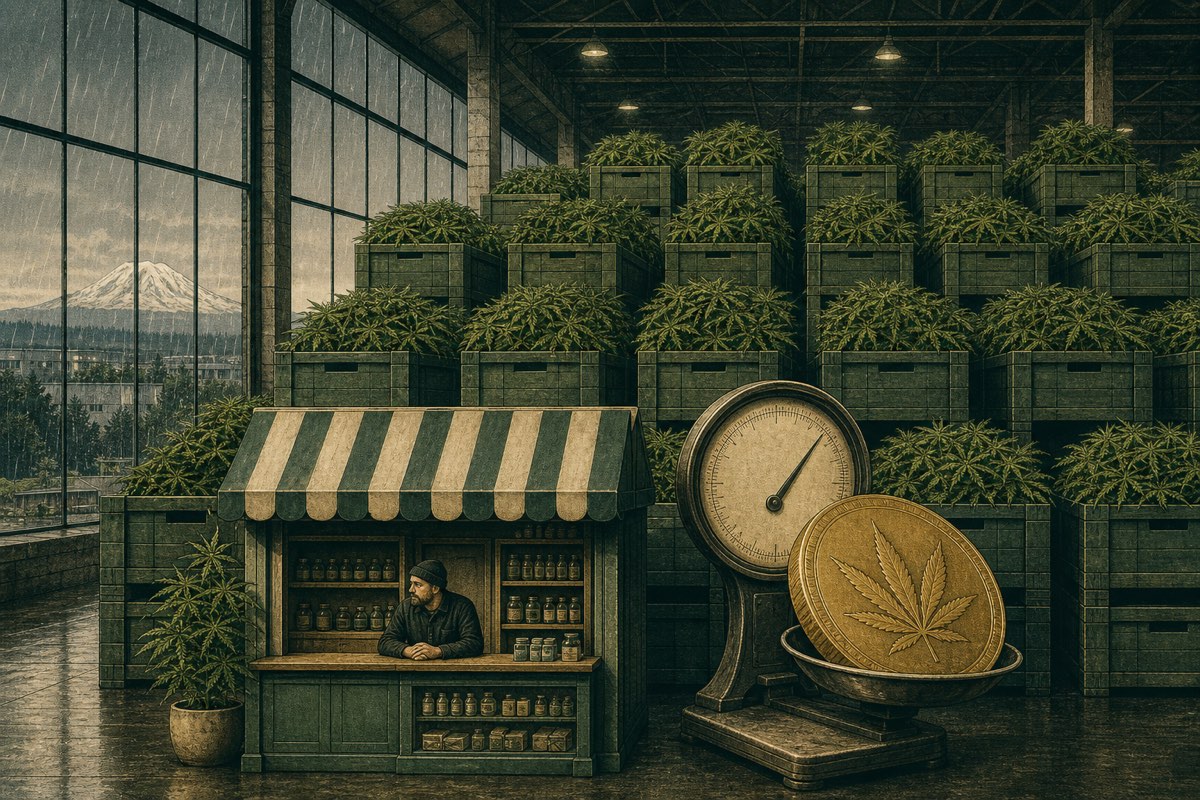
Michael Dykstra farms against a clock. His Bellingham operation, Mount Baker Homegrown, is a small licensed grow without the preservation equipment the big producers run, which gives him roughly eight weeks to sell each harvest at quality, against as much as four months for the majors. "Cannabis truly degrades at least some fraction of a penny every second," he says. "You're losing money every second it's not being sold or consumed." In December 2024 his revenue was down $150,000 before clawing partway back. Around him, the arithmetic is winning: neighbors with decade-old licenses, the legacy growers of one of America's two original legal markets, are going out of business, and growers who cleared $500,000 a year have watched it cut in half. (S16)
The numbers behind Dykstra's clock came into full view this month. Washington sold $1.14 billion of licensed cannabis in 2025, according to Department of Revenue data, the fourth consecutive annual decline from the 2021 peak of $1.47 billion, a roughly 22 percent slide. The first quarter of 2026 came in below last year's, so the streak is intact. Washington voted for legalization in 2012 alongside Colorado and opened stores in 2014; a dozen years later, the market that helped invent legal cannabis is demonstrating what a mature one looks like when the policy around it stops fitting. (S1, S4, S5)
Start with supply. In 2017, Washington's growers produced 121,254 pounds of THC, nearly double what the state sold that year. By 2023, production had tripled to more than 363,000 pounds while sales had merely doubled. The state's own audit arm, JLARC, published a market study last July with a finding that would be comic if it weren't structural: regulators license growing canopy, 12.2 million square feet of it, rather than output, the seed-to-sale traceability system has been broken since 2017, its replacement is "incomplete and unreliable," and a working one is not expected until 2031. Washington cannot measure the oversupply it created. The producers can: their ranks have thinned 31.6 percent since 2017, with producer-processor attrition hitting 20 percent a year against 7 percent for retailers. (S3, S6)
"A lot of our colleagues are closing," said Jordan Zager, the plant scientist who co-founded Dewey Scientific in Pullman. "The volume of product moving from producer to retailer has severely declined, down 60% in just a year." In Benton County, producer and processor revenue fell 22 percent in 2025 to $8.2 million, roughly half its 2023 level, and of about 40 license holders, only 25 reported any revenue at all. (S3)
Then there is the tax. Washington's 37 percent excise is the highest cannabis rate in the nation, and layered under federal Section 280E it takes some operators' effective rate toward 70 percent, by Whitney Economics' reckoning. The state's own auditors and RAND estimate licensed retailers capture only 60 to 70 percent of what Washingtonians actually consume; the industry's economists put the legal share closer to half. "If the tax rate, as we believe, is pushing people into the untaxed illicit marketplace, then we've got to look at the tax rate as one of the barriers to a safer choice," said Aaron Pickus, spokesperson for the Washington CannaBusiness Association. (S16, S3, S6, S7)
Earlier proposals in Olympia pointed toward higher taxes, but the 2026 session adjourned March 12. A citizen initiative to cut the excise from 37 percent to 7 percent failed to gather signatures by January. HB 2075 proposed a higher tier for high-THC products; its last recorded action was reintroduction on January 12. A separate revenue proposal analyzed by Whitney Economics in February would have lifted the base rate to 39.3 percent. Whitney's projection for that idea: legal demand falls 5.7 percent, and instead of raising the hoped-for $20 million, state revenue drops $9.5 million. "Solving a supply issue by changing tax policy does not appear, from our numbers, to be a viable solution," chief economist Beau Whitney concluded. His association counterpart, Vicki Christophersen, was blunter: "A regressive tax measure is not a viable solution. It does more harm than good." (S7, S10, S14, S15)
“Cannabis truly degrades at least some fraction of a penny every second. You're losing money every second it's not being sold or consumed.”
— Michael Dykstra, Owner, Mount Baker Homegrown, Bellingham
The federal relief lifting other markets will mostly skip Washington. Because the state licenses a single recreational market with no separate medical tier, the Liquor and Cannabis Board's June analysis concluded April's Schedule III rescheduling of medical cannabis "does not appear to apply" to its licensees, leaving them under 280E while medical-heavy operators in Florida and Pennsylvania book the tax savings. The board allowed its reading "may not be our final interpretation." For now, the pioneer state is watching the industry's biggest financial reform from the wrong side of its own statute. (S8)
There are gentler readings of the data, and they deserve the hearing. The 2021 peak was a pandemic artifact, 2025's total still exceeds 2019's, and the state framed the first decline, back in 2022, as a return to normal. Analysts at Headset have long attributed most of the slide to price compression rather than vanishing customers: in a mature market, falling prices shrink dollar sales even when volumes hold. Some of the decline is migration, not loss, Whitney's data shows buyers shifting from taxed adult-use purchases to tax-free medical ones. And Washington is not the worst-off pioneer: Colorado has fallen roughly 41 percent from its own 2021 peak, nearly double Washington's drop. Benton County even posted a modest first-quarter uptick this year. Shrinking, in other words, is what winning looks like among legacy markets. (S3, S4, S9, S12, S13)
What makes the standoff self-perpetuating is that every actor is responding rationally to a system nobody would design on purpose. Growers overproduce because canopy is licensed and output is not, and because exiting means abandoning a sunk-cost license that can't be replaced, the state stopped accepting new applications years ago, except through a Social Equity window that is now adding 10 producer-processor and 52 retail licenses into the oversupply. Retailers under-order because wholesale prices keep falling and fresher product is always coming. Consumers arbitrage: toward the illicit market, toward tax-free medical purchases, toward the hemp-derived products that filled gas stations until the state and then Congress moved to close that channel. And the Legislature's earlier tax-increase proposals treated cannabis as a potential source of additional revenue. Each rational choice deepens the hole. (S16, S3, S6, S7)
- Whether lawmakers revisit cannabis tax increases in a future session; the 2026 session ended March 12, and Whitney's February model addressed the proposed 39.3% rate. (S7, S14)
- The LCB's rescheduling interpretation, it flagged its 280E reading 'may not be our final interpretation'; a reversal would be the biggest financial event in the state's market in years.
- 2031, the target date for a working traceability system, without which the state will keep regulating an oversupply it cannot see.
- The Social Equity licensing window, 10 producer-processor and 52 retail licenses being issued into a market RAND estimated produced two to three times licensed retail sales in 2023. (S6)
Dykstra's eight-week clock keeps running either way. The growers who survive Washington's correction will be the ones who can wait out a legislature, a broken traceability system, and a tax code that treats their product as a windfall, all while it loses a fraction of a penny, every second, on the shelf.
Correction (September 8, 2026): The 2026 legislative session ended March 12, before this article's July publication; tax-increase proposals were incorrectly described as awaiting imminent votes. Dykstra's reported $150,000 revenue decline was in December 2024. The peak-to-2025 sales decline is rounded to 22 percent using the cited annual totals. (S16, S4, S14, S15)
- [1]MJBizDaily — Washington cannabis sales fell to $1.14 billion in 2025 (July 8)
- [2]KUOW — Washington state has too much pot as recreational sales decline (July 7; Dykstra, Pickus)
- [3]Tri-Cities Area Journal of Business — oversupply and taxes batter cannabis producers (June 15; Zager, Benton County)
- [4]WashingtonStateCannabis.org — annual sales table 2015–2026, sourced to WA Dept. of Revenue
- [5]Washington Department of Revenue — cannabis tax statistics (primary dataset)
- [6]JLARC — Cannabis Market Study, Report 25-05 (July 2025, primary state audit)
- [7]Whitney Economics — Cannabis Tax Policy Analysis for Washington (Feb 24, primary)
- [8]MJBizDaily — federal rescheduling may not apply in Washington, regulator warns (June 17)
- [9]MJBizDaily — Washington's first annual sales decline (Dec 2022, WSLCB framing)
- [10]Ballotpedia — Washington Reduce Cannabis Excise Tax Initiative (2026, failed to qualify)
- [11]FastDemocracy — WA HB 2075, high-THC tax tier proposal
- [12]Cannabis Business Times — Colorado, Oregon face steepest market corrections (Headset analysis)
- [13]Colorado Department of Revenue — marijuana sales reports (comparison data)
- [14]Washington Legislature — 2026 session adjourned March 12 (primary session record)
- [15]Washington Legislature — HB 2075 official bill history, last action January 12, 2026 (primary)
- [16]KUOW — accessible July 7 report: Dykstra December 2024 revenue decline and interview (corrected URL)
Comments are open to verified operators. Sign in or create a free account to weigh in.

$10 Billion in Sales, $3.83 a Gram: Massachusetts Heads to a Repeal Vote With Its Growers Broke
The state crossed the milestone on September 5, seven months after the last one. Thirty-one licensees were in receivership by April, and the campaign to abolish the market has banked $3.18 million from a single Virginia nonprofit before the November 3 vote.

GAO Finds Cannabis Banking’s Gap: An Account Doesn’t Mean Full Access
Federal investigators heard from 74 financial institutions and 51 cannabis businesses. Their report describes costly accounts, restricted credit and fragile payment services, while warning that its roughly 1,000 reporting institutions are not a directory of banks accepting dispensaries.