Nine People Weighed In. Then Wyoming Told the Trump Administration No on Cannabis.
Attorney General Keith Kautz, a 72-year-old retired state supreme court justice, used a 30-day trigger statute, one sparsely attended hearing and a final decision to keep marijuana on Wyoming's Schedule I despite federal medical-cannabis rescheduling. A South Carolina senator read a similar alignment law and argued it legalized medical marijuana there.
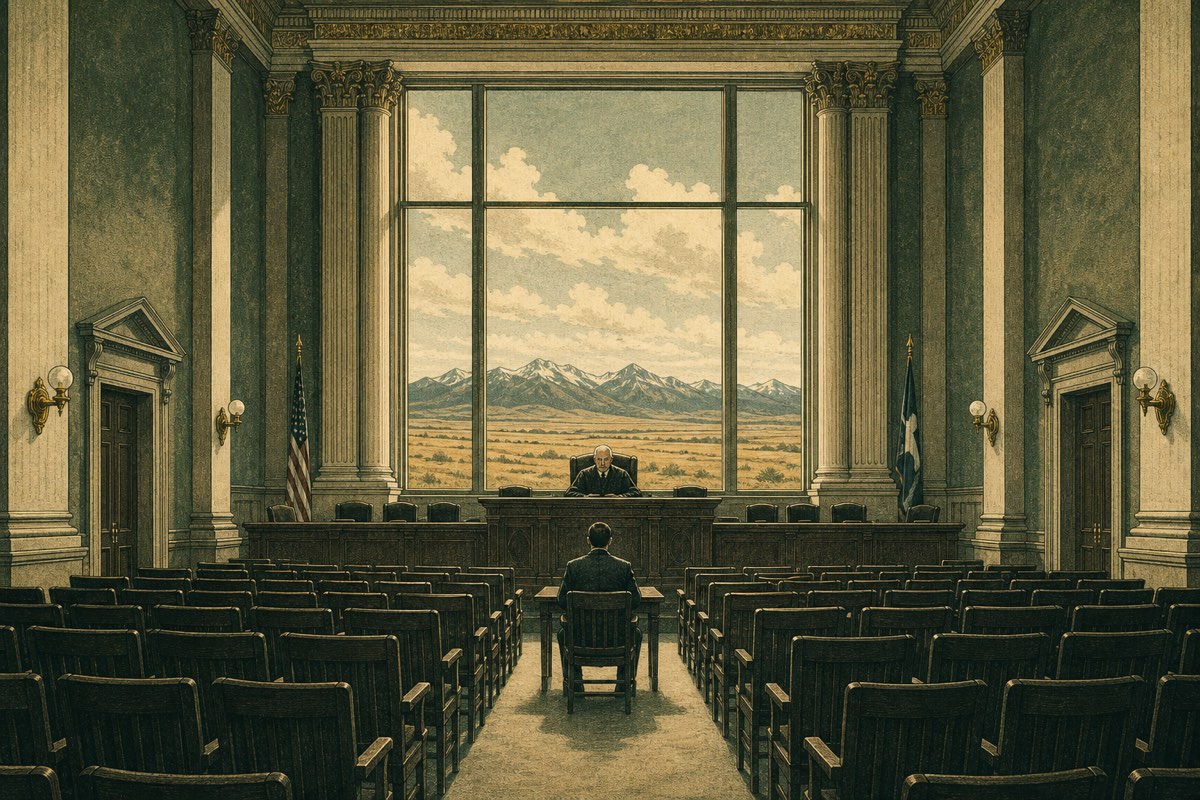
At 10 a.m. on June 18, in public meeting room W004 of the Wyoming State Capitol, Keith Kautz convened a hearing on the most significant loosening of federal marijuana law in half a century, and exactly one member of the public showed up. Kautz, 72, is Wyoming's attorney general, a retired state supreme court justice who left the bench at the mandatory retirement age and, by an accident of statute, also serves as the state's commissioner of drugs and substances control. The lone witness asked him to keep marijuana exactly where Wyoming has always kept it: Schedule I. Eight more people had emailed comments, split precisely four for rescheduling and four against. (S1, S16, S17)
On July 7, Kautz gave the witness what he asked for. In his final decision, he announced that all marijuana products, explicitly including marijuana sold under any other state's medical license, remain on Schedule I of the Wyoming Controlled Substances Act. The decision completed Wyoming's administrative objection process, retaining state Schedule I treatment despite the federal government's April rescheduling of medical cannabis. (S1, S2, S3)
The mechanism is the story. Wyoming, like a number of states, has a trigger statute, Wyo. Stat. § 35-7-1011(d), that automatically mirrors any federal scheduling change into state law within 30 days of Federal Register publication, unless the commissioner objects, publishes his reasons, holds a public hearing, and issues a decision. When Acting US Attorney General Todd Blanche's order moving state-licensed medical cannabis to federal Schedule III was published on April 28, the clock started everywhere at once. What happened next depended entirely on who was holding the statute. (S2, S5, S7)
In South Carolina, a Republican state senator, Tom Davis, read his state's alignment law and declared victory for the medical-cannabis program he had spent a decade failing to pass: "Medical marijuana is now legal in South Carolina," he announced in May, calling it the 41st state with an authorized program and warning colleagues that "doing nothing is a choice. And doing nothing has consequences." In Alabama, the state health committee objected, but only, its health officer Scott Harris insisted, to buy implementation time: "We're not saying Alabama's not going to do this. We certainly are going to do this." Tennessee's legislature didn't trust the process at all; Governor Bill Lee signed a bill in April severing the state's automatic review before it could run. (S9, S10, S11)
Kautz objected in late May and, unlike Alabama, meant it. His reasoning was institutional rather than medical: Wyoming's legislature has never legalized medical marijuana, never approved a licensing scheme, never recognized any other state's licenses, so importing Schedule III through administrative rulemaking, he wrote, would be "inconsistent with the police powers exercised to date by the Wyoming Legislature." The question of removing marijuana from Schedule I "is for the Wyoming Legislature and should not be done through the administrative rule making process." As for FDA-approved cannabinoid medicines, dronabinol, Cesamet, Epidiolex, Wyoming already schedules those consistently with federal law, and Kautz committed to keep doing so as new products are approved. (S3, S1)
“This decision is final unless altered by statute.”
— Keith G. Kautz, Attorney General and Commissioner of Drugs and Substances Control, Wyoming
Kautz is an unusual figure to hold this particular pen. He spent three decades on Wyoming's bench, a district judge from 1993, elevated to the state supreme court in 2015, until the state's mandatory retirement age of 70 forced him off in March 2024. Governor Mark Gordon appointed him attorney general effective July 7, 2025, about fifteen months later. Bridget Hill had left the attorney general's office for the supreme court seat vacated by Chief Justice Kate Fox; Kautz succeeded interim Attorney General Ryan Schelhaas. Wyoming's attorney general is appointed, not elected; the state's scheduling power thus ran through a 72-year-old former justice answerable to no ballot, applying a statute written for ministerial paperwork to the biggest cannabis-policy question the state has ever faced. His decision reads like the judicial opinions he wrote for years, and its logic is that of a judge declining jurisdiction. (S3, S14, S15, S16, S17)
The practical stakes are what Schedule I means on the ground in Wyoming, one of eight states with no licensed medical cannabis program of any kind. Possession of three ounces or less of marijuana plant material is a misdemeanor carrying up to 12 months in jail and a $1,000 fine. More than three ounces is a felony, up to five years. Selling any amount: up to ten years and $10,000. Even being under the influence is its own misdemeanor, worth up to six months. A Wyoming patient holding legally purchased medical cannabis from a Montana or Colorado dispensary is, after July 7 as before it, committing a crime the moment they cross the state line. (S1, S8)
The nine-comment record sits awkwardly beside what Wyomingites tell pollsters. A University of Wyoming Survey and Analysis Center poll released in December 2020 found 85 percent of residents supported legalizing medical cannabis when prescribed by a doctor; 54 percent backed personal-use possession. The gap between that number and one person in room W004 is partly apathy and partly history: activists failed to qualify medical and decriminalization initiatives for the 2024 ballot, a 2021 adult-use bill cleared a House committee 6-3 and died without a floor vote, and a 2022 decriminalization bill never got a hearing. In Wyoming, cannabis reform loses by not showing up. (S1, S2, S18)
The restrictionists, by contrast, show up consistently. House Speaker Chip Neiman, a rancher from Hulett, made the case in December with a line that travels well in Cheyenne: "We're talking about a product right now that is not ditch weed. I just hate to see the door thrown open here, and (us) saying, 'Hey, go for it.'" The state has been moving his direction, a 2024 law added delta-8 THC to state Schedule I and counted every THC isomer toward the hemp limit, and the Tenth Circuit upheld it against Farm Bill preemption claims last October. (S6, S13)
There is an argument on Kautz's side that even reform advocates concede quietly: he is right about where the power sits. Wyoming's statute directs the commissioner to follow federal scheduling changes while expressly providing an objection and hearing process; a policy change this large, done by one appointed official on nine comments, would be a strange kind of democracy in either direction. The federal government's own case for Schedule III, the FDA's finding of credible scientific support for treating anorexia, nausea and pain, was in the record. Kautz didn't dispute it. He ruled that it wasn't his call. (S3, S6, S7)
South Carolina shows what the road not taken looks like. There, Republican Representative Ralph Norman, running for governor, is opposing medical-marijuana legalization as Davis argues that alignment has already occurred: "It's a gateway drug, and there other options other than marijuana for veterans or anybody who needs it for that matter." Davis's rejoinder is aimed at legislatures like Wyoming's as much as his own: "The legislature, quite frankly, has been derelict in its duty." Between those two positions sits every trigger-statute state in the country, each now discovering that the federal government's biggest cannabis reform in fifty years delegated the real decision right back to them. (S9)
- The 2027 Wyoming legislative session, the decision is final 'unless altered by statute,' which puts any change squarely on lawmakers who have declined every prior opportunity.
- The DEA's broader rescheduling proceeding, if adult-use cannabis moves to Schedule III federally, Wyoming's 30-day trigger fires again, and so does the objection process.
- The other trigger-statute states, South Carolina's contested '41st state' claim and Alabama's promised implementation will show whether alignment actually delivers patient access.
Kautz's decision closes with the sentence that defines it: final unless altered by statute. In a state where 85 percent of poll respondents say they want medical cannabis and only one person came to the hearing, that sentence is less a wall than a mirror. The federal government moved. State trigger statutes came into play. And in Cheyenne, the question went back where Kautz always said it belonged, to a legislature that has never once said yes, and now cannot say the administrator did it for them.
Correction (September 8, 2026): Kautz was 72 at the time of this article, and became attorney general about fifteen months after retiring from the court, not four. Bridget Hill filled Kate Fox's court seat. We also removed an unsubstantiated claim that Wyoming was the first state to complete a formal refusal, clarified that its scheduling process is statutory, and corrected source references and the poll description. (S7, S15, S16, S17, S18)
- [1]Cannabis Business Times — Wyoming rejects Trump administration's Schedule III listing (July 8)
- [2]Marijuana Moment — Wyoming AG blocks state rescheduling triggered by Trump's federal reform (July 8)
- [3]Wyoming Attorney General — Commissioner's Final Decision, July 7, 2026 (primary document)
- [4]Wyoming Attorney General — objection notice, late May 2026 (primary document)
- [5]Federal Register — DEA final rule, 91 FR 22714 (April 28, 2026, primary)
- [6]Cowboy State Daily — Wyoming AG objects to Trump reclassifying marijuana; Neiman quote; hearing logistics
- [7]Justia — Wyo. Stat. § 35-7-1011 (the 30-day trigger statute, primary)
- [8]NORML — Wyoming laws and penalties
- [9]Marijuana Moment — South Carolina trigger law: Sen. Tom Davis declares medical marijuana legal (May)
- [10]Marijuana Moment — Alabama officials move to delay automatic rescheduling (May)
- [11]Marijuana Moment — Tennessee governor signs bill blocking automatic scheduling review (April)
- [12]Oil City News (Casper) — local coverage of the final decision and comment tally
- [13]Cannabis Business Times — 10th Circuit upholds Wyoming's delta-8/THC hemp law (Oct 2025)
- [14]WyoFile — Gordon names Keith Kautz attorney general (July 2025, background)
- [15]Governor of Wyoming — Bridget Hill appointed to replace Chief Justice Kate Fox (April 11, 2025, primary)
- [16]Governor of Wyoming — Keith Kautz appointed attorney general effective July 7, 2025 (primary)
- [17]WyoFile — interview and March 2024 retirement date for Justice Keith Kautz (November 16, 2023)
- [18]University of Wyoming Survey and Analysis Center — 2020 marijuana survey results and fieldwork dates (primary)
Comments are open to verified operators. Sign in or create a free account to weigh in.

DEA's Drug-Felony Hiring Bar Covers Dispensary Clerks, Not Cannabis Growers
Mississippi's Nicole Huff was told her two flagged workers can stay only in non-plant-touching jobs while waivers of unknown length are pending, and Sen. Cory Booker calls the policy ridiculous. Growers registering since Oct. 5 face screening rules under which a conviction will not necessarily preclude employment.

Oklahoma's Cannabis Regulator Exits With 1,703 Growers Left and a DEA Registration Cliff Ahead
Licensed growers fell from 9,402 to 1,703 on Adria Berry's watch. Her interim successor, a former sheriff's lieutenant, inherits a Jan. 1 date after which the state drug bureau may move against growers lacking DEA registration, and a governor who wants the program shut down.