Five Years and Three Failed License Rounds Later, Alabama Finally Sold Its First Legal Cannabis
Amanda Taylor's June purchase at Callie's Apothecary in Montgomery ended the slowest medical launch in US history, 102 patients followed in week one. Eleven more dispensaries are promised, and the licenses that decide the market's real size just went to trial in Tuscaloosa.
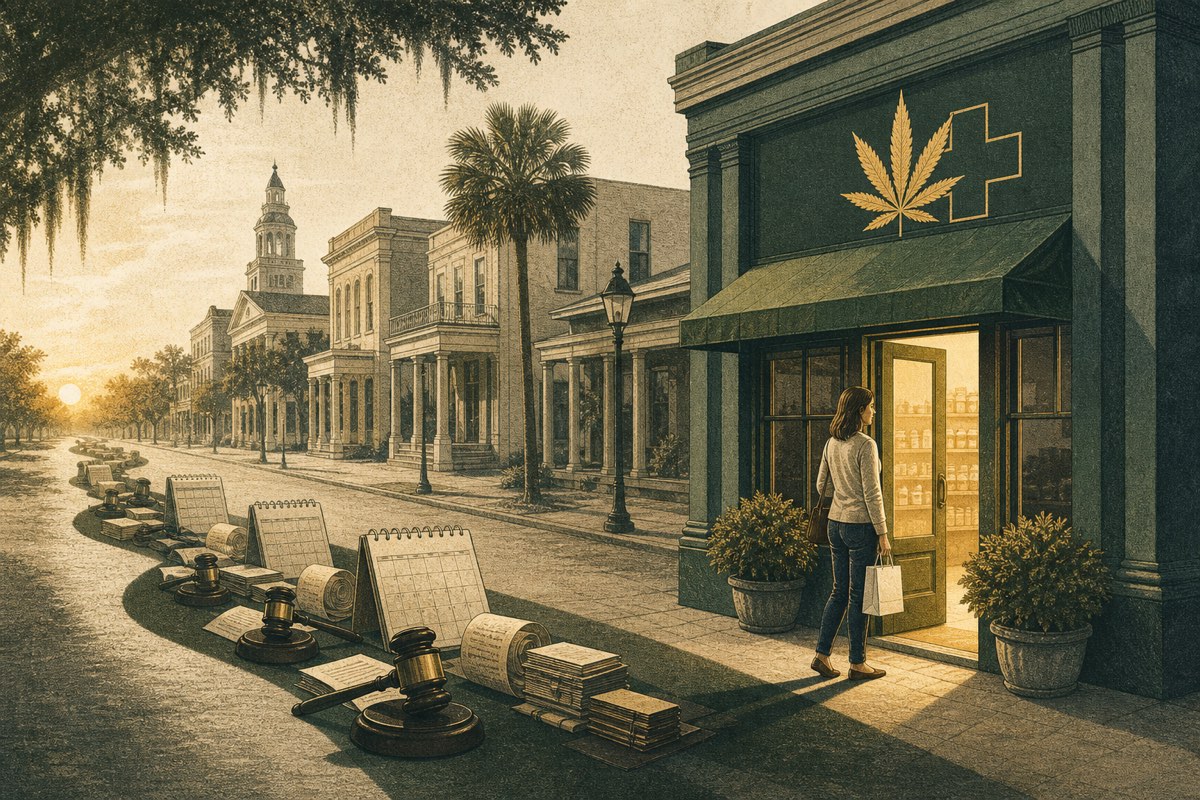
On the morning of June 3, a woman in a pink suit walked out of a converted storefront on Atlanta Highway in Montgomery carrying a white paper gift bag. Inside were a water-soluble tincture and peach-flavored gel cubes, the first cannabis ever legally sold in the state of Alabama. Amanda Taylor had driven more than two hours from Cullman for the moment. She has multiple sclerosis, 45 lesions on her brain and one on her spine, and eleven years of advocacy behind her; years ago she moved to Arizona just to use the medicine legally, then came back, she says, to be a voice for the patients. "I will be able to remove some very dangerous pharmaceuticals," she said outside Callie's Apothecary, "and I'll be able to replace them with something that God put on this earth for this specific reason." (S2)
The purchase closed the longest gap between a medical cannabis law and a first sale in American history. Governor Kay Ivey signed the Darren Wesley 'Ato' Hall Compassion Act on May 17, 2021; Callie's soft-opened June 3, 2026, and officially opened the next day, five years, with the previous record, West Virginia's four and a half, comfortably surpassed. Mississippi, next door, went from law to sales in under a year. What consumed Alabama's five years was not cultivation or construction. It was litigation about who would be allowed to sell. (S1, S2, S8, S15)
The Alabama Medical Cannabis Commission awarded licenses three times, and all three rounds collapsed. The June 2023 awards were withdrawn over scoring irregularities; the second round halted over Open Meetings Act allegations and was rescinded entirely that October; the December 2023 round was enjoined within weeks by Montgomery Circuit Judge James Anderson, who wrote that all three rounds "have been challenged as legally infirm." A March state audit later substantiated pieces of what losing applicants had alleged for years: open-meetings violations, a $204,000 overpayment to an outside law firm on a $400,000 contract, a non-compliant fee structure, inadequate records. The logjam broke only when an appeals court moved the disputes out of circuit court and into administrative hearings before Bernard Harwood, a former state supreme court justice, the process that finally produced dispensary licenses in December 2025. (S5, S9, S10, S11)
The store that ended the wait is deliberately unlike a dispensary anywhere else. Callie's, the storefront of licensee CCS of Alabama, owned by Vince Schilleci, checks IDs in a buzzed vestibule before patients reach a sales floor its owner describes as "a mix between a doctor's office and a pharmacy." Alabama's product rules enforce the clinical mood: no raw flower, no smoking, nothing shaped like a candy or cookie. Tablets, tinctures, patches, oils, and gel cubes in exactly one flavor, peach, for roughly 15 qualifying conditions, at $42 to $52 a product. In week one the store served 102 patients across 111 transactions, about $14,600 in pre-tax sales, and briefly rationed purchases until new shipments landed. "Our store manager saw a patient walking out, and as silly as it sounds, they jumped and clicked their heels," Schilleci said. "They were that happy about having that medicine." (S3, S4, S13)
“I will be able to remove some very dangerous pharmaceuticals, and I'll be able to replace them with something that God put on this earth for this specific reason.”
— Amanda Taylor, multiple sclerosis patient and advocate, after Alabama's first legal purchase
The machine behind the storefront is still mostly unbuilt. Eleven more dispensaries are supposed to follow from four companies, CCS in Bessemer and Talladega, GP6 Wellness in Birmingham, Athens and Attalla, RJK Holdings in Oxford, Daphne and Mobile, and, if its stayed license survives litigation, Yellowhammer Medical Dispensaries. As of mid-July, the commission's own site still lists exactly one open dispensary, with the rest promised "during summer 2026." Physician participation is the other bottleneck: 52 doctors are certified to recommend cannabis, but as of June 11 only 21 had actually done so, for 446 issued patient cards in a state of five million people. (S1, S3, S12)
And the biggest prize is back in a hearing room. On July 27, in Tuscaloosa, hearings opened before Harwood on the five integrated facility licenses, the coveted seed-to-sale permits that each carry up to five dispensing sites, meaning as many as 25 additional storefronts ride on the outcome. Fourteen applicants, fourteen trial dates, three weeks. Among them is Joey Robertson of Wagon Trail in Cullman, who won an integrated award in 2023 and has watched multimillion-dollar processing machinery sit idle through every collapsed round since; his facility, he says, can press enough oil in a day for 3.5 million doses, "enough for the entire state of Alabama." Veteran observers of the program offer the obvious caution: the pattern to date has been license awarded, license sued, license stayed, repeat. (S14, S8)
Not everyone credits the design. Marty Schelper, the Alabama Cannabis Coalition founder who spent years pushing broader reform, calls the limited-license framework "the Alabama medical cannabis cartel" and predicts constrained supply and $40-plus products will keep patients in a cheaper illicit market. The program's defenders answer with the same word Taylor used on the sidewalk: patients. "It's all about the patients, every step of the whole process," said John McMillan, the commission's director, whose registry held some 300 names on launch day and is growing. (S2, S8)
Even with sales underway, cannabis remains contested ground in Montgomery. At a July 22 public health hearing on whether Alabama should adopt the federal government's Schedule III reclassification, the sole industry voice in favor was Robertson; the opposition came organized. "Rescheduling marijuana from a Schedule I to a Schedule III puts it on the same level as Tylenol with codeine," argued Becky Gerritson of the Eagle Forum of Alabama, while the Alabama Citizens Action Program opposed it "on behalf of our churches across the state." The commission, meanwhile, preaches operational patience: its chairman, pharmacist Sam Blakemore, says the program will be judged on "price, education, access and safety. If they do those four things, they're going to build trust." Under the law, patients under 19 need a parent's approval and are capped at 3 percent THC, a reminder of how narrow the corridor is that Alabama's legislature drew. (S10, S4)
- The Tuscaloosa integrated-facility hearings, three weeks, 14 applicants, 5 licenses, up to 25 more dispensing sites; a recommended order from Harwood follows.
- Second-store watch, the commission expects more of the 11 remaining dispensaries to open through summer 2026.
- The Yellowhammer stay, resolution would complete the fourth dispensary company and its three sites.
- Alabama's rescheduling decision, the health committee's objection window and hearing process determine when Schedule III lands in state law.
Taylor, for her part, has already told reporters where she thinks this goes: "I see this growing exponentially, because once people see the results and see the difference that it makes... There's no shame in that. This is medicine." Five years of lawyers finally produced a gift bag. Whether Alabama's program becomes a market or stays a monument to its own litigation now depends on three weeks in a Tuscaloosa hearing room.
- [1]Alabama Reflector — first medical cannabis store opens after years of delays (June 4, first-person account)
- [2]Alabama Reflector — dispensary sees over 100 patients in first week (June 12, AMCC figures)
- [3]MJBizDaily — Alabama cannabis market opens with one dispensary, 11 to follow (June 4)
- [4]CBS42 — Alabama's first medical cannabis dispensary set to open (May, Schilleci/Blakemore)
- [5]Alabama Reflector — court again delays licensing; Judge Anderson's 'legally infirm' order (Jan 2024)
- [6]Alabama Reflector — producers see reasons for hope; Schelper and Robertson (July 2025)
- [7]MJBizDaily — scathing audit for the AMCC on eve of launch (March)
- [8]Budding Trends (Bradley) — integrated facility hearings kick off in Tuscaloosa (July)
- [9]AMCC — official patients page: dispensary announcements, program rules (primary)
- [10]Alabama Reflector — Alabama delays rescheduling of marijuana (May, Harris objection)
- [11]Marijuana Policy Project — state implementation timelines (slowest-launch comparison)
- [12]MJBizDaily — Alabama market to finally launch (April, AMCC meeting figures)
Comments are open to verified operators. Sign in or create a free account to weigh in.

$10 Billion in Sales, $3.83 a Gram: Massachusetts Heads to a Repeal Vote With Its Growers Broke
The state crossed the milestone on September 5, seven months after the last one. Thirty-one licensees were in receivership by April, and the campaign to abolish the market has banked $3.18 million from a single Virginia nonprofit before the November 3 vote.

GAO Finds Cannabis Banking’s Gap: An Account Doesn’t Mean Full Access
Federal investigators heard from 74 financial institutions and 51 cannabis businesses. Their report describes costly accounts, restricted credit and fragile payment services, while warning that its roughly 1,000 reporting institutions are not a directory of banks accepting dispensaries.