Six Cannabis Companies Wired $11.5 Million to a Trump Super PAC. It's Now Buying Ads for Mike Lawler.
America First Agriculture Action shares a treasurer with MAGA Inc. and has spent nearly $1.8 million supporting 11 vulnerable House Republicans, among them a New York congressman who calls marijuana a gateway drug and co-sponsored a bill to keep 280E in place.
On the afternoon of December 18, 2025, Kim Rivers walked out of the White House having just watched President Trump sign an executive order titled "Increasing Medical Marijuana and Cannabidiol Research," which directed Attorney General Pam Bondi to finish moving marijuana to Schedule III. Rivers, the chief executive of Trulieve, had spent years working toward that signature. Forbes would later call her the cannabis industry's Trump whisperer. On the day itself she gave CNN a line that has aged into the industry's motto: "We've been operating with both hands tied behind our back. And now it'll only be one hand tied behind our back." (S1, S2, S3)
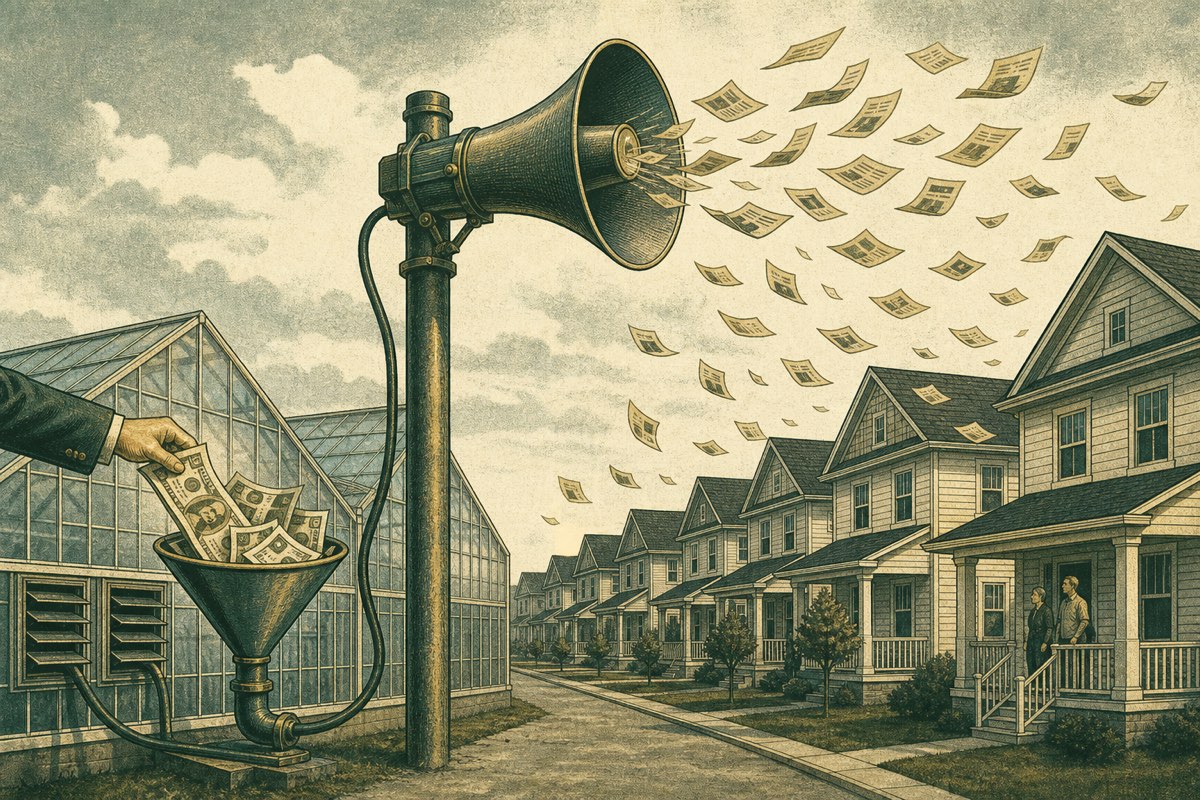
Six months later, in June 2026, Trulieve wired $2.5 million to a super PAC called America First Agriculture Action Inc. So did Curaleaf. So did Verano Holdings. So did Vision Management Services, a Green Thumb Industries subsidiary. Ascend Wellness sent $500,000. An entity called Arboretum Bidco sent $1 million. Total: $11.5 million from six of the largest cannabis companies in the United States into a committee that had been registered with the Federal Election Commission three months earlier. (S4, S5)
The treasurer of America First Agriculture Action Inc. is Charles Gantt. He is also the treasurer of MAGA Inc., the president's principal super PAC. (S4, S5)
The proportion is the part that gets lost in the headline number. As of July, America First Agriculture Action Inc. had raised roughly $13 million in total. The cannabis contributions were $11.5 million of it. A committee that presents itself as an agriculture PAC is, by the arithmetic of its own filings, very close to being a cannabis PAC with an agricultural name. (S6)
In September, reporting on the PAC's spending disclosed where the money went. Nearly $1.8 million has gone to advertising supporting 11 vulnerable House Republicans in the midterms. Several of them have voted against cannabis legalization. One of them has co-sponsored legislation to make sure cannabis businesses can never deduct their expenses. (S4)
Counting an additional $1.5 million routed through American Rights and Reform PAC, Inc., whose treasurer is the Curaleaf executive Matt Harrell, and $2.05 million that a cannabis industry PAC sent directly to MAGA Inc., cannabis money into Trump-aligned committees now totals at least $15.05 million. Trulieve and Curaleaf had already given a combined $1 million to the president's inaugural committee after the 2024 election. Trulieve put another $250,000 into the Republican Jewish Coalition Victory Fund. (S4, S5, S6)
Who the money is running ads for
The eleven are Tom Barrett of Michigan, Nick Begich of Alaska, Rob Bresnahan and Brian Fitzpatrick and Scott Perry of Pennsylvania, Juan Ciscomani of Arizona, Gabe Evans of Colorado, Jen Kiggans of Virginia, Mike Lawler of New York, and Bryan Steil and Derrick Van Orden of Wisconsin. Five have no cannabis voting record at all. The other six have records, and the records are not ambiguous. (S4)
Lawler is the sharpest case. He has said it would be "wrong" for the Trump administration to reschedule cannabis and has argued that marijuana is a gateway drug. He signed a letter to the president warning that rescheduling would "send the wrong message to America's children, enable drug cartels, and make our roads more dangerous." He also co-sponsored a bill to block cannabis businesses from taking federal tax deductions, which is to say a bill to preserve Section 280E, the provision that has cost the companies now funding his campaign hundreds of millions of dollars in non-deductible expenses. (S4)
Fitzpatrick voted against federal legalization bills in 2020 and 2022 and against medical cannabis amendments for veterans between 2014 and 2016, though he supported banking access in 2019 and 2021. Steil voted against the same legalization bills and the same veterans amendments. Kiggans voted against legalization as a Virginia state senator. Ciscomani, after Arizona voters rejected legalization in 2016, called the defeat an awesome victory for his community. Perry's record runs both directions: for state-protection amendments in 2015, against them in 2019 and 2020, for banking access. (S4)
“This is how Trump operates. You've got to grease the palms.”
— Ryan Hunter, Chief Revenue Officer, Spherex
Hunter's line is the honest version of the industry's reasoning, and it is worth stating fairly rather than dismissing. The argument runs like this: cannabis reform has been stuck in Congress for a decade. SAFE Banking has passed the House seven times and died in the Senate every time. The descheduling bills that Senate Democrats keep reintroducing do not have the votes and everybody involved knows it. The only reform that has actually moved in ten years moved because one president signed one executive order in December, and he did that after a lobbying campaign, not after a floor vote.
Joe Gerrity, chief executive of Crescent Canna, put it the same way from the hemp side of the industry. "Congress isn't getting anything done and the Trump administration has shown a willingness to move otherwise stagnant issues forward," he said. If the executive branch is the only functioning lever, you pay to reach the executive branch, and the committees that reach it are the ones with the president's treasurer on the paperwork. (S6)
There is also a mechanical reason the money moves this way rather than through conventional channels. A federally illegal business cannot easily make ordinary corporate political contributions, and for years most cannabis operators could not get a bank to process a payroll run, let alone a PAC check. A super PAC takes unlimited corporate money and spends it independently, which makes it the one campaign-finance instrument fully available to companies that the federal government still treats as a compliance hazard. The industry did not choose independent expenditures over direct giving on strategy. It is most of what was open to it.
What $15 million does not buy
The counter-argument has two parts, and the first one is arithmetic. More than 20 Republican senators and several House members have signed letters urging the White House to halt reclassification. Money that goes to defending eleven House incumbents does not address a Senate problem, and it does not buy a vote from a member who has already told his constituents that marijuana is a gateway drug. Morgan Fox, NORML's political director, framed the ceiling plainly: "There's certainly opposition from very, very powerful people within the Republican Party and within Congress that would make it very difficult to get any sort of legislation to the floor without severe pressure from the president." (S6)
The second part is about who inside the industry is paying. Every one of the six companies in the June filing is a multistate operator with a nine-figure balance sheet. None of them is a social-equity licensee in Illinois or a caregiver in Maine or a craft grower in Michigan. Josh Kesselman, who founded RAW Rolling Papers, has been the loudest voice on this point. "If Washington gets this wrong, reform could end up favoring the players who spend the most on lobbying," he said, adding that the plant "should not be handed over to cannabis oligarchs who profit at the expense of everyone beneath them." (S6)
That is not a hypothetical concern. The version of rescheduling the industry bought gives Schedule III treatment to medical and FDA-approved cannabis, which lifts 280E for licensed operators and does essentially nothing for anyone still serving a federal sentence or trying to enter a market where the license costs more than a house. The companies that funded the campaign are the companies the outcome was shaped for, which is how lobbying is supposed to work and also why the people left out of it are angry.
- October 2026, Quarterly FEC filings will show whether the June contributions were a one-time push or a recurring program, and whether additional operators joined.
- November 3, 2026, The midterms decide whether the eleven incumbents the PAC is defending are still in Congress to vote on anything.
- Ongoing, The D.C. Circuit's challenges to Schedule III, where the rescheduling the money was spent to secure is being litigated rather than legislated.
- Next Congress, Whether any of the eleven, having been defended with cannabis money, co-sponsors a cannabis bill. That is the only number that would settle the question.
Rivers got what she went to the White House for. Trulieve's first quarter after 280E relief landed showed the difference a single tax provision makes to a company's margin, and the difference was enormous. The bet the industry made in June is that the arrangement holds, that the executive order survives the D.C. Circuit, and that defending the president's majority is the cheapest available insurance on a policy the president delivered by pen.
The uncomfortable part is what the bet concedes. An industry that spent a decade arguing that cannabis prohibition was an injustice has concluded that the fastest route out of it is to write checks to a committee running advertisements for a congressman who thinks the plant is a gateway drug, and to hope he never gets the chance to act on it.
- [1]The White House — Executive order: Increasing Medical Marijuana and Cannabidiol Research (Dec. 18, 2025)
- [2]CNN — Trump signs executive order expediting marijuana reclassification after industry lobbying
- [3]Forbes — Meet the cannabis industry's Trump whisperer (Kim Rivers)
- [4]Marijuana Moment — Trump-linked PAC uses marijuana business donations to campaign for GOP lawmakers
- [5]Marijuana Moment — Marijuana companies donated at least $1 million to Trump's inauguration
- [6]Salon — Big cannabis has cozied up to the GOP
- [7]CNBC — Cannabis reform is emerging as a midterm elections issue
- [8]The Spokesman-Review — Corporate political donations shatter record at $646 million for US midterms
- [9]Washington Examiner — Marijuana companies spent millions lobbying ahead of Trump's rescheduling order
- [10]OpenSecrets — Marijuana lobbying profile
Comments are open to verified operators. Sign in or create a free account to weigh in.

Two Pollsters, Six Weeks Apart, Disagree by 16 Points on Whether Massachusetts Will Ban Its Own Cannabis Stores.
UNH has Question 8 losing 71-24. UMass Amherst had it 55-33 in August. The measure needs a simple majority on November 3, and the side trying to close a $1.65 billion market is outspending the side defending it two to one.

Three Days Before He Lost in the Nebraska Supreme Court, Mike Hilgers Subpoenaed a Dispensary in Colorado.
Peak Dispensary sits on Railroad Street in Sedgwick, a half-hour from the state line. Nebraska's attorney general wants the home addresses of everyone who has ever worked there, and has not said which law he thinks was broken.