Two Pollsters, Six Weeks Apart, Disagree by 16 Points on Whether Massachusetts Will Ban Its Own Cannabis Stores.
UNH has Question 8 losing 71-24. UMass Amherst had it 55-33 in August. The measure needs a simple majority on November 3, and the side trying to close a $1.65 billion market is outspending the side defending it two to one.

On August 20, Tatishe Nteta released a poll and attached a warning to it. Nteta is a provost professor of political science at the University of Massachusetts Amherst and directs its statewide survey, and what his numbers showed was that 55 percent of registered voters intended to reject Question 8, the ballot measure that would shut down adult-use cannabis retail in Massachusetts. Thirty-three percent intended to support it. About one in ten had not decided. (S1)
He did not describe that as safe. "With the campaign for the ballot question still in its nascent stages and 1 in 10 voters remaining undecided," he said, "there remains time for the tables to turn and support for repeal to grow." (S1)
Five weeks later, on September 24, the University of New Hampshire Survey Center released its Bay State Poll and the same question came back 71 to 24 against. Not a majority against. Nearly three to one. (S2, S3)
Both polls are real, both were fielded by university survey centers, and they are sixteen points apart on the margin. The measure on which they disagree needs fifty percent plus one vote on November 3, and if it passes Massachusetts becomes the first state in the country to shut down a legal cannabis industry after years of sales. An operator trying to decide whether to renew a lease cannot average two polls and get an answer.
Same question, different houses
The cleanest reading of the sixteen points is that it is mostly a house effect rather than a swing in opinion, and the third data point supports that. In February, the same UNH Survey Center found 63 percent opposed, 48 percent strongly, 15 percent somewhat, against 20 percent in support. So UNH has measured opposition at 63 and then 71. UMass Amherst, fielding between those two, measured 55. The pollster that moved is the one that did not change. (S1, S2)
The methods differ in ways that matter. UMass surveyed 800 registered voters between August 5 and 12, and offered respondents a four-point scale: definitely no, probably no, probably yes, definitely yes. Forty percent said definitely no and 15 percent probably no. Splitting the soft answers out is a more conservative instrument, and it produced a more conservative number. UNH's September poll surveyed 590 people online between September 17 and the following week, with a margin of sampling error of plus or minus 4.1 percentage points. (S1, S3)
One thing the UNH poll found that neither campaign will love is that voters are not confused. Seventy-eight percent said they understand Question 8 very or somewhat well, 46 percent very well, 32 percent somewhat. On a ballot carrying nine questions, that puts Question 8 among the better-understood ones. Whatever is happening in these numbers, it is not happening because people cannot tell what they are voting on. (S3)
What both pollsters agree on is the partisan shape, and it is the shape that makes repeal hard in Massachusetts. UNH found Republicans more likely than Democrats to vote yes. UMass put Democratic support for repeal at 24 percent against Republican support at 45 percent, and Trump voters at 48 percent, the only two groups approaching a majority. More than 61 percent of the state voted for Kamala Harris in 2024. A measure that needs a simple majority and tops out near half among the state's Republican minority has an arithmetic problem no amount of advertising fixes. (S1)
“There remains time for the tables to turn and support for repeal to grow.”
— Tatishe Nteta, Provost Professor of Political Science and poll director, UMass Amherst
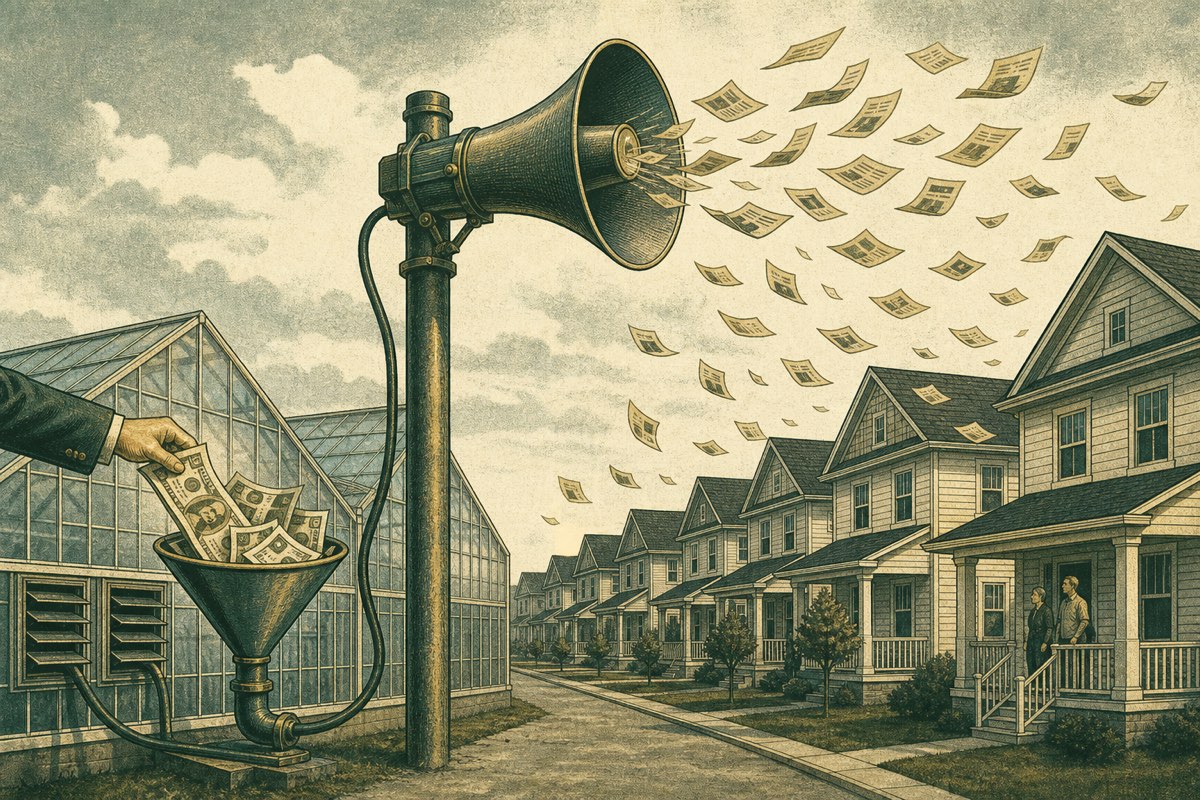
The losing side is outspending the winning one
Through the end of August, SAM Action Inc., the political arm of Smart Approaches to Marijuana, had committed nearly $3.2 million to the Coalition for a Healthy Massachusetts, the committee sponsoring Question 8. The cannabis industry, including several multistate operators, had raised roughly $1.54 million against it. That is better than two to one. (S4)
The figure that matters more is what each side still has. Cash on hand was almost identical: about $980,000 for repeal, about $947,000 for the opposition. The repeal campaign spent its advantage getting onto the ballot. SAM had already put $1.55 million into the signature drive in 2025, single-handedly funding the sponsoring committee. Going into the final five weeks, the two campaigns are effectively even on money and twenty to forty points apart in the polls. (S1, S4)
Question 8 got to the ballot over sustained objection. The Massachusetts Cannabis Business Association accused paid signature gatherers of using deceptive tactics to trick people into signing. The State Ballot Law Commission ruled for the campaign twice, in January on the deception claim and in July on a challenge to validated signatures. In June the Supreme Judicial Court held that Attorney General Andrea Campbell had not erred in certifying the petition in September 2025, rejecting four voters' argument that it bundled unrelated subjects and that her summary was unfair. (S1)
What the question actually does
The measure is titled "An Act to Restore Sensible Marijuana Policy." It would repeal the chapters of Massachusetts law that regulate and tax adult-use dispensary sales, and it would recriminalize home cultivation, which adults 21 and over can currently do up to six plants. It would leave possession legal: up to an ounce of flower or five grams of concentrate. Medical sales would continue. (S1)
That combination is the part operators find hardest to argue against on the merits, because it is genuinely not a return to 2015. Demand stays legal. Supply becomes a crime. Anyone reading that as a plan to move a $1.65 billion market into the hands of people who do not test their product is reading it correctly, and that is the opposition's central argument.
The counter-position deserves stating in its own terms. SAM's case has never been that prohibition works perfectly; it is that commercialization produces harms, youth access, high-potency products, impaired driving, that a possession-only regime avoids while still not jailing users. Question 8 is built to that specification, and in Massachusetts 33 percent of registered voters in August and 24 percent in September agreed with it. That is not a fringe. It is roughly a quarter to a third of the electorate, and it is why the industry raised $1.54 million rather than treating this as free.
The local arithmetic cuts the other way. In Gardner, a Worcester County city of about 21,000, repeal would take roughly $300,000 a year out of municipal revenue. Multiply that across every host community in the state and you get the reason major Massachusetts labor organizations have lined up against the question. (S5)
There is a reason both sides are spending on a race one poll calls a blowout. Ryan Dominguez, who chairs the No on 8 campaign, has framed the outcome as bigger than one state. "If we beat SAM here, I think it's an opportunity for us to put a really big dent in what they're able to do going forward," he told MJBizDaily. A repeal effort in Arizona fizzled this year; a Maine campaign was gathering signatures. Observers read Massachusetts as the first proving ground partly because its signature thresholds are low and partly for the symbolism of an early East Coast adopter reversing itself. (S4)
- Any October poll from either house. A second UMass Amherst read is the single most informative thing left, because it tests whether the sixteen-point gap is method or movement.
- Post-September campaign finance filings, which will show whether SAM Action topped up after spending its lead to reach the ballot.
- Whether advertising actually runs. Two campaigns with roughly $950,000 each and five weeks left can both go quiet or both go loud.
- November 3, 2026, the vote. Fifty percent plus one decides it.
- Maine's signature drive, which is the next test regardless of how Massachusetts votes.
Massachusetts voters legalized adult-use cannabis in 2016 by 54 percent, and a decade on, 54 percent told UMass they still view legalization positively while 22 percent call it negative for the state. Nteta's reading of his own data was that those settled views make repeal a formidable challenge. It was also his reading that a tenth of the electorate had not made up its mind.
Five weeks out, one pollster says this is over and another says it is a race. The industry defending the market has $947,000 to spend finding out which.
- [1]Cannabis Business Times — 55% of Massachusetts voters oppose repealing cannabis laws (UMass Amherst / WCVB poll, Aug. 5-12, 2026)
- [2]UNH Survey Center — Markey, Healey favored for re-election in Massachusetts, marijuana prohibition question lacks support (9/24/2026)
- [3]UNH Survey Center — Bay State Poll, September 2026 full report (PDF)
- [4]MJBizDaily — Voters overwhelmingly oppose Massachusetts adult-use cannabis repeal, new poll finds
- [5]The Gardner News — Question 8 would put $300,000 in annual Gardner revenue at risk
- [6]Massachusetts OCPF — SAM Action Inc. / Coalition for a Healthy Massachusetts filings
- [7]Commonwealth of Massachusetts — Initiative petition for a law relative to regulating marijuana (version B)
- [8]UMass Amherst Poll — August 2026 Massachusetts public opinion poll
- [9]UNH Survey Center — 63% of Massachusetts voters oppose repeal petition (February 2026 Bay State Poll)
- [10]MJBizDaily — Massachusetts cannabis sales hit record $1.65 billion despite falling prices
- [11]Ballotpedia — Massachusetts Question 8 (2026)
Comments are open to verified operators. Sign in or create a free account to weigh in.

Three Days Before He Lost in the Nebraska Supreme Court, Mike Hilgers Subpoenaed a Dispensary in Colorado.
Peak Dispensary sits on Railroad Street in Sedgwick, a half-hour from the state line. Nebraska's attorney general wants the home addresses of everyone who has ever worked there, and has not said which law he thinks was broken.
Six Cannabis Companies Wired $11.5 Million to a Trump Super PAC. It's Now Buying Ads for Mike Lawler.
America First Agriculture Action shares a treasurer with MAGA Inc. and has spent nearly $1.8 million supporting 11 vulnerable House Republicans, among them a New York congressman who calls marijuana a gateway drug and co-sponsored a bill to keep 280E in place.