Georgia Wrote the Mail Carrier Into Its Cannabis Rules. Two Senators Want the Carrier Out
Rule 351-6-.11, in force since Oct. 26, lets Georgia dispensaries ship to patients by certified mail. Postal rules tie controlled-substance mail to DEA registration, and Georgia's 60 timely dispensary applicants were not among the 900-plus the agency registered Oct. 30.
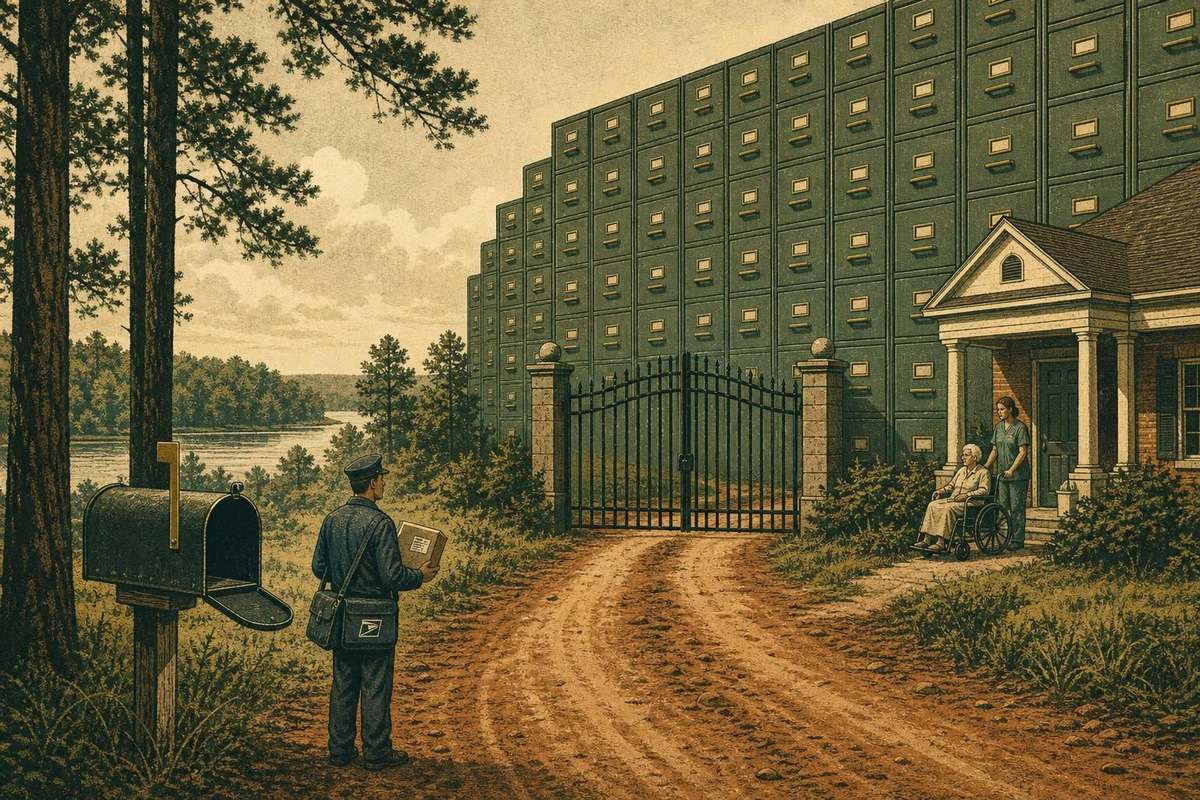
Andrew Turnage has a geography problem, and in August he told his commissioners he had found a way around it. At the Georgia Access to Medical Cannabis Commission's regular meeting on August 13, the commission's executive director introduced a proposed rule he called "one of the more exciting changes" in a long package of amendments. "Everyone knows that Georgia is a very large state. We have a large geography," Turnage said. "Everyone knows that patients have had many struggles through this process to get access to the medication that we regulate." (S8)
His answer was the mail. Patients in many parts of the state, he said, were traveling two hours or more into a congested metro area or around the mountains, rivers and lakes that make it hard to get "east to west across our great state." The new rule would let the state's dispensing licensees ship cannabis straight to a registered patient's door, through the U.S. Postal Service or a private carrier such as FedEx, UPS or DHL. "This will provide the opportunity for our dispensing licensees to be able to ship directly to a patient's home," he said. (S8, S9)
The commission adopted the rule at a special called meeting on September 30, and Georgia's official compilation lists Rule 351-6-.11, "Delivery," as effective October 26. The day after it took effect, two Republican senators from other states asked the head of the Postal Service to make sure it never works. (S11, S1, S2)
Sens. James Lankford of Oklahoma and Ted Budd of North Carolina wrote to Postmaster General David Steiner on October 27, urging the Postal Service to keep its prohibition on mailing marijuana even though state-licensed medical cannabis now sits in Schedule III of the Controlled Substances Act. Their letter named Georgia as the state that had gotten ahead of the rules. It landed three days before the Justice Department announced the first federal registrations for medical dispensaries, more than 900 of them in seven states. Georgia was not one of the seven. The DEA's October 30 list of businesses still waiting includes 60 Georgia dispensary entries, five manufacturers and two distributors. (S2, S3, S6, S7)
That gap is the whole fight. Georgia has written a delivery system that works under state law. Whether a package can lawfully travel through the federal mail depends on federal rules that turn on DEA registration, and as of October 30 no Georgia dispensary held one. (S1, S4, S6)
The rule reads like a logistics manual. A dispensing licensee must file a delivery plan identifying its shipping method, how it will report tracking information and how it will recall delivered products, and the commission's executive director approves it. Before shipping, the dispensary must verify and keep copies of the patient's or caregiver's photo ID and active registry card, ship only to the Georgia address on that ID, stay within the possession limits in state law and leave out any product form the patient may not possess. Healthcare institutions can receive deliveries on a patient's behalf if they designate employees to sign. (S1)
The delivery itself must use certified mail, or a carrier service with equivalent tracking and proof of delivery, restricted to the patient, caregiver or listed institution employee, and requiring that person's signature. The dispensary must record the receipt or tracking number in the commission's tracking system "immediately upon completion of delivery." A failed delivery goes back into the licensee's secured custody and is logged. Products that need temperature control must arrive intact. (S1)
The Postal Service's own rulebook sets out those conditions. Publication 52, section 453.31, says that if distributing a controlled substance is unlawful under federal drug law, "then the mailing of the substance is also unlawful." Controlled substances are acceptable in domestic mail only when both mailer and addressee are registered with the DEA or exempt from registration, such as military and law enforcement personnel on duty; through drug mail-back programs; or as prescription medicines mailed by manufacturers, pharmacies, practitioners "or other authorized dispensers, as permitted by 21 CFR § 1307.11." Patients cannot register with the DEA, so the first route is closed to home delivery. Georgia's case rests on the third. (S4)
Georgia's argument for that route runs through the federal rule itself. The April rescheduling rule says that a certification state law deems sufficient for a patient to obtain medical cannabis "shall be sufficient to permit dispensing" to that patient, provided it is dated, signed and identifies the practitioner. Read generously, a Georgia registry certification works like a prescription and a state-licensed dispensary works like an authorized dispenser. The weak link is the dispenser. The same rule lets businesses that applied on time keep operating under their state licenses while the DEA reviews them, but it does not make them registrants, and the Justice Department's announcement put Georgia outside the first round. (S5, S6)
The Postal Service has not said what it will do. Nikolaj Hagen, a senior public relations representative for USPS, pointed Marijuana Moment to the general mailability rules when Georgia adopted its rule, and when pressed on how rescheduling changes them said "we have nothing additional to offer at this time." A DHL spokesperson said the company is "monitoring" and will comply with applicable laws. UPS and FedEx did not respond to that outlet. (S9)
Lankford and Budd want that silence to become a no. Their letter argues that the DEA put too much weight on state licensing when it moved medical cannabis to Schedule III, that inhaled cannabis and edibles are not FDA-approved drugs, and that some states have "very low barriers to entry" for licensees. They cited calls to poison centers involving young children and warned against shipments into Idaho and Kansas, which have not legalized cannabis in any form. Georgia's rule does not contemplate interstate shipping; it requires delivery to a Georgia address. (S2, S3, S1)
The senators also went after the premise of rescheduling itself. The government, they wrote, "relied on the fact that many states call marijuana 'medical'" as evidence of a currently accepted medical use, and "although 'medical' marijuana is classified as a Schedule III drug, it is unlike any other Schedule III drug." They pointed to Oklahoma, Lankford's home state, as an example of a market where state licenses were handed out with few barriers and product, they argued, has flowed across state lines. Lankford has pressed the administration on other fronts too, questioning Treasury Secretary Scott Bessent about the tax relief that registration may bring cannabis businesses. (S3, S2)
“It is our understanding that marijuana cannot currently be mailed at all using the USPS. However, some states are under a different impression.”
— Sens. James Lankford and Ted Budd, letter to Postmaster General David Steiner, Oct. 27, 2026
Kevin Sabet, president of Smart Approaches to Marijuana, praised the letter the next day. "Rescheduling did not make marijuana medicine, and it certainly should not turn the Postal Service into a delivery service for the pot industry," he said, adding that mail delivery would put high-potency THC "within reach of young children." The letter also concedes a point that cuts the other way: Georgia, they wrote, "does not have the authority to alter current USPS regulations," and their worry is that the Postal Service will change its own. (S10, S2)
Turnage framed delivery as the safer option, not the riskier one. The greatest value, he said in August, is for patients who live permanently in long-term care facilities and cannot drive. A facility could buy from a dispensary and have the product delivered, "without presenting a risk for diversion, without presenting a risk for, frankly, theft, robbery, an attack in the parking lot." (S8, S9)
Georgia has pushed against federal limits before and lost. In 2023, the state tried to let independent pharmacies dispense medical cannabis, and the DEA told pharmacies holding federal registrations that they could not possess or dispense marijuana while it remained in Schedule I; the Georgia Board of Pharmacy put the warning in its December 2023 meeting record, and the plan stalled. Schedule III changes that premise for state medical programs. It does not change who holds a registration. (S12)
Gov. Brian Kemp, who signed the 2026 law expanding the program's qualifying conditions and allowing vaping for patients 21 and over, has kept the program on a medical footing. "I do not believe that a well-implemented medical cannabis program must inevitably lead to the legalization of recreational use in Georgia," he wrote in his signing statement. That position may help the state with the DEA, which on October 30 moved to deny a Minneapolis dispensary on the ground that Minnesota licenses cover both medical and adult-use sales. Georgia's licenses cover only medical sales. (S9, S13)
For now, Georgia's dispensaries can write delivery plans, and the commission's executive director can approve them. Each plan has to identify a shipping method, and the rule lists three: the Postal Service, a private carrier, or the commission itself, or a carrier the commission hires, acting on a licensee's behalf under state law. Only the last is fully under the state's control, and it still has to satisfy the same certified-mail and signature requirements. Each plan must also tell patients what to do when a package is late or arrives damaged. The Justice Department says the DEA will keep issuing dispensary registrations in phases, which leaves Georgia's licensees waiting on a federal timetable no state rule can set. (S1, S6)
Turnage built his pitch around the patient in a nursing-home bed who cannot make a two-hour drive. Under the rule he wrote, that patient's medicine would arrive in a tracked envelope that only a named employee may sign for, with the receipt logged in a state database the moment it lands. The paperwork is ready. What Georgia still lacks is a federal registration on the sender's side and a carrier willing to take the box. (S8, S1)
- [1]Georgia Secretary of State: Rule 351-6-.11, Delivery (effective Oct. 26, 2026)
- [2]Marijuana Moment: GOP senators urge USPS not to deliver medical marijuana through the mail
- [3]Cannabis Business Times: US senators from NC, Oklahoma try to dictate Georgia cannabis policy (Oct. 29, 2026)
- [4]USPS Publication 52, section 453: Controlled substances and drugs
- [5]eCFR: 21 CFR 1301.13(k), medical marijuana registrations and certifications
- [6]U.S. Department of Justice: Federal registrations for medical marijuana dispensaries (Oct. 30, 2026)
- [7]DEA Diversion Control Division: Medical marijuana timely applicants list (file dated Oct. 30, 2026)
- [8]Cannabis Business Times: Georgia cannabis regulators propose allowing USPS deliveries (Aug. 18, 2026)
- [9]Marijuana Moment: Georgia officials approve rule allowing medical marijuana delivery by USPS
- [10]Smart Approaches to Marijuana: statement on the Lankford-Budd letter
- [11]Georgia Access to Medical Cannabis Commission: commission meetings and rule notices
- [12]Emerald Intel: From pharmacies to the Postal Service, Georgia tests cannabis normalization
- [13]Marijuana Moment: DEA refuses to approve marijuana businesses in dual-license states
- [14]Sen. James Lankford: Lankford, Budd urge USPS to maintain ban on mailing marijuana
Comments are open to verified operators. Sign in or create a free account to weigh in.
Congress's Anti-Scam Bill Labels Cannabis Ads 'High-Risk,' in the Same Clause as Alcohol
Amy Deneson's Cannabis Media Council says H.R. 10433 lumps licensed dispensaries in with crypto. The bill's real pressure lands on platforms with 100,000 users: heavier vetting, three-year records, and FTC, state and private lawsuits that Section 230 would not block.

Rhode Island Said No to 11 p.m. Cannabis Delivery in September. Five Weeks Later, It Voted Yes
A Pawtucket compassion center's petition lost 3-0, then won 2-1 on Oct. 23. The rule book still says deliveries stop at 8 p.m., the commission has not named a start date, and its next meeting is Dec. 4.