122 Signatures Stand Between Massachusetts and the First Repeal of a Legal Cannabis Market
The prohibitionists' petition cleared its last threshold on July 9 by the thinnest margin in memory, and a Dorchester cannabis advocate had already filed to disqualify exactly that many names. The state's $1.65 billion adult-use market now rides on a commission ruling and a November 3 vote.
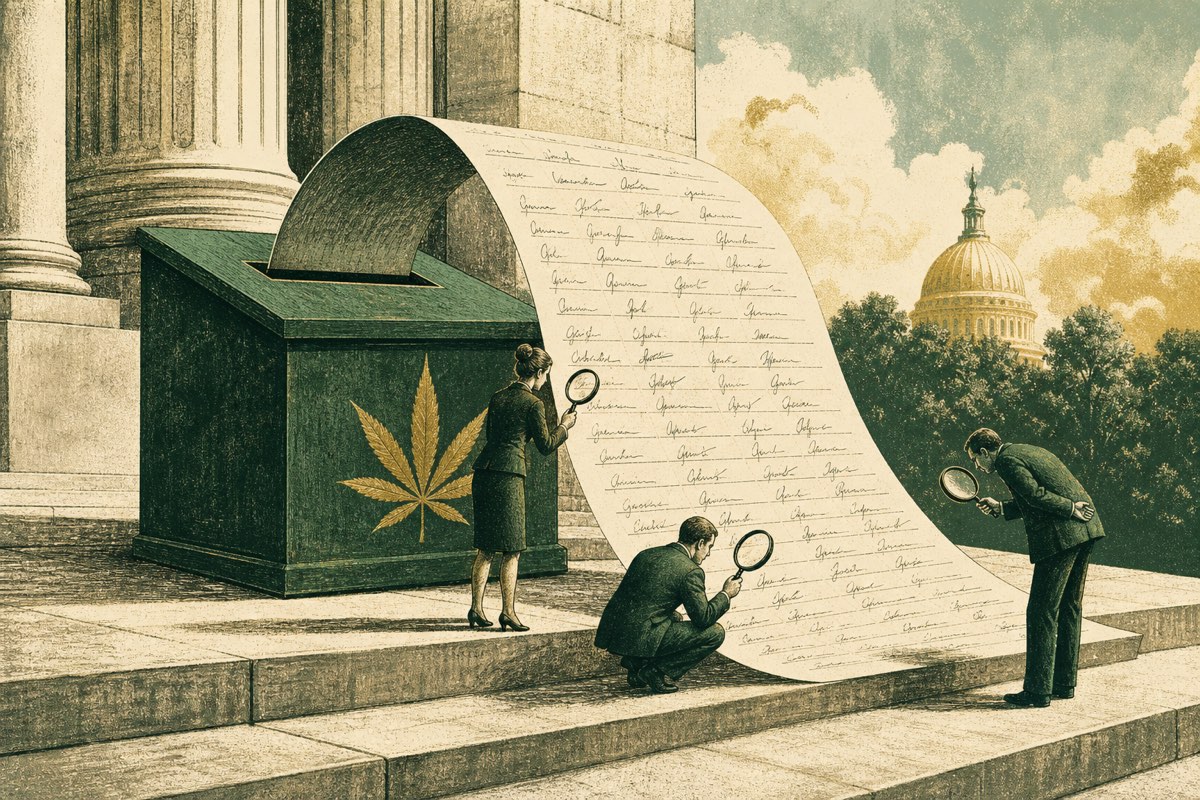
Kevin Gilnack wasn't waiting for the letter. On July 8, the day before Massachusetts election officials certified the petition that would put cannabis prohibition back on a statewide ballot, the Dorchester public-affairs consultant and longtime cannabis advocate filed a seven-point objection with the State Ballot Law Commission. His request was surgical: review the challenged signatures from the petition's final round, disqualify them, and order the secretary of the commonwealth to keep the question off the November ballot. He would need to knock out only a handful. As it turned out, the number was 122.
The letter came the next day. Michelle K. Tassinari, first deputy secretary and director of the state's Elections Division, informed the Coalition for a Healthy Massachusetts on July 9 that 12,551 of the 12,889 signatures it submitted by the July 1 deadline had been allowed, 122 more than the 12,429 required. "Therefore, the initiative petition will be printed on the November 3, 2026, state election ballot as required by the Constitution," Tassinari wrote.
With that sentence, Massachusetts became the first state in America where voters will decide whether to repeal a legal adult-use cannabis market, a market that did $1.65 billion in sales last year, crossed $9 billion in cumulative sales in February, and employs, by the industry's own count, somewhere between 14,000 and 20,000 people. Ten years after Bay State voters legalized recreational cannabis by passing Question 4 with nearly 54 percent of the vote, they are being asked to take it back.
No legalization state has ever reversed itself at the ballot box. Ohio's legislature has trimmed its voter-passed law; a Virginia governor vetoed her state's retail market into limbo; South Dakota's 2020 legalization was undone in court before it began. But a straight up-or-down repeal vote on a functioning, taxed, billion-dollar retail market is new territory, which is why both national campaigns have already landed in Boston, and why a fight over 122 signatures may end up in front of the Ballot Law Commission with the whole question riding on it.
The measure, titled "An Act to Restore Sensible Marijuana Policy," is narrower than full prohibition, and its architects lean on that distinction. It would repeal the laws allowing recreational sale, cultivation and taxation, eliminating the state's 10.75 percent excise tax and local option taxes along with the stores that pay them. Possession would survive in a shrunken form: an ounce or less would carry no penalty at all, one to two ounces would be a $100 civil fine, and no agency could deny housing assistance, financial aid or a driver's license over it. The medical program, launched in 2012, would remain.
The Coalition for a Healthy Massachusetts took the long road here. It filed 74,574 valid signatures in December 2025, enough to put the proposal in front of the Legislature, which declined to act. That set up round two: at least 12,429 additional signatures, gathered in roughly two months, due July 1. The campaign turned in 12,889. Election officials struck 338. The 122 that remained were the margin between a historic ballot question and nothing.
The gathering itself is part of the fight. In June, the coalition fired one of its paid signature gatherers after video surfaced of conduct the campaign itself called "wholly unacceptable," and local coverage has carried accusations that circulators misrepresented what the petition would do. Gilnack's objection channels those complaints into procedure: among his seven points, he argues that signatures came from people who are not registered voters at the addresses listed and that entire petition sheets should be tossed. The Ballot Law Commission must now decide whether at least 123 of the certified names fail, before ballots are printed.
That the repeal campaign got this far owes something to the regulator it wants to abolish. The Cannabis Control Commission has spent two years in the headlines for reasons no agency wants: a suspended and then ousted chair, an acting executive director, and a state audit that faulted its oversight of product testing. The coalition quotes that audit constantly, contaminated product that had passed testing and later failed is its favorite exhibit. Industry groups respond that the answer to a struggling regulator is a better regulator, not the elimination of the regulated market; the distinction will be litigated in television ads for the next four months.
The money at stake extends past the stores themselves. Adult-use cannabis carries the state's 6.25 percent sales tax, a 10.75 percent excise, and a local-option tax of up to 3 percent that scores of municipalities have written into their budgets, the revenue that host communities from Worcester to Northampton have used to justify saying yes to dispensaries in the first place. Repeal would take the local checks with it, which is why mayors, not just operators, have started signing on to the opposition.
The campaign to pass the repeal is led by the coalition with backing from Smart Approaches to Marijuana, the national group that has fought legalization measures for a decade. Its case is less about cannabis itself than about the state's stewardship of it. "One of the things we were sold when voting to accept looser cannabis rules was that the black market would go away, and that just hasn't happened," spokesperson Wendy Wakeman has argued. "The black market is still thriving." The coalition also points at the Cannabis Control Commission, citing a state audit that found regulatory noncompliance let previously passed, later-failed product reach consumers, and calls the agency "a disaster."
The opposition campaign, Stop the Repeal, counts the Marijuana Policy Project, the Retailers Association of Massachusetts, Fitchburg Mayor Samantha Squailia and former Boston City Councilor Tito Jackson among its ranks. Its argument is arithmetic: repeal would zero out hundreds of millions in state and local tax revenue and the roughly 20,000 jobs the campaign attributes to the industry, in the middle of an affordability crisis.
Meg Sanders, chief executive of Canna Provisions, the Lee and Holyoke retailer, put the industry's frustration plainly: "Prohibition doesn't work. The United States has shown this time and time and time again, and this notion that 'Oh, we're just going to reinvigorate the medical program' is just a fool's errand." Caroline Pineau, the Haverhill dispensary owner who has already fought the initiative once, as lead plaintiff in a challenge to the attorney general's certification of the petition, sees outside money behind the whole effort.
“[This initiative] is driven by out-of-state alcohol and gambling billionaires, trying to protect their own pockets.”
— Caroline Pineau, Owner, Stem Haverhill
The polling gives both sides something to hold. A University of New Hampshire survey in April found repeal losing 69 percent to 22 percent, a rout. But Polity Research Consulting, polling in late April and early May with the question framed around the measure's actual mechanics, found something closer to a race: 48 percent opposed, 41 percent in favor, 11 percent undecided. A ten-year-old legalization consensus, in other words, may be softer than the industry assumed.
For the state's roughly 400 licensed retailers, the procedural window is narrow and strange. Their market posted its best year ever in 2025. Their regulator is under audit. And their existence now depends, in the near term, on whether a commission finds 123 bad signatures in a stack of 12,551, and in the long term, on a campaign where the other side needs to persuade only a fraction of the voters who once said yes.
- State Ballot Law Commission ruling on Kevin Gilnack's July 8 objection, if more than 122 signatures fall, the question comes off the ballot.
- Campaign-finance disclosures through the fall, Stop the Repeal has promised to detail who is funding the Coalition for a Healthy Massachusetts.
- November 3, 2026, the vote itself, the first statewide repeal referendum on a legal adult-use market in US history.
Gilnack, for his part, has framed his objection as consumer protection for the ballot itself, a demand that a question this large not reach voters on the strength of signatures he contends were gathered under false pretenses. The commission will decide whether he is right. If he is, the repeal dies at 122. If he isn't, the most closely watched cannabis vote in a decade begins, in the state that helped start the East Coast's legal market, over whether to become the first to end one.
- [1]Cannabis Business Times — MA repeal petition qualifies; objector files new challenge (July 10, primary detail)
- [2]Ballotpedia — Massachusetts Eliminate Recreational Marijuana Sales Initiative (2026): measure design, campaigns, polls
- [3]Cannabis Control Commission — Massachusetts adult-use sales generated $1.65 billion in 2025 (primary)
- [4]Cannabis Control Commission — Marijuana establishments pass $9 billion in gross adult-use sales (primary)
- [5]Marijuana Moment — MA rollback initiative officially qualifies for November ballot (fired signature gatherer)
- [6]Kevin Gilnack — objection filed with the State Ballot Law Commission, July 8, 2026 (primary document)
- [7]Elections Division — certification letter from Michelle K. Tassinari (primary document)
- [8]Coalition for a Healthy Massachusetts — campaign site (supporter arguments)
- [9]Newton Beacon — ballot question could upend Newton's cannabis industry (deceptive-gathering accusations)
- [10]WBUR — Massachusetts votes to legalize recreational marijuana (2016 Question 4 result)
- [11]Ballotpedia — Massachusetts Question 4, Marijuana Legalization (2016)
Comments are open to verified operators. Sign in or create a free account to weigh in.

DEA's Drug-Felony Hiring Bar Covers Dispensary Clerks, Not Cannabis Growers
Mississippi's Nicole Huff was told her two flagged workers can stay only in non-plant-touching jobs while waivers of unknown length are pending, and Sen. Cory Booker calls the policy ridiculous. Growers registering since Oct. 5 face screening rules under which a conviction will not necessarily preclude employment.

Oklahoma's Cannabis Regulator Exits With 1,703 Growers Left and a DEA Registration Cliff Ahead
Licensed growers fell from 9,402 to 1,703 on Adria Berry's watch. Her interim successor, a former sheriff's lieutenant, inherits a Jan. 1 date after which the state drug bureau may move against growers lacking DEA registration, and a governor who wants the program shut down.