Legal to Grow, Illegal to Buy: Spanberger's Veto Keeps Virginia's $780M Market Dark
Abigail Spanberger campaigned on a promise to sign adult-use legislation. On May 19 she vetoed it instead, siding against sponsors in her own party and pushing legal sales to 2027 at the earliest, leaving five medical operators holding the only legal storefronts and equity applicants back in limbo.
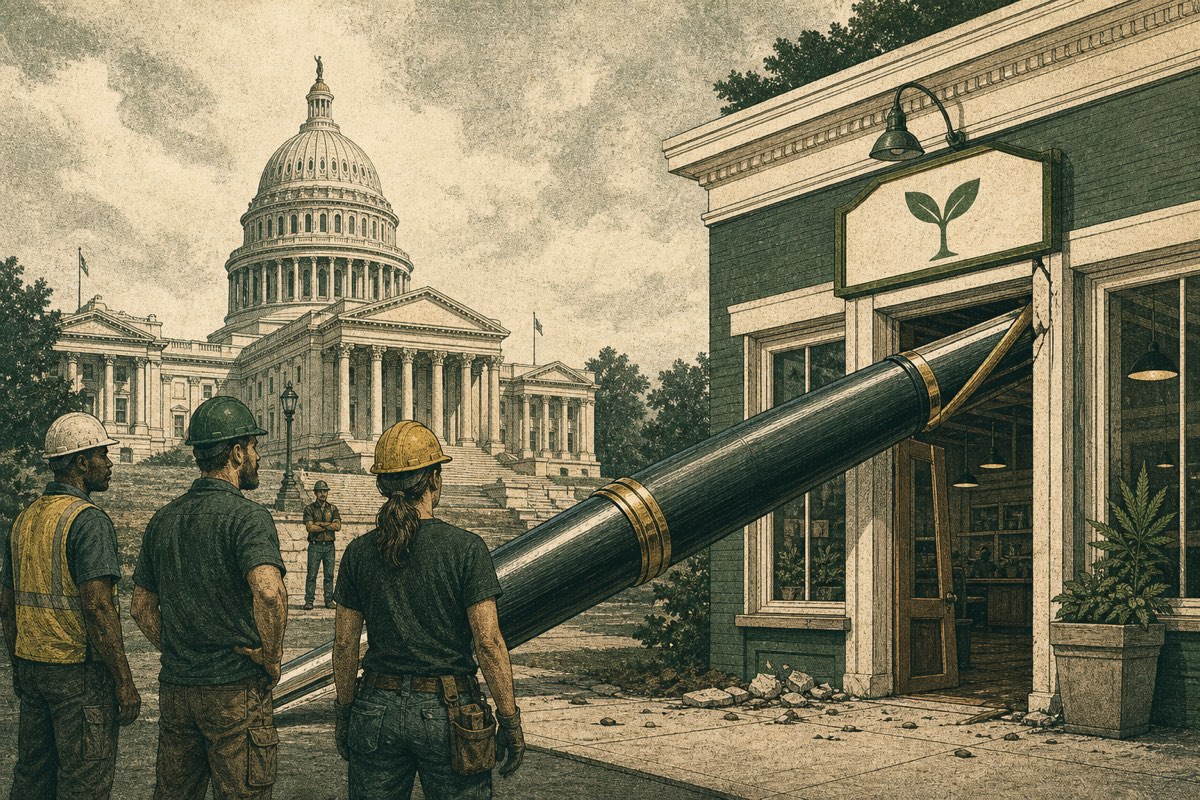
Abigail Spanberger had been governor of Virginia for barely four months when, on May 19, she picked up her veto pen and did the thing she had spent a year on the campaign trail promising she would not. On her desk sat House Bill 642 and Senate Bill 542, a single retail framework, years in the making, that would have finally given the Commonwealth what it has lacked since 2021: a legal place to buy the cannabis its residents can already legally grow and carry.
The bill had cleared a Democratic House and a Democratic Senate. It carried the names of legislators she had campaigned beside. And she had run, in part, on a plain pledge, that if lawmakers sent her a bill to stand up a retail marijuana market, she would sign it. Three days before her deadline to act, she sent it back dead, with a message saying the framework arrived 'without the timeline, structure, or resources to be successfully implemented.'
The veto landed less like a policy dispute than a family rupture. Within hours, the bill's two lead sponsors, Sen. Lashrecse Aird of Henrico and Del. Paul Krizek of Fairfax, both Democrats, issued a joint statement accusing the governor of handing a gift to the very operators her caution was supposed to guard against.
Virginia legalized possessing and growing cannabis five years ago, then never built the store to sell it. A required second vote stalled when Republicans took the House of Delegates in 2022, and Gov. Glenn Youngkin vetoed every retail proposal that reached him after that. Spanberger's election last November was supposed to be the circuit-breaker, a Democratic governor, a Democratic legislature, and a mandate to finish the job. Her veto instead extended a paradox five years running: an adult in Virginia can hold up to an ounce in public and grow four plants at home, but the only working market to supply them is illegal.
The stakes are concrete. Analysts pegged the legal market at roughly $780 million in its first full year, with a path to a billion the next. The vetoed bill authorized as many as 350 stores statewide, a 6% state excise tax, and a licensing system tilted toward social-equity applicants and microbusinesses. With one signature withheld, all of it slid to 2027 at the earliest, and, by some readings, 2028.
A Law With a Catch
The road to this point is littered with near-misses. Democrats wrote the 2021 legalization law with a built-in catch: its commercial-sales provisions had to be re-passed the following year to take effect. When Republicans flipped the House of Delegates that November, the re-passage never came. For the next four years the legislature kept sending Youngkin some version of a sales bill, and Youngkin kept saying no. Each cycle, the date when Virginians might actually buy legal cannabis slid further out. Spanberger's campaign promise was supposed to end that pattern, not extend it.
The break did not come from nowhere. In March, the General Assembly passed the framework after splitting its most contested detail down the middle: the House wanted sales to open Nov. 1, 2026, the Senate Jan. 1, 2027, and the compromise took the later date. On April 13, Spanberger returned the bill with a substitute that rewrote the bargain. She wanted to push the launch another six months, to July 1, 2027; cut the store cap from 350 to 200 through 2029; raise the excise tax to 8% by 2029; and delay the application window for new operators. Her office cast the changes as prudence, time to 'incorporate lessons learned by other states' and 'provide strong oversight from day one.'
Lawmakers read it as a gut renovation of a bill they had spent two years negotiating. On April 22, the General Assembly rejected the governor's amendments and sent the original back to her desk, daring her, in effect, to sign their version or kill it. On May 19, she killed it.
What the bill built was not a free-for-all. It capped any single company at a handful of licenses, required labor-peace agreements, and routed most cannabis tax revenue into a Cannabis Equity Reinvestment Fund, with slices carved out for substance-use treatment and pre-kindergarten for at-risk children. It was, by the design of the commission that drafted it, chaired by Krizek, with Aird as vice chair, a deliberately cautious bill. That is what made the 'not ready' rationale sting for its authors: they had spent two years building in the very guardrails the governor said were missing.
The timing carried its own sting. Just weeks earlier, federal rescheduling had handed medical-cannabis operators their first real tax relief in years, brightening the books of the same multistate companies that dominate Virginia's medical program. The state's five vertically integrated processors, the only businesses now licensed to grow, process, and dispense here, would have been allowed to convert to adult-use sales for a $10 million fee each, a running start the day stores opened. Instead they keep something better: a monopoly on the only legal shelves in Virginia, with no end date.
Virginia is not starting from zero. Its medical program, run by that handful of vertically integrated processors under the Cannabis Control Authority, already serves registered patients, and the agency spent late 2025 modernizing how those patients get certified. But medical access is narrow by design, and the recreational demand it does not touch has simply gone underground or across state lines, the exact gap the retail bill was written to close.
For everyone outside that circle of five, the veto reopened a familiar limbo. The bill set aside half its first licenses for microbusinesses and built an 'impact license' track for people from the neighborhoods that bore the weight of prohibition, residents of heavily policed communities, people with old marijuana convictions, their families. Many had been preparing for an application window expected to open as soon as July 2026. That window no longer exists.
Into the vacuum has rushed a sprawling gray market. Unregulated shops across Virginia sell intoxicating hemp-derived products, delta-8 gummies, high-THC 'hemp' flower, in a legal twilight no state license governs, alongside the older illicit trade in plain marijuana. Lawmakers have spent recent sessions trying to rein in those shops, and the retail bill was meant to give consumers a tested, taxed alternative. Its veto leaves the tested option on the shelf and the untested ones in the strip mall.
The contrast presses in from every side. Maryland switched on adult-use sales in 2023 and now rings up cannabis a short drive from Northern Virginia's suburbs. Washington, D.C., runs its own quasi-legal 'gifting' market. Virginians have spent five years watching neighbors collect the tax revenue, the jobs, and the storefronts their own 2021 vote was supposed to deliver at home.
To the sponsors, the governor's worry, that Virginia was not ready to regulate a market well, skipped past the fact that an unregulated one already thrives. 'The Governor's veto ignores the reality that cannabis is already being sold everyday across Virginia,' Aird and Krizek wrote. The General Assembly had handed the state 'an opportunity to lead,' they said, and the veto instead 'prolongs uncertainty and provides comfort to those profiting from the illicit market.'
“[The veto] leaves the Commonwealth exactly where we have been since 2021: with an unchecked illicit market hurting our communities.”
— Sen. Lashrecse Aird, D-Henrico
The advocacy groups that lobbied for the bill, Virginia NORML, the Marijuana Policy Project, Marijuana Justice and others, had signed a coalition letter urging Spanberger to sign. 'NORML will remain steadfast in our advocacy for consumers' access to cannabis products that are safe, convenient, and affordable,' said JM Pedini, the group's Virginia director, after the veto. Sen. Aaron Rouse of Virginia Beach, one of the Senate sponsors, had framed the market in plain fiscal terms during the session: 'Any measure that we can take to find revenue, I'm very optimistic about that approach.' The revenue, for now, stays theoretical.
Not everyone who wanted a market wanted this one. Chelsea Higgs Wise, co-founder of the Richmond advocacy group Marijuana Justice, had spent the session warning that an early launch could let the established medical operators open first and crowd out the equity entrepreneurs the law was meant to lift. The veto delays both the harm she feared and the market she wanted, a reminder that 'pass anything' was never the consensus, even among legalization's allies.
Spanberger has not backed away from legalization itself. 'I support a legal marketplace for cannabis,' she said as a candidate, adding that she wanted to be sure 'it is fully regulated.' Her veto message leaned on that line: the objection, her office insisted, was to a specific blueprint it judged underbuilt, too many licenses too fast, too little funding and staff behind the regulator, not to the idea of legal sales. Whether that reads as caution or a broken promise depends on which Democrat you ask.
A Narrow Road Back
The procedural math is unforgiving. Overriding a Virginia veto takes a two-thirds vote in both chambers, a margin Democrats do not hold, so the override sponsors have floated is closer to a statement than a plan. The realistic openings are a long-shot move through the state budget before July 1, or the 2027 General Assembly session, which would push actual sales toward 2028, seven years after Virginia first legalized the plant.
- Before July 1, 2026, the state budget is the only near-term vehicle that could revive retail-sales language this year.
- 2026 veto session, sponsors may force an override vote, but the two-thirds threshold is out of reach.
- January 2027, the next General Assembly session, and the first realistic chance to pass a bill Spanberger will sign.
- Already moot, the vetoed bill's July 2026 license window and its Jan. 1, 2027 sales date died with it.
For ordinary Virginians, nothing visible changes, which is the whole problem. They can still grow four plants and keep what those plants yield. They simply have nowhere legal to buy a seed, a gummy, or a pre-roll, so they buy from the unlicensed sellers and out-of-state shops the veto was partly sold as a way to discourage.
Spanberger calls the wait the price of getting it right. The lawmakers who wrote the bill see five more years of the wrong thing already happening. Both can be true. What is certain is that the logjam a Democratic sweep was supposed to clear is now held in place, for the first time, by a Democrat, and Virginians will spend at least another year legally holding a product they cannot legally buy.
- [1]Virginia Mercury — Spanberger vetoes cannabis bill, stalling legal sales again (May 19, 2026)
- [2]VPM News — Spanberger vetoes retail weed market bill, despite campaign pledge (May 19, 2026)
- [3]Foley Hoag — Update: Governor Spanberger Vetoes Adult-Use Cannabis Bill
- [4]Foley Hoag — Stalemate Over Virginia Adult-Use Cannabis Bill
- [5]The National Law Review — Virginia's Cannabis Crossroads: Spanberger's Veto Leaves the Market in Limbo
- [6]Marijuana Moment — Virginia Marijuana Commission Unveils Plan to Legalize Adult-Use Sales
- [7]Cardinal News — Spanberger vetoes bills to legalize retail recreational cannabis sales (May 19, 2026)
- [8]Axios Richmond — Gov. Spanberger vetoes Virginia retail marijuana sales bill
Comments are open to verified operators. Sign in or create a free account to weigh in.

DEA's Drug-Felony Hiring Bar Covers Dispensary Clerks, Not Cannabis Growers
Mississippi's Nicole Huff was told her two flagged workers can stay only in non-plant-touching jobs while waivers of unknown length are pending, and Sen. Cory Booker calls the policy ridiculous. Growers registering since Oct. 5 face screening rules under which a conviction will not necessarily preclude employment.

Oklahoma's Cannabis Regulator Exits With 1,703 Growers Left and a DEA Registration Cliff Ahead
Licensed growers fell from 9,402 to 1,703 on Adria Berry's watch. Her interim successor, a former sheriff's lieutenant, inherits a Jan. 1 date after which the state drug bureau may move against growers lacking DEA registration, and a governor who wants the program shut down.