San Francisco Approves Amsterdam-Style Cannabis Cafés by a 7-4 Vote, a Bay Area First
Board President Rafael Mandelman's ordinance lets the city's 66 surviving retailers add food, coffee and live entertainment to legal on-site consumption, over objections from the Lung Association and from operators who begged the city to slow down. Mayor Daniel Lurie's signature is the last step.
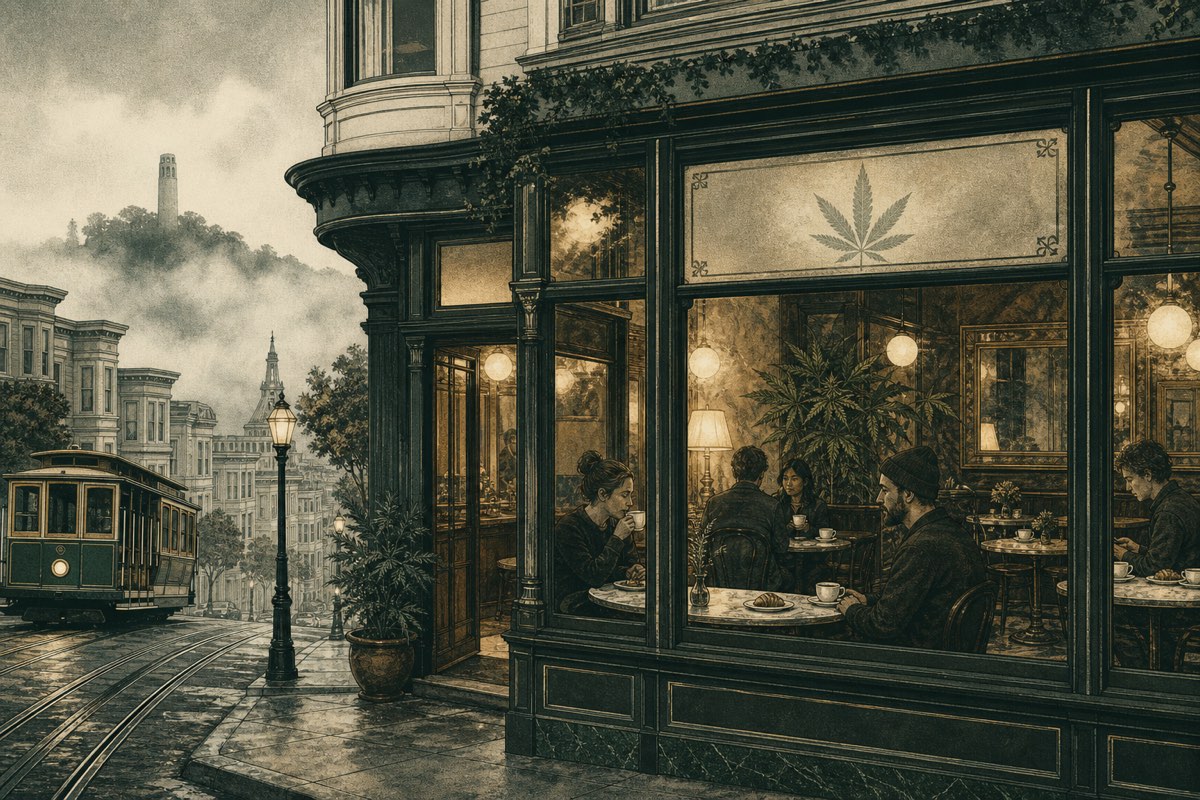
For nearly ten years, Will Dolan has been looking at a boarded-up storefront on Valencia Street and seeing tables. Coffee, light bites, standup comedy on a small stage, and cannabis, consumed legally, indoors, in company. Dolan runs HYRBA, a dispensary out in the Sunset District, and the Mission café he has imagined since the pre-legalization days was always one ordinance short of possible. On July 14, by a 7-4 vote of the Board of Supervisors, the ordinance arrived: San Francisco became the first city in the Bay Area to authorize Amsterdam-style cannabis cafés.
"We're looking to develop a space where people can socialize, relax, unwind, grab a bite to eat, have a snack, have a coffee and consume cannabis in a way where they're doing it legally," Dolan said of the plan. "They don't have to do it in their apartment, or they don't have to do it on the street." (S4)
The measure, File No. 260281, was authored by Board President Rafael Mandelman and implements Assembly Bill 1775, the 2024 state law by Assemblymember Matt Haney, a San Francisco Democrat, that lets California cities opt into cannabis cafés serving fresh food, nonalcoholic drinks and live entertainment. Governor Gavin Newsom signed it on September 30, 2024, after vetoing a previous version over worker protections. San Diego, West Hollywood and Sacramento moved first; San Francisco, the city most associated with cannabis culture in America, is arriving fourth, and betting the model can do for its struggling retailers what it did for Dutch tourism. (S2, S5, S7, S8)
The rules are tight. Cafés may sell cannabis only for consumption on the premises, nothing leaves the building, with no alcohol and no tobacco. Operators need a Department of Public Health consumption permit on top of their cannabis permit, must meet restaurant-grade food-safety code, and must electronically verify every customer is 21 at the door. For the first year, only San Francisco's existing storefront retailers and their equity partners may apply; equity applicants pay a $2,000 application fee and $3,000 for the first year's license. If Mayor Daniel Lurie signs, the Office of Cannabis starts taking applications 31 days later. (S1, S2, S3)
The economic backdrop explains the urgency. California's licensed cannabis sales fell below $4 billion in 2025, and the state itself estimates roughly 60 percent of cannabis sold in California moves through the illicit market. San Francisco froze new retail licenses in 2023, citing oversaturation; of 79 retailer permits the city has issued, 66 were active as of earlier this year. David Goldman, president of the Brownie Mary Democratic Club's San Francisco chapter, told the board that 23 storefronts and 21 delivery services have already closed since the city began permitting them. (S1, S2, S3)
For Haney, the vote closes a loop he started in Sacramento. His first café bill, AB 374, cleared the Legislature only to be vetoed by Newsom in 2023 over cannabis-worker protections; AB 1775 came back with United Food and Commercial Workers-backed safeguards and passed the Senate 30-7 and the Assembly 63-5. "Lots of people want to enjoy legal cannabis in the company of others," Haney said when San Francisco's ordinance was unveiled at City Hall in March. "And many people want to do that while sipping coffee, eating a sandwich, or listening to music." His sharper argument was the one aimed at his own party's regulators: "If we don't innovate and adapt like we are doing today, we risk watching California's legal cannabis industry continue to collapse." (S5, S8)
San Francisco is not starting from zero. A handful of legacy consumption lounges, the dab bar at Moe Greens on Market Street among them, already operate under the city's older smoking-permit regime; what they cannot do is serve a sandwich or book a comedian. The café ordinance adds food, nonalcoholic drinks and live entertainment, which is where the hospitality industry says the model either works or doesn't. "Most people don't know their tolerance, and that's where education and safety come in," Dale Sky Jones, chancellor of Oakland's Oaksterdam University, told an industry roundtable on lounges last winter. "Bars have alcohol management techniques, and we need that for cannabis." (S1, S8)
Mandelman's pitch is recovery economics: cafés as street-level activation for a downtown-challenged city, in the same bucket as entertainment zones and free concerts. "There's no reason our operators shouldn't have the same tools to compete and help bring people back into our neighborhoods," he argued. He has also been careful with the comparison everyone reaches for: "San Francisco is not Amsterdam; there may be elements of that that we're going to see out here, and again, that could be part of our recovery." (S2, S3, S4)
“San Francisco just gave our legal cannabis industry a real tool to compete and grow.”
— Rafael Mandelman, President, San Francisco Board of Supervisors
The dissent came from two directions. Supervisor Myrna Melgar, one of four no votes, with Supervisors Connie Chan, Chyanne Chen and Alan Wong, framed hers on public health: "What I don't like about this legislation is that it permits indoor smoking, and I think that is going backward on our public health goals." The American Lung Association and the American Cancer Society Cancer Action Network sent letters urging rejection; the ordinance carves an exception into the smoke-free-workplace architecture California has been building since it banned smoking in restaurants in 1995. "No worker should have to choose between earning a paycheck and protecting their health," wrote Kesa Bruce, the Lung Association's advocacy director. (S1, S2, S4)
The second objection came from inside the industry. Kevin Reed, who founded The Green Cross two decades ago, wrote the board a letter he called unprecedented for him: "This is the first time in my career that I have felt compelled to ask the City to slow the expansion of cannabis businesses." Goldman, likewise, supported letting existing retailers add food and entertainment but opposed minting a new license type in a saturated market, at least until the city's economic impact report on the industry lands in mid-2027. The board's one-year exclusivity window for existing retailers is the compromise both men's letters bought. (S1, S2)
The cautionary case is Nevada. Las Vegas prepared for dozens of consumption lounges; as of April, exactly two state-licensed lounges were open in the entire state, and one early entrant, Thrive's Smoke and Mirrors, closed in under a year. Nevada's cannabis sales fell about 9 percent to $757.7 million in the year through June 2025. Lounge hospitality, the operators who run them say, is a low-margin business bolted onto a declining retail one, which is precisely the bet San Francisco is now making, with better food. (S6)
The in-state precedents are modest but real. West Hollywood built a dedicated license structure, eight consumption lounges permitting smoking and vaping, eight more for edibles only, and San Diego and Sacramento cafés are operating today. None has transformed its market; none has produced the public-health crisis opponents predicted, either. Against California's $29 billion in cumulative legal sales since 2020, the café experiment is small. What San Francisco adds is scale, tourism gravity, and a brand: the first major American city to say the Amsterdam comparison out loud and legislate toward it. (S7, S8)
- Mayor Daniel Lurie's signature, the ordinance sits in his office now; it takes effect 31 days after he signs.
- Application volume, how many of the 66 active retailers (and their equity partners) actually file during the one-year exclusivity window.
- Mid-2027, the city's economic impact report on the cannabis industry, the study skeptics wanted to see first.
- Whether Oakland, Berkeley or San Jose follow with their own AB 1775 opt-ins.
Dolan, for his part, can finally pull his building permit. The Valencia Street space has been boarded up long enough that the plan predates legal adult-use sales in California entirely. "The community can gather, consume cannabis and enjoy such things as coffee, light bites, a snack, and entertainment such as music and standup comedy," he said. A decade is a long time to wait for a cup of coffee. San Francisco is about to find out how many people were waiting with him. (S4)
Correction (September 8, 2026): An earlier version misidentified one of the supervisors who voted against the ordinance. The supervisor was Alan Wong. (S1)
- [1]KQED — SF approves cannabis cafés, a first for the Bay Area (July 15; vote detail, permits, opposition letters)
- [2]CBS News Bay Area — final approval report with Mandelman statement and permit counts
- [3]SF Board of Supervisors Legistar — File #260281, Various Codes – Cannabis Cafés (primary legislative record)
- [4]NBC Bay Area — first-reading coverage; Mandelman Amsterdam quote; Will Dolan's Valencia Street plans
- [5]Assemblymember Matt Haney — AB 1775 signed into law (Oct 2024 release, primary)
- [6]The Nevada Independent — Las Vegas consumption-lounge reality check (two open lounges statewide)
- [7]ArentFox Schiff — Understanding AB 1775 (legal analysis of the state framework)
- [8]KQED (March 2026) — Mandelman/Haney City Hall announcement of the ordinance
- [9]MJBizDaily — San Francisco legalizes 'Amsterdam-style' cannabis cafés (statewide market context)
Comments are open to verified operators. Sign in or create a free account to weigh in.

Missouri's Hemp Flower Goes Dark Nov. 12. THC Seltzers Get 29 More Days.
HB 2641 makes selling intoxicating hemp outside a licensed dispensary a class D felony with a $5,000 fine per transaction. Because Congress pushed the federal ban to Dec. 11, the law's fine print hits smoke-shop flower and gummies first and spares beverages for a month.
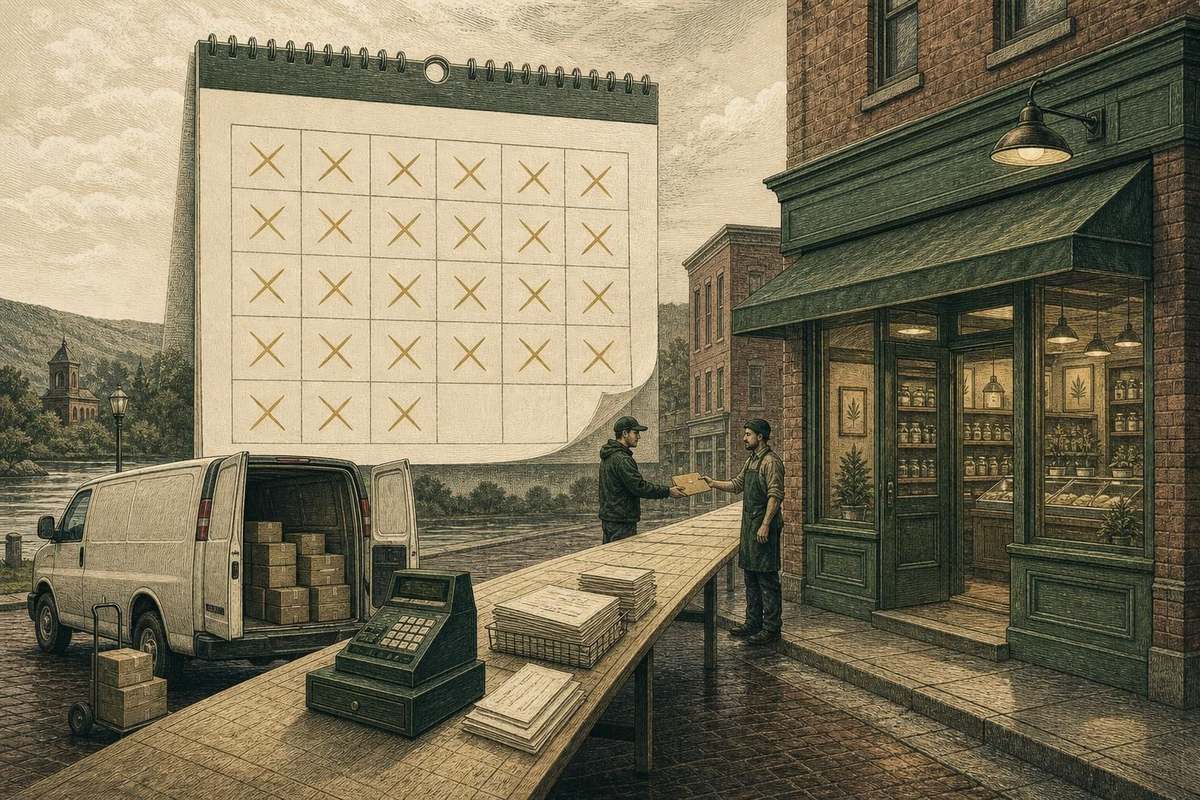
New York Wired Its Cannabis Debt List Into Metrc. Now a Late Invoice Means Cash at the Door.
Since Sept. 15, a store more than 30 days late on a supplier bill is flagged on the shipping manifest itself, and the state's old reporting portal closed to new reports on Oct. 23. Suppliers call the notice window too short; one state adviser says the real debt is about double what regulators can see.