A Paint Stripper Turned Up in 49 Colorado Vapes. The Testing Rule That Would Have Caught It Was Due in July.
StayCon, doing business as Craft, pulled Maui Wowie and Grape Gorilla cartridges after a private Denver lab found methylene chloride. The Marijuana Enforcement Division has still not warned consumers, and says it does not comment on investigations.
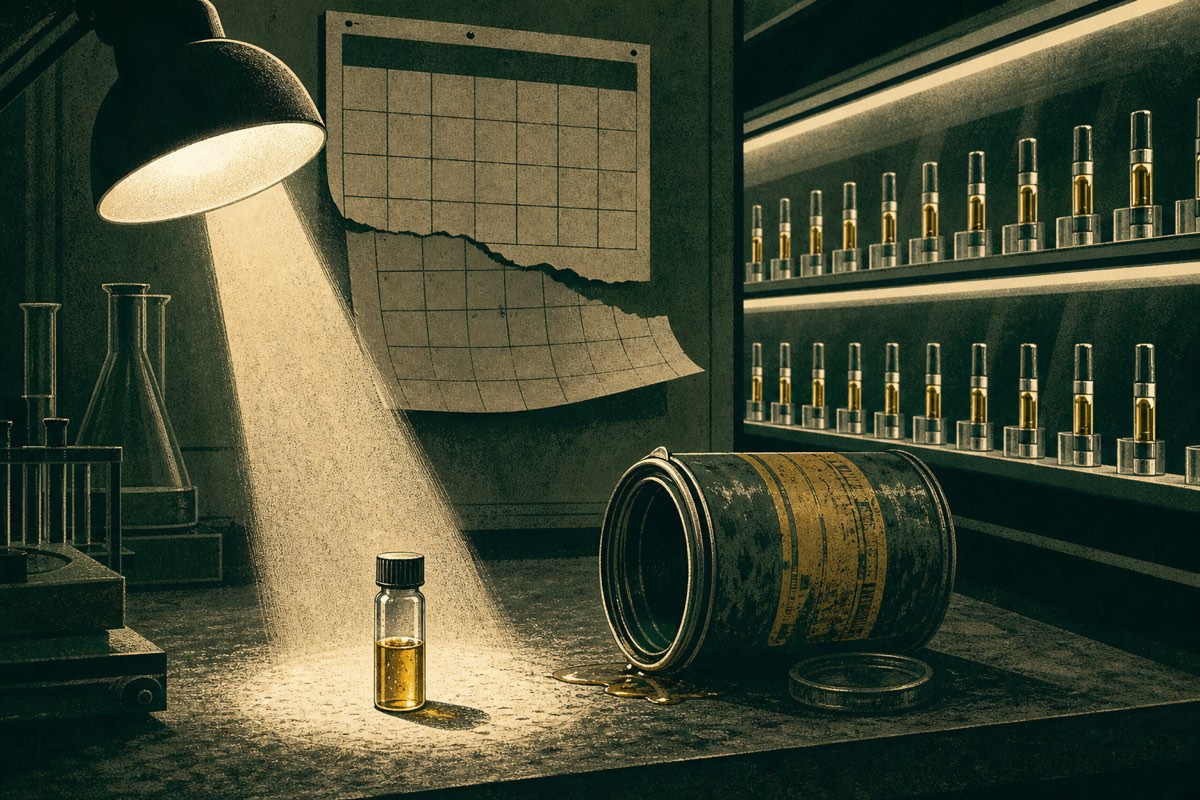
In August, a technician at Bona Fides Laboratory in Denver was running a routine screen on a marijuana vape cartridge, the kind of test that happens thousands of times a month in Colorado and almost never produces news. The lab was looking for pesticides and mold. It found methylene chloride. (S1)
Methylene chloride is a solvent used to strip paint. The Environmental Protection Agency moved in 2024 to bar it from most uses because it causes cancer. Colorado law prohibits marijuana manufacturers from using it at all.
David Mathis owns Bona Fides. He notified the manufacturer and he notified the state. Then he waited six weeks. (S1)
On Friday, September 18, the manufacturer, StayCon, a Pueblo County company that does business as Craft, sent dispensaries a voluntary recall notice covering 49 products, sold under the brand names Maui Wowie and Grape Gorilla. Some of them had first gone onto Colorado shelves more than a year and a half earlier. The notice attributed the methylene chloride to a "botanically-derived" flavoring compound. (S1, S2)
As of this week, the state of Colorado has issued no alert to consumers. Asked by The Denver Gazette and ProPublica why the agency had not made the recall public, Kyle Boyd, a spokesperson for the Marijuana Enforcement Division, said the agency "does not comment on investigations." StayCon did not respond to the publications' questions. (S1)
Due in July, arriving at the end of September
What makes this a regulatory story rather than a product story is the calendar. Colorado wrote a rule requiring labs to screen for methylene chloride and 30 other residual solvents, expanding the state's listed panel from 13 substances to 30-plus. It was meant to align Colorado with the 24 of 43 regulated marijuana states that already restrict the chemical. It was supposed to take effect in July. (S1)
It did not. A Marijuana Enforcement Division spokesperson said the state public health department, which reviews laboratories and recommends their certification, told the agency it needed more time. Implementation is now expected at the end of September, which is to say roughly three months after the deadline and roughly six weeks after a private lab found the chemical on its own. (S1)
Mathis's objection is not that the rule is hard. It is that his lab was ready. Bona Fides had been prepared to run the expanded screen since the start of July, and spent the summer not running it because the state had not switched the requirement on.
“How many samples were not tested but have contaminants in them and were passed to the public?”
— David Mathis, owner, Bona Fides Laboratory
Why this particular solvent matters
Methylene chloride is not a random contaminant. It is a tool. It can be used to cheaply convert hemp-derived CBD into THC, and that converted material can then be labeled and sold as state-licensed marijuana. The practice has a name in Colorado: inversion. It is illegal, it undercuts licensed cultivators on price, and it avoids the marijuana tax. Colorado banned the conversion process years ago, first by regulatory advisory in 2021 and then by statute. (S1)
So a solvent showing up in a cartridge is ambiguous in a way a pesticide is not. It can mean a contaminated flavoring, which is what StayCon's notice says. It can also be residue from converting hemp into THC. The recall notice offers the first explanation. A competitor has spent two years arguing for the second.
Justin Trouard, who owns Mammoth Farms, told the Gazette and ProPublica that he suspects StayCon was synthesizing hemp-derived cannabinoids and selling the result into the regulated market. He produced 2024 test results in which a third-party lab concluded that a StayCon vape had been made from chemically synthesized hemp source material. StayCon's lawyer denied it at the time. (S2)
Trouard took the findings to the Marijuana Enforcement Division. The agency confirms it received the complaints. Its own testing did not find synthetically derived THC, so it took no action. Regulators describe the current investigation as open, ongoing and unrelated to that 2024 complaint. (S2)
The agency's own people have conceded the scale of the underlying problem. In May, the Gazette and ProPublica reported that a senior official at the Marijuana Enforcement Division, the unit Dominique Mendiola runs as senior director inside the Colorado Department of Revenue, told industry representatives in a meeting that the volume of chemically converted hemp being sold as marijuana is larger than the agency has disclosed publicly. In April the division had announced a crackdown on the practice, citing tax avoidance and serious risks to public safety. (S1, S5, S8)
Manufacturers still pick their own samples
Underneath the delayed rule sits a deeper one that Colorado looked at and walked away from. In this state, as in most, the manufacturer chooses which samples go to the lab and which lab receives them. A company selects the material that will represent its batch and selects the company that will grade it.
In February, Colorado regulators floated replacing that with independent sample collection, requiring lab personnel or contractors to pull the samples themselves. It is the single change most likely to make compliance testing mean what it claims to mean. Top manufacturers said it would be too expensive. Regulators backed down. (S1)
That incentive structure is not a Colorado peculiarity. It is the reason California spent two years pulling laboratory licenses and then watched a licensed farm the size of a small town run banned fungicides until a worker died. A lab that fails batches loses the customer who chose it. The result is a national market in which the most rigorous laboratories are the ones under the most commercial pressure, and Bona Fides has just demonstrated the corollary: the lab that finds the problem is the one that has to decide, alone, what to do about it.
There is a defense of the state's position and it deserves to be made. Certifying laboratories to run a new 30-solvent panel is not a formality. If Colorado had switched the requirement on in July with an insufficient number of certified labs, it would have created a testing bottleneck that halts product statewide, and a rushed certification produces exactly the unreliable results the rule exists to prevent. The public health department asking for more time is the kind of caution that looks prudent until something turns up in the interval.
The harder question is the consumer advisory, and there the agency's position is weaker. An open investigation is a reason not to characterize a company's conduct. It is not obviously a reason to leave buyers of 49 recalled cartridges unaware that the recall exists.
There is one more wrinkle, and it arrived ten days before the recall. On September 15, in East Fork Enterprises, Inc. v. EPA, the U.S. Court of Appeals for the Fifth Circuit vacated the EPA's methylene chloride risk management rule under the Toxic Substances Control Act, holding that the agency had committed errors of law and that substantial evidence did not support key parts of its unreasonable-risk determination. The federal restriction that made this chemical notorious has been sent back to the agency. (S3)
That changes nothing about Colorado law, which bans the solvent in marijuana manufacturing on its own authority. It does mean the sentence "the EPA banned it" is now doing less work than it was a month ago, at precisely the moment a state agency is deciding how urgently to tell people what they bought.
- End of September 2026, Colorado's expanded residual-solvent testing panel is expected to take effect, roughly three months late.
- Whether the Marijuana Enforcement Division issues a public consumer advisory on the StayCon recall, or lets the manufacturer's dispensary notice stand as the only warning.
- The outcome of MED's open investigation, and whether it reaches the inversion question a competitor raised in 2024.
- Whether regulators revisit independent sample collection after backing down in February. Nothing has been rescheduled.
- EPA's response to the Fifth Circuit remand on methylene chloride, which will determine what the federal baseline is.
Colorado was the first state in the country to sell recreational marijuana, on January 1, 2014. Twelve years on, the thing that caught a carcinogenic solvent in 49 cartridges was not the state's testing regime, because the state's testing regime for that solvent had not started yet. It was one lab in Denver looking for something else.
Mathis notified everybody he was supposed to notify, in August. The recall came in September. The public notice has not come at all.
- [1]ProPublica / The Denver Gazette — Colorado marijuana company voluntarily recalls dozens of contaminated products amid state regulatory delays
- [2]MJBizDaily — Colorado cannabis firm recalls vapes over cancer-causing solvent
- [3]Holland & Knight — Fifth Circuit vacates EPA's methylene chloride risk management rule under TSCA (East Fork Enterprises v. EPA, Sept. 15, 2026)
- [4]StayCon recall notice, September 18, 2026 (DocumentCloud)
- [5]ProPublica / The Denver Gazette — Smoke and Mirrors: how intoxicating hemp seeped into the first recreational marijuana market in the country
- [6]ProPublica / The Denver Gazette — Regulators knew this marijuana product was harming people. It stayed on shelves for more than a year.
- [7]ProPublica — Colorado regulators discussed ending manufacturer-chosen lab sampling
- [8]ProPublica — Colorado marijuana regulators announce crackdown on intoxicating hemp
- [9]Colorado Marijuana Enforcement Division — about the division
- [10]Denver Gazette — Marijuana company recalls contaminated products
Comments are open to verified operators. Sign in or create a free account to weigh in.
Yufang Lan Had Not Been Paid. She Died August 27, and California Began Pulling the Cannabis She Grew.
The Department of Cannabis Control suspended Joel Michaely Farms on September 8 after a warrant turned up 55,069 plants, Eagle 20 in the hoophouses and a crew living on moldy floors. Four products have been recalled so far.

Hohenheim Study Challenges Cannabis’s Drought-for-Potency Pitch
Danilo Crispim Massuela and his colleagues found that two CBD-dominant varieties responded more strongly to genetics than to imposed water stress. Their new paper offers a quieter environmental prize: lower water use with output maintained.