Yufang Lan Had Not Been Paid. She Died August 27, and California Began Pulling the Cannabis She Grew.
The Department of Cannabis Control suspended Joel Michaely Farms on September 8 after a warrant turned up 55,069 plants, Eagle 20 in the hoophouses and a crew living on moldy floors. Four products have been recalled so far.
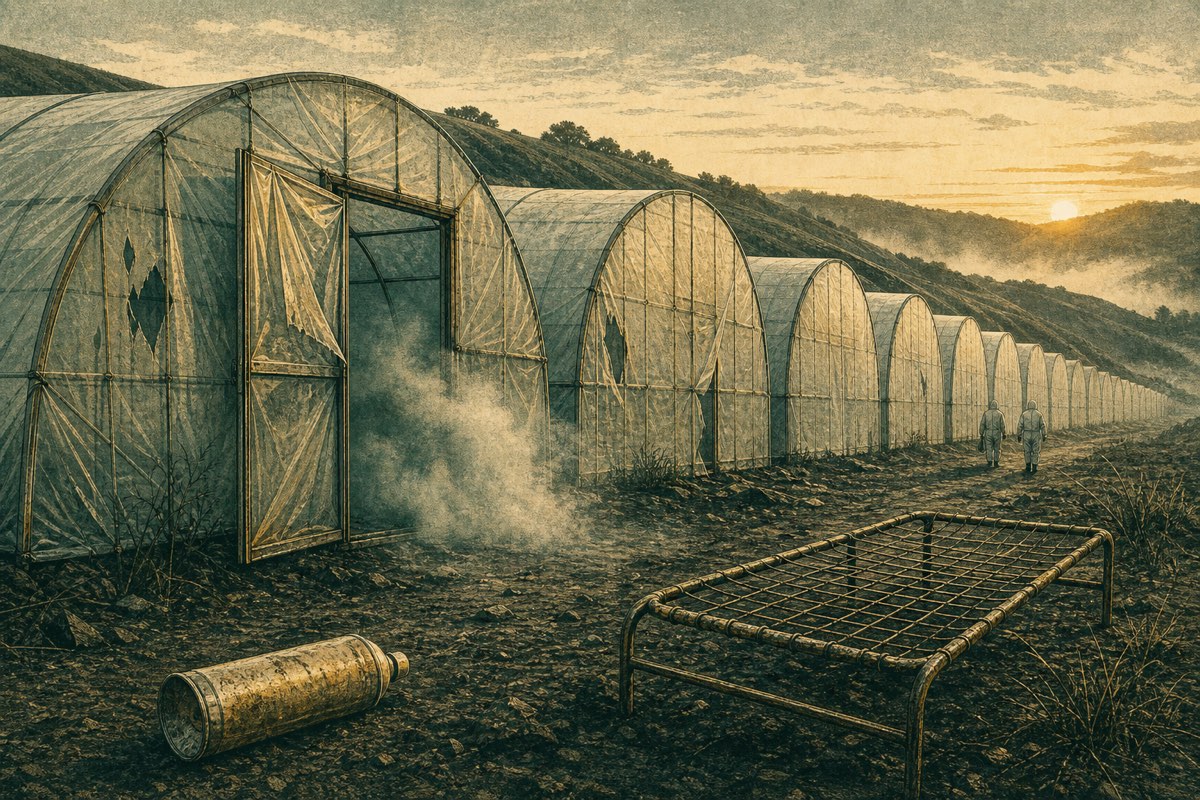
On the morning of August 21, someone carried Yufang Lan out of a cannabis farm in Lower Lake, California, and drove her to a hospital. She was 46. She was unresponsive. Her heart had stopped. The man who brought her in has never been publicly identified, and the hospital is a small one, roughly two hours north of the Napa Valley in a county where the biggest employers are a casino, a school district and the weed.
Lan spent six days in intensive care. She died on August 27. State investigators now believe she was poisoned at work, by the chemicals sprayed on the plants she tended. A final public determination of her cause of death has not been made. (S1, S2)
Ten days after she died, a California Department of Cannabis Control special investigator named Jaime Musuda signed an affidavit describing what the state found when it executed a search warrant at her workplace on August 31. The farm held 55,069 cannabis plants. It held 6,000 pounds of processed cannabis, two firearms, and roughly 20,000 gallons of contaminated liquid that would require specialized disposal. It also held ten to fifteen people, living in the buildings, sleeping against walls that had gone moldy. They spoke Mandarin. According to the cultivation manager, none of them had been paid, because the farm had not yet turned a profit and was not expected to for years. (S1, S3)
The farm was not an illicit grow hidden in the hills. Joel Michaely Farms held a California state cannabis license and a Lake County use permit, UP 22-15, approved for nearly 1,089,000 square feet of outdoor canopy spread across more than 500 acres. It was one of the largest permitted cultivation sites in Northern California. Its flower moved through licensed distributors into licensed dispensaries, where it was sold to customers who had chosen the legal market specifically so they would not have to wonder what was on it. (S1, S4)
On September 8, the Department of Cannabis Control suspended the license, citing evidence that the operation was adulterating cannabis, selling or transferring adulterated cannabis, and engaging in criminal activity on the premises. The next day the recalls started. As of September 16 there were four products off the shelves, two of them confirmed to trace back to Lower Lake, sold at as many as 45 retail locations between Los Angeles and the rest of the state. The investigation is expected to run for months. No one has been arrested. (S1, S2, S5)
What investigators say they found in the hoophouses is the part that should worry anyone who buys cannabis in California. Musuda's affidavit describes cans of Real-Kill Indoor Fogger, a consumer fumigant sold for roaches, discharged inside roughly 20 of the property's 112 hoophouse structures. Outdoors, investigators reported bottles of illicit foreign-labeled pesticides alongside three products that are legal on other crops and unapproved for cannabis: Sanmite SC, whose active ingredient is pyridaben; Altus, which carries flupyradifurone; and Eagle 20. (S1, S3)
Eagle 20 is the one cultivators recognize on sight. Its active ingredient, myclobutanil, is a routine grape and apple fungicide and a catastrophe on cannabis, because when myclobutanil is heated it can release hydrogen cyanide. It is the single most notorious banned input in the American cannabis supply chain. It is also, in outdoor cultivation, extremely effective against powdery mildew, which is why it keeps turning up.
The recall list reads like a tour of the middle of the California market. Iced Infused Flower, distributed by Natura Distribution, went to 20 retailers statewide and is confirmed to have originated at the Lower Lake farm. Martini's Pre-Roll in the Double Runtz variety, from Peace and Joy LLC, is also confirmed and was sold in Los Angeles. Tree House Flower, from the same manufacturer, and Cali Lean Tincture, from 510 Consultants LLC, which reached 25 retailers, were pulled for potential contamination with the connection still unconfirmed. (S2, S5)
Every batch in that recall list was supposed to have been tested. That is the whole architecture of California's legal market: a licensed lab pulls a sample, screens it against a state pesticide panel, issues a certificate of analysis, and only then can the batch move to retail. The system caught none of this. It took a woman's death.
The suspension order points at the other half of the failure. Alongside the pesticides, the department cited untagged plants, inventory it could not account for, and track-and-trace breakdowns. California's seed-to-sale system, Metrc, is the mechanism that is supposed to make a recall possible in the first place: every plant gets a tag, every tag follows the material into a package, and the package number is what a regulator traces backward from a dispensary shelf. When the tags are missing at the farm, the chain of custody is a guess. That is why two of the four recalled products are still listed with an unconfirmed connection nine days after the suspension.
It is not the first time the screen has failed. In 2024, a Los Angeles Times investigation had Anresco Laboratories and SC Labs run more than 100 pesticides against 42 products bought off legal California shelves. Twenty-five came back above allowed levels, including compounds linked to cancer, liver damage and neurological harm. The state responded by pulling testing-lab licenses, and Zachary Eisenberg, vice president of Anresco Laboratories, called the revocations "a step in the right direction." Two years later, a licensed farm the size of a small town was running foggers in its hoophouses. (S6, S7)
The pattern that connects the two episodes is not incompetence at any single lab. It is an incentive structure. A cultivator pays for its own compliance test and chooses which lab performs it, which means the lab that fails the most batches loses the most customers. California has spent two years pulling licenses from laboratories on the losing end of that arithmetic, and the department's own analysis of the new pesticide thresholds concedes how thin the surviving sector is.
The DCC did not wait for the recall to rewrite the rules. The pesticide testing regulation was filed with the Secretary of State on July 27, 2026, more than a month before Lan was hospitalized. Its first phase takes effect October 1. An earlier and stricter draft was walked back after the department's own economic analysis found it could have wiped out half of California's licensed testing laboratories, which is its own commentary on the health of that sector. (S8)
“Approximately 10 to 15 workers were living on the property in cramped conditions with mold on the walls.”
— Jaime Musuda, Special Investigator, California Department of Cannabis Control
The labor half of the story has gone almost entirely uncovered. California has had a cannabis worker-safety mandate on the books since 2018, when Governor Jerry Brown signed AB 2799, requiring every licensed cannabis business to put at least one employee and one supervisor through the 30-hour Cal/OSHA course within a year of licensure. The bill was pushed by the UFCW Western States Council. "California's cannabis industry creates thousands of jobs where workers must know how to be safe and how to report violations," Amber Baur, the council's executive director, said at the time. (S9, S10)
A 30-hour course does not help a worker who is not being paid, does not speak English, and lives in the building. The enforcement question raised by Lower Lake is not whether the rule existed. It is whether anyone verified it at a site licensed for 25 acres of canopy.
There is a fair counter-argument, and operators in Lake County have been making a version of it for years. A licensed farm that breaks the rules is a licensee the state can suspend, seize from and prosecute. An unlicensed farm is not. The recalls are visible precisely because the product was in the legal chain, tagged in track-and-trace, traceable to a distributor and a store. Nothing comparable happens when a traditional-market grow poisons someone. That is an argument for the system working slowly rather than not working, and it is worth taking seriously. It is also not much comfort to a customer who bought a pre-roll in Los Angeles in July.
- October 1, 2026, Phase one of DCC-2025-03-R takes effect; numerical pesticide action levels replace the Category I/II framework and a 0.10 microgram-per-gram limit applies to former Category I compounds.
- Ongoing, The DCC continues tracing distribution out of Lower Lake; additional recalls are possible on lots with an unconfirmed link.
- Pending, The Lake County coroner's determination of Yufang Lan's cause of death, which the state has not yet released.
- Pending, Any Cal/OSHA or labor-enforcement referral arising from the on-site living and pay conditions described in the affidavit.
- Unscheduled, The criminal investigation, which state officials have said will run for months. No arrests have been announced.
State records list the point of contact for Joel Michaely Farms as Josh Michaely, a real estate agent in the Las Vegas area. Asked about the suspension and the death, he declined to comment. (S1)
Lake County spent the better part of a decade rebuilding itself around cannabis after the fires, courting permits, fighting neighbors over setbacks and water and evacuation routes, arguing at supervisor meetings about how many acres of canopy a hillside could hold. The county got its industry. In the 11000 block of Spruce Grove Road, the plants have been seized, the liquid hauled away, and the hoophouses are empty.
Yufang Lan's name did not appear in most of the trade coverage of the recall. She had worked at one of the largest licensed cannabis farms in California and had not received a paycheck from it. Whatever the coroner ultimately writes down, the state's own investigator has already put the essential fact on the record: she was living where she worked, and what she worked with was not supposed to be there.
- [1]MJBizDaily — California cannabis officials suspend farm after worker death
- [2]Yahoo News — California marijuana pulled from shelves after farm worker's death
- [3]Kind Green Buds — Investigator affidavit details, seizure figures and worker conditions
- [4]CEQAnet — Joel Michaely Farms, Lake County Use Permit UP 22-15
- [5]Marijuana Retail Report — California regulators recall 'adulterated' cannabis, shutter farm
- [6]Beyond Pesticides — Pesticide-contaminated cannabis in California reveals testing failures
- [7]SFGate — Banned pesticides keep showing up in California's legal pot
- [8]California DCC — Rulemaking DCC-2025-03-R, pesticide testing
- [9]UFCW Western States Council — Governor Brown signs AB 2799
- [10]Cal/OSHA — Cannabis industry health and safety
- [11]California DCC Recalls Portal
Comments are open to verified operators. Sign in or create a free account to weigh in.
A Paint Stripper Turned Up in 49 Colorado Vapes. The Testing Rule That Would Have Caught It Was Due in July.
StayCon, doing business as Craft, pulled Maui Wowie and Grape Gorilla cartridges after a private Denver lab found methylene chloride. The Marijuana Enforcement Division has still not warned consumers, and says it does not comment on investigations.

Hohenheim Study Challenges Cannabis’s Drought-for-Potency Pitch
Danilo Crispim Massuela and his colleagues found that two CBD-dominant varieties responded more strongly to genetics than to imposed water stress. Their new paper offers a quieter environmental prize: lower water use with output maintained.