Texas Tightens Hemp Restrictions as Trulieve and Green Thumb Get Conditional Medical Licenses
Restrictions on delta-8 and other covered THC products take effect July 31, while qualifying delta-9 hemp products remain permitted. Senator Charles Perry has promised a total-ban bill for January 2027, and Texas has expanded its medical program from three dispensing licenses to fifteen, with the twelve new awards still conditional.
Behind the counter of Austinite Cannabis Co., the family-owned shop where she does 60 percent of her revenue in hemp-derived THC, Estella Castro is doing the survival math for the third time in two years. First came Senate Bill 3, the total ban that passed the Legislature in 2025 before the governor's veto saved her. Then came January's proposed retail registration fee of $20,000 per location, a proposal she told regulators "would force me to close despite doing everything right." Now the author of the original ban has promised to file it again in January, and a court ruling has put a July 31 deadline on delta-8 products beyond permitted naturally occurring traces. "I feel like we're better than that, you know, we're Texas," she says. "We need to find some middle ground." (S3, S5, S17, S19)
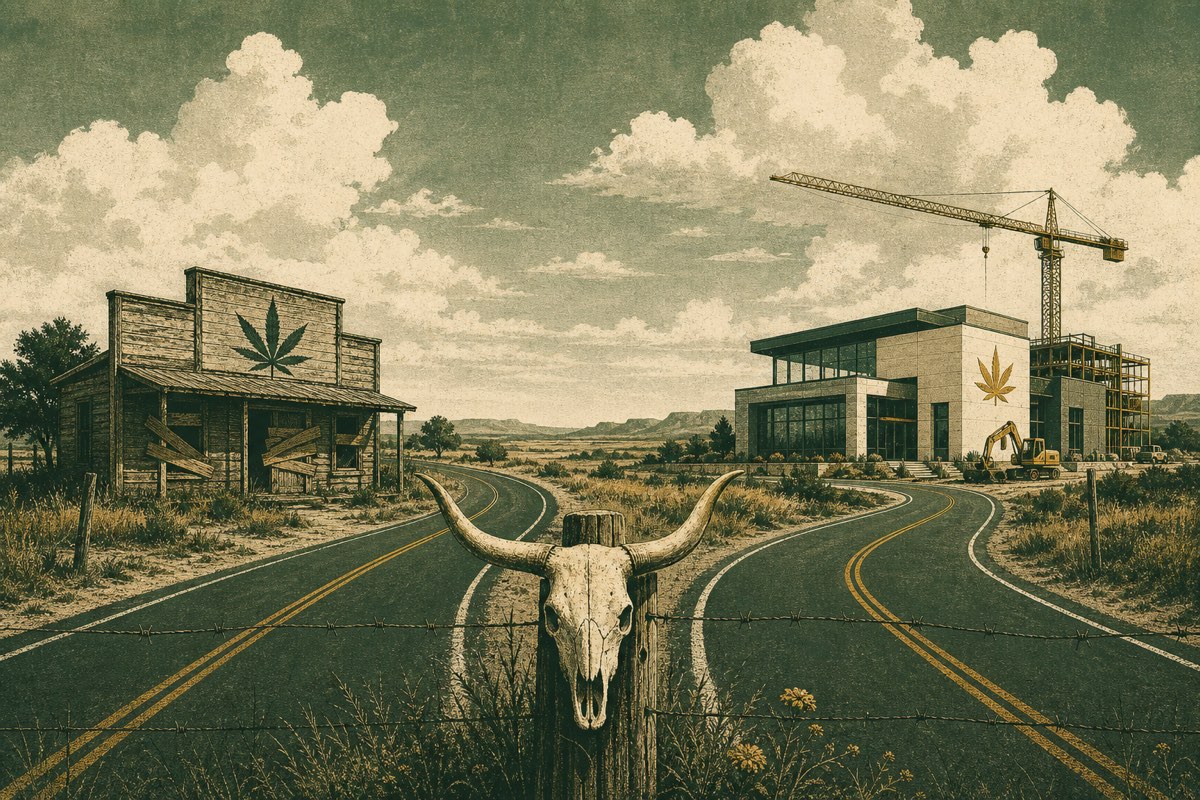
Texas is running the American cannabis argument in both directions at once. The state is moving, by court ruling, by agency rule, and if Senator Charles Perry has his way, by statute, to restrict products sold by a hemp industry whose annual cannabinoid sales were estimated at $5.5 billion in a commissioned 2025 study. January reporting counted more than 9,100 licensed hemp sellers. In the same twelve months, it has conditionally selected twelve new medical cannabis dispensing organizations, including Trulieve and Green Thumb, and added chronic pain to the qualifying conditions of a program that, until now, served a sliver of Texans through exactly three providers. One market is being strangled while its replacement is still under construction. (S1, S5, S9, S16, S20)
The renewed ban push was announced July 7 at a Senate Health and Human Services interim hearing. Dr. Manda Hall reported 10,515 THC exposure-related calls to the Texas Poison Center Network, with children five and under the largest age group; the cited account did not specify the data period or an age-group percentage. Dr. Dominic Lucia of Baylor Scott & White reported cannabis overdose visits at his pediatric hospital rising from 348 in 2021 to more than 900 in 2025. Perry, the author of the vetoed SB 3, promised to re-file a total ban when the Legislature convenes in January 2027. (S1, S3)
The court route is already moving. On May 1, the Texas Supreme Court reversed the injunction that had blocked delta-8 enforcement since 2021, allowing the health department to classify manufactured delta-8 as a Schedule I substance. DSHS published its reinstated cannabinoid definitions July 10, effective July 31. Its guidance permits only naturally occurring trace delta-8 in qualifying hemp products, while preserving qualifying delta-9 at no more than 0.3 percent by dry weight. The separate injunction against the March hemp rules had already been lifted June 5, and reinstatement was denied June 26; that litigation remained active, but the rules were enforceable. (S12, S17, S18, S19)
The prohibition drive has been a three-year Republican civil war. Lieutenant Governor Dan Patrick made the ban his signature fight, "I'm not going to legalize marijuana in Texas... if people want to vote me out of office for that, so be it", and pushed SB 3 through both chambers, only to watch Governor Greg Abbott veto it in June 2025. Two special sessions deadlocked. Abbott answered instead with an executive order: 21-and-up sales, ID checks, testing and labeling standards. The backlash to the ban came from Patrick's own side, veterans' groups, small-business conservatives, talk-radio hosts, and it is why lawmakers like Democrat Nathan Johnson predict the House "won't go with it again." Perry is betting the poison-center testimony changes that. (S2, S7, S8)
“I feel like we're better than that, you know, we're Texas. We need to find some middle ground where it's not a complete ban, and we can still be able to come together.”
— Estella Castro, Owner, Austinite Cannabis Co., Austin
The fight has produced scenes no one would have scripted for Texas Republican politics. Patrick, defending the ban at a Capitol press conference, threw a bag of THC edibles at a reporter to make a point about packaging that mimics candy. Conservative radio host Dana Loesch fired back at the whole enterprise: "This is stupid. It's like the gun ban argument with a different variable... do your job as a parent and parent instead of idiotically expanding government." Patrick, running for reelection with a Trump endorsement and more than $33 million banked, has made clear he considers the political risk acceptable. Veterans' groups, who rely on hemp THC in a state whose medical program only now covers chronic pain, have been the ban's most sympathetic opponents. (S7)
While the hemp market fights for its life, the state's official cannabis program is staffing up. House Bill 46, signed the day before the SB 3 veto, expanded the Compassionate Use Program from 3 dispensing licenses to 15, added chronic pain, traumatic brain injury, Crohn's disease and hospice care to the qualifying conditions, and allowed satellite locations. The corrected May 8 list of twelve conditional winners includes Trulieve, Verano, PharmaCann and Green Thumb's RISE. Cresco's earlier award was rescinded, placing it on the eligibility list. All twelve remain conditional, not yet cleared to sell; only the three original providers are operating. Trulieve is targeting September openings in Austin, Dallas and San Antonio. (S9, S16, S21)
The two stories are not independent, and the industry knows it. Texas's medical operators stand to inherit whatever demand a hemp ban displaces, a point trade coverage has made explicitly, which complicates every framing of the medical expansion as a neutral policy good. The hemp side's economics deserve their own scrutiny: the $5.5 billion and 53,300-job figures come from a 2025 Whitney Economics hemp-cannabinoid report commissioned by the Texas Hemp Business Council and Hometown Hero. The hearing's child-safety testimony is driving Perry's renewed push, whatever one thinks of his remedy. The council has advocated 21-plus sales and child-resistant packaging while opposing a ban, a position closer to Abbott's executive order than to either extreme. (S1, S5, S6, S20)
- July 31, the reinstated cannabinoid definitions take effect; enforcement against covered delta-8 products is the first test. (S17, S19)
- The appeal over the March rules, which remain enforceable after the injunction was lifted; whether the industry can regain court protection. (S18)
- November 2026, the separate federal hemp-product ban takes effect, potentially mooting parts of the Texas fight.
- January 2027, Perry has promised another total-ban bill, reopening the legislative fight. (S1, S3)
- September, Trulieve's Austin, Dallas and San Antonio dispensaries target opening, subject to approval. (S16, S21)
Castro's middle ground is, at this point, the loneliest position in Texas cannabis: too regulated for the prohibitionists, too permissive for the Senate, and squeezed on the calendar from both ends, state restrictions on covered THC products arriving July 31 and federal restrictions scheduled for November. "Banning it is just hurting the consumer," she says. The consumers will decide that at the register, among the state's thousands of hemp sellers or, as the medical expansion opens, through its medical dispensing organizations. (S3, S5, S9, S17, S19)
Correction (September 8, 2026): Cresco's conditional award was rescinded in May, and the March-rule injunction was lifted in June. The article also overstated the July 31 restrictions and the share of poison-center calls involving young children. The text now distinguishes the broader hemp-market estimate, conditional licenses and reported age-group data. (S1, S16, S17, S18, S20)
- [1]MJBizDaily — new ban threat for Texas hemp THC market as medical access expands (July 9)
- [2]The Texan — Senate committee revisits THC ban in interim hearing (July 9, Perry/Kolkhorst)
- [3]CBS Austin — Austin cannabis shop seeks middle ground on THC ban (Castro)
- [4]MJBizDaily — Trulieve targets September opening for 3 Texas stores (July)
- [5]MJBizDaily — proposed regulations threaten $5.5 billion market (Jan; fee hikes)
- [6]Texas Governor — Executive Order GA-56 on hemp products (Sept 2025, primary)
- [7]Houston Public Media/Texas Tribune — Patrick's THC ban draws backlash from the right (June 2025)
- [8]Lt. Gov. Dan Patrick — statement on Senate passage of SB 6 (Aug 2025, primary)
- [9]Texas DPS — TCUP 89th legislation page: HB 46 requirements (primary)
- [10]Texas DPS — Phase I TCUP expansion: 9 conditional licensees (Dec 2025, primary)
- [11]Texas DPS — Phase II TCUP expansion: 3 conditional licensees (April, primary)
- [12]KUT — Texas Supreme Court clears way to classify delta-8 as controlled substance (May 1)
- [13]The Texan — Supreme Court restores delta-8 regulation; hemp product ban remains blocked (May)
- [14]The Texan — Texas Hemp Business Council urges regulate-not-ban (July; Gilkey July 31 warning)
- [15]Cannabis Science and Technology — Whitney Economics Texas hemp market report (2025)
- [16]Texas DPS — corrected May 8 conditional-license awards; Cresco moved to eligibility list (primary)
- [17]Texas DSHS — hemp-program guidance on July 31 scheduling, trace exceptions and qualifying delta-9 (primary)
- [18]Texas Hemp Business Council — litigation chronology documenting June 5 injunction lift and June 26 denial (party account)
- [19]Texas DSHS — July 10 Texas Register notice effective July 31, 2026 (primary schedule record)
- [20]Hometown Hero / GlobeNewswire — March 2025 commissioned Whitney Economics hemp-cannabinoid study (primary sponsor release)
- [21]The Marijuana Herald — July 10 report on Trulieve September targets in three Texas cities
Comments are open to verified operators. Sign in or create a free account to weigh in.

Kevin Harden Served 14 Years of a 30-Year Marijuana Sentence. On September 3, Trump Sent Him Home.
A commutation, a letter from Mike Tyson, and a co-defendant freed five years earlier. Roughly 3,000 people are still in federal prison on marijuana trafficking convictions that rescheduling will not touch.

A Drug-Testing Trade Group Tried to Undo Schedule III. On September 9, Three Judges Said No.
The D.C. Circuit left medical cannabis in Schedule III and, in the same order, barred a Pittsburgh grower and an Iowa producer from joining the case to defend it. Briefing proposals are due within 30 days.