Pierce Township Asked for 4.5% of a Dispensary's Gross. Vext Science Is Suing for $2.5 Million
Ohio law already sends host towns 36% of the state's 10% cannabis excise and, since March, bars local fees based on gross receipts. A neighboring township asked for 3.6% with a rebate clause. An appeals court has sent Vext's constitutional claims toward discovery.
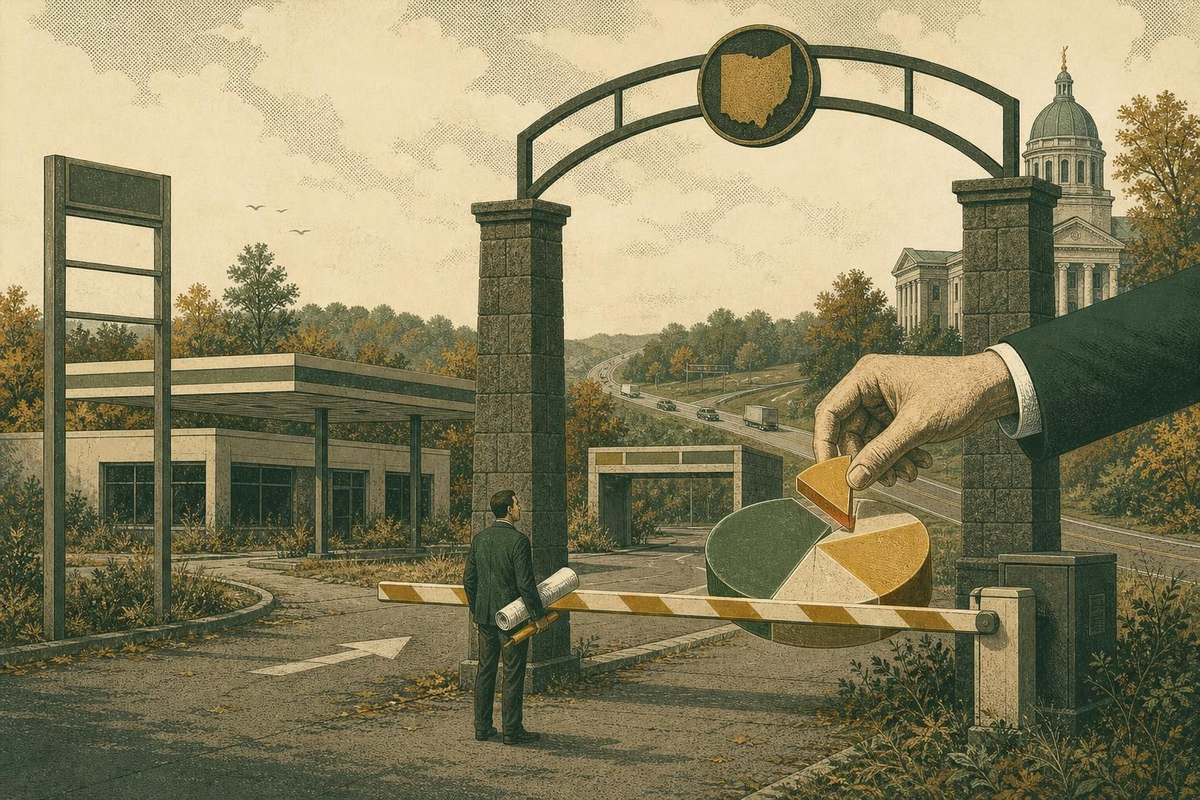
Scott Everett found the corner on a family visit. Early in 2024, driving through Pierce Township in Clermont County, Ohio, to see his parents, the general counsel of Vext Science noticed a vacant gas station on Ohio Pike near the old village of Amelia, east of Cincinnati. It had what a dispensary operator wants: a busy road, cross traffic, room to park and space for a drive-through window. (S1)
The township had a moratorium on dispensaries then. In late summer 2024, Everett told WCPO, officials called him back to say they were looking at lifting it and allowing a limited number of stores, and asked whether he was still interested. He met the township administrator at the site, signed a lease in the fall of 2024 and began paying the taxes and insurance on a building he could not yet use. (S1)
Then came the conditions. To operate, Everett said, Vext's store would have to sign an exclusive operating agreement with the township: a $50,000 application fee, a $10,000 annual fee and bond, and 4.5 percent of the dispensary's gross revenue, every year, for as long as it stayed open. "Candidly, I thought that was the force of government trying to extort us," he told the station. "I was left with, 'Take it or leave it.'" (S1, S2)
Vext did not take it. The Phoenix-based company, which operates six dispensaries in Ohio, filed two lawsuits in the Clermont County Court of Common Pleas in 2025 through its subsidiary New Gen RE Ohio LLC. One fought the permit denial. The second, still pending, seeks $2.5 million in damages, legal fees and lost profits for a store that Everett says should have opened in the spring of 2025 and now is planned for early spring 2027. MJBizDaily picked up the case on Oct. 26, three weeks after WCPO first reported it. (S1, S2, S3)
The case is about more than one corner. Ohio's adult-use law, approved by voters as Issue 2 in 2023, gave cities and townships the power to ban or limit dispensaries, and many in the state's southwest did so quickly, Everett says. That created scarcity, and scarcity gave local officials leverage over who opened where. Everett contends Pierce used that leverage to charge a cannabis business something it charges no one else. The township contends it is entitled to set its own terms, and that another dispensary down the road agreed to the same ones. A ruling for either side would tell operators across Ohio what a permit can cost beyond the fees printed in the statute. (S1, S4)
The state already shares the cannabis tax with host towns. Ohio levies a 10 percent excise on adult-use purchases, and under Section 3796.40 of the Revised Code, 36 percent of what remains after refunds goes to a host community cannabis fund for cities and townships with at least one licensed dispensary, distributed monthly by each community's share of sales and usable "for any lawful purpose." That works out to roughly 3.6 cents of every taxable sales dollar. (S4)
For more than a year after sales began, though, towns did not get that money. Issue 2 created the tax without appropriating the revenue, and it took Senate Bill 56, sponsored by state Sen. Steve Huffman, a Tipp City Republican, to set up the fund. In mid-January 2026 the state released the first distributions, including nearly $100 million in back payments, the Ohio Township Association reported. In Piqua, City Manager Paul Oberdorfer said his city's first check topped $438,000. (S5, S6)
That gap explains what nearby townships were doing in 2024. In Union Township, also in Clermont County, a July 2, 2024, zoning staff report on the Beyond Hello dispensary at 693 Old State Route 74 recommended a one-time $50,000 impact fee and a community benefits agreement paying the township 3.6 percent of gross sales, "as contemplated by voters" in Issue 2, regardless of any later change to state law. The same paragraph promised a credit: if state distributions arrived, the township would rebate duplicate payments. (S7)
Pierce went further. Its 4.5 percent is higher than the 3.6 percent that Union pegged to the state formula, and none of the public accounts of Pierce's terms mention a rebate. Since August 2025 the township's zoning code has written the arrangement in. Dispensaries are conditional uses in its general business and industrial districts, every cannabis use "shall negotiate an agreement with the Board of Township Trustees to outline community benefits," and a permit is void after 60 days if no operator agreement is in place. (S1, S8)
Before SB 56 rewrote it, the older provision Everett cites barred townships from levying any tax, fee or charge on adult-use operators "which is not generally charged on other businesses." Townships do not ask hardware stores for a share of their gross, Everett argues. "It also says directly in the statute that you cannot single out our business for a fee, a tax … that you don't charge everybody else in the township," he said. (S1, S9)
The courts have not reached that question. On the permit, WCPO reported, a Clermont County judge found the township zoning board's denial "illegal, arbitrary, capricious, unreasonable, and unsupported by a preponderance of substantial, reliable, and probative evidence," and after an appeal the two sides reached a partial settlement and Vext got its permit a few weeks before WCPO's Oct. 6 report. (S1)
The damages case is moving more slowly. Vext's amended complaint, filed June 11, 2025, raised constitutional challenges under the U.S. and Ohio constitutions and a federal civil-rights claim under 42 U.S.C. 1983 against the township, its zoning board, township administrator Eddie McCarthy and planner and zoning inspector Mary Berta Coggeshall. Pierce asked for judgment on the pleadings, arguing McCarthy and Coggeshall had qualified immunity. The trial court refused on Nov. 10, 2025, writing that the case "involves a resolution and operating agreement that is said to violate the Constitution." (S10)
On July 13, 2026, Ohio's Twelfth District Court of Appeals affirmed. Judge Robin N. Piper, joined by Judges Matthew R. Byrne and Robert A. Hendrickson, held that immunity and the constitutionality of the township's rules could not be decided on the pleadings alone. "Cases are to be tried after discovery, and on the merits, not by pleadings," the opinion said, quoting an earlier Ohio decision. The ruling decided nothing about whether the 4.5 percent demand is legal. It sends the dispute toward discovery, where the township's records on how it set its terms could come out. (S10)
Allen Freeman, chairman of the Pierce Township Board of Trustees, says he will not pay to end it. "I would like a judge to rule either way," he told WCPO. "But the notion that we owe them some random amount of money that their attorney figured out on the back of a napkin, I don't see that they're entitled to anything." (S1)
Freeman points down Ohio Pike. Shangri-La Monroe West LLC opened a dispensary there this summer after its manager signed an operating agreement with what WCPO described as seemingly the same terms: a $50,000 application fee, a $10,000 annual fee, a $10,000 bond and 4.5 percent of gross sales as a community benefit agreement. The township has not collected those payments while the Vext case is pending, Freeman said. (S1)
“Look down the street at Shangri La, same township, same trustees, same government, different result.”
— Allen Freeman, Chairman, Pierce Township Board of Trustees, to WCPO
Freeman's broader argument is local control, which Ohio's law grants in plain terms when it comes to whether and where dispensaries open. "The township has rules," he said. "We have a right to tell people what kind of development we want, and where we want it." He added that Vext would have met similar agreements almost anywhere: "If you go to almost any other township, if you go to any other local jurisdiction, a lot of those things are there." (S1)
Everett agrees the practice is common in the region and says that is the problem. "Where we've seen it most prevalently, frankly, is the southwest part of the state, and I think it is because it's a chopped-up metropolitan area in terms of a lot of small townships," he said. "This area was quick to put on a lot of moratoriums, and so it created some scarcity." He drew a line between donations and conditions. A Little League sponsorship or help with a park is one thing, he said; "This is, you're going to pay it or else." (S1)
Other states have lived with versions of the same deal for years. In Massachusetts, operators have paid tens of millions of dollars to local governments under host community agreements that take a percentage of gross, MJBizDaily noted in its account of the Ohio suit. In Michigan, a resort town's long fight with a single dispensary showed how much leverage local permits carry. (S3)
Pierce's position has a logic that predates the lawsuit. In 2024 its neighbors could not count on the state's cannabis money arriving, and Union wrote that fear into its terms. That money now flows monthly by statute. What Pierce would do with a 4.5 percent share on top of it, and whether a court will let it collect, is now a matter for discovery. (S5, S7, S10)
Everett, meanwhile, has construction drawings for the gas station on Ohio Pike: a reception area, plenty of parking and the drive-through he wanted from the start, under Vext's Herbal Wellness Center name. Vext's newest store in Fairfield has met expectations "and then some" in its first 90 days, he said. He plans to open the Pierce store in the spring and keep suing anyway. "We're not just going to walk away and ignore our rights here," he said. (S1)
- [1]WCPO 9 I-Team - Cannabis dispensary sues Pierce Township for $2.5M over alleged extortion, pay-to-play for permit (Oct. 6, 2026)
- [2]MMJ Daily - Vext Science seeks $2.5M from Pierce Township over cannabis permit extortion claims
- [3]MJBizDaily - Marijuana MSO sues Ohio town, claiming local fees were 'extortion' (Oct. 26, 2026)
- [4]Ohio Revised Code Chapter 3796 (sections 3796.31 and 3796.40, as amended by SB 56)
- [5]Ohio Township Association - Adult-use cannabis tax funds distributed (Feb. 2, 2026)
- [6]Ohio Senate - Sen. Steve Huffman announces release of cannabis tax funds to local municipalities
- [7]Union Township (Clermont County) Board of Zoning Appeals - Staff report, Case 2-24-A, Beyond Hello, July 2, 2024
- [8]Pierce Township Zoning Resolution, amended through Dec. 10, 2025 (cannabis uses added Aug. 12, 2025)
- [9]Ohio Revised Code 3780.25 (2025 version) - Local authority regarding adult use cannabis operators
- [10]New Gen RE Ohio, L.L.C. v. Pierce Twp. Bd. of Trustees, 2026-Ohio-2650 (12th Dist., July 13, 2026)
Comments are open to verified operators. Sign in or create a free account to weigh in.

Cresco Paid $46.9 Million for Nine Pennsylvania Stores. Then Pennsylvania Flipped Its Senate
Cresco announced the PharmaCann deal as $50 million; its Nov. 6 filing books $25.3 million of the final price as permits. On the same day's call, Charlie Bachtell said adult-use odds are meaningfully better, and an analyst asked whether the real holdup was ever Republicans.

A $120 Delivery Got Her Fired. A Labor Judge Says the Union Was the Real Reason
An NLRB judge ruled Nov. 2 that Utah's The Flower Shop illegally fired three pharmacy workers after a 2024 organizing drive and ordered them reinstated. The company is still arguing in federal court that labor law does not reach an intrastate cannabis business.