A $120 Delivery Got Her Fired. A Labor Judge Says the Union Was the Real Reason
An NLRB judge ruled Nov. 2 that Utah's The Flower Shop illegally fired three pharmacy workers after a 2024 organizing drive and ordered them reinstated. The company is still arguing in federal court that labor law does not reach an intrastate cannabis business.
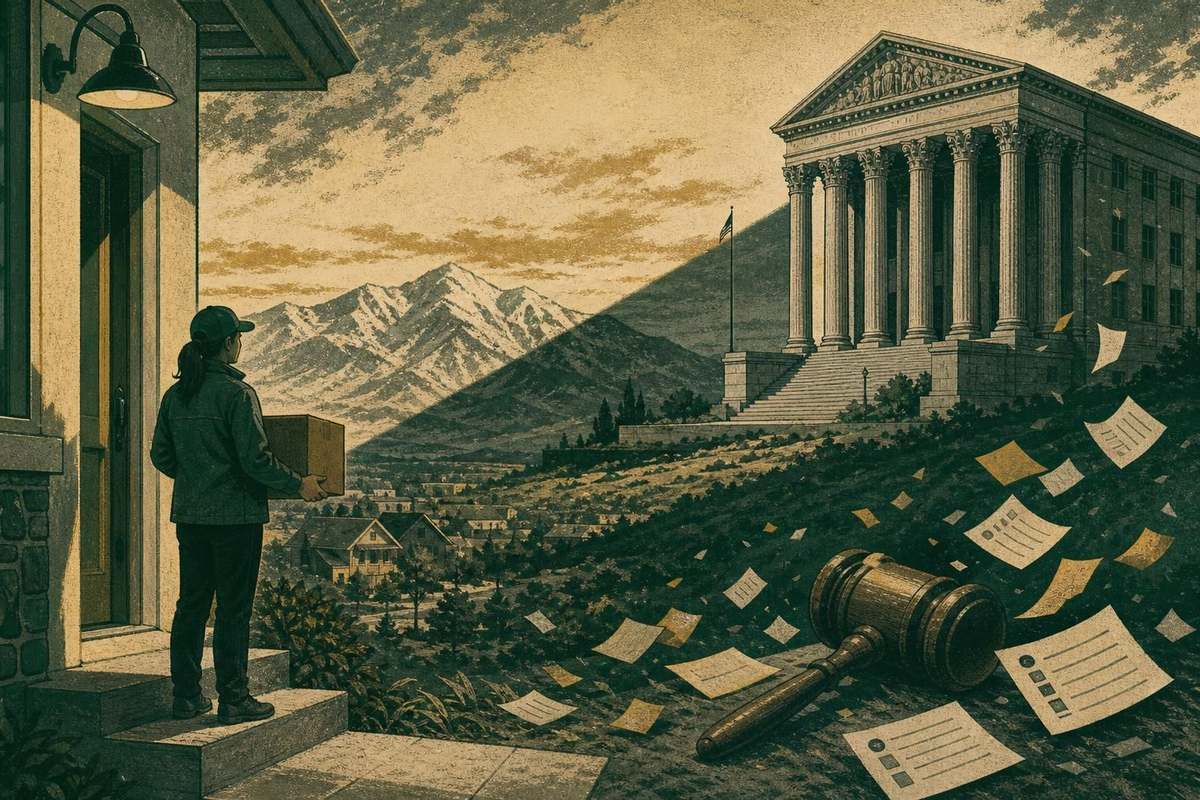
On April 23, 2024, Bridget Hughes stood at a patient's door in northern Utah holding a sealed box from The Flower Shop, the medical cannabis pharmacy in South Ogden where she had worked since the previous September. The receipt taped to the box did not match the order on the patient's phone. Someone at the store had packed the wrong products, and the price on the box was higher than the price the patient had agreed to online. The patient objected. Hughes called the store at least twice to reach the delivery manager, Ryan Ratigan-Allen, and could not get him. (S1)
She made a decision on the doorstep. She charged the patient the lower price shown on the online order, $120 according to the federal labor judge who later reconstructed the afternoon, handed over the box and returned to the store. Later, her register came up short, and she worked out why. She told an assistant manager. Two days later, on April 25, The Flower Shop fired her for charging a patient a price management had not approved, and banned her from its Utah pharmacies. Nobody from the company spoke with her before deciding. (S1)
Ten weeks earlier the same managers had written her up as an asset. Her 90-day review, prepared on Feb. 16, 2024, rated her "Meets Standards," came with a $1-an-hour raise and called her a great wellness expert. In March, she had signed a union card. On or about April 1, she told a labor consultant the company brought into the store that she was very interested in the union. (S1)
On Nov. 2, 2026, Administrative Law Judge Geoffrey Carter of the National Labor Relations Board ruled that the firing was illegal. In a decision dated in Washington, he found that True North of Utah LLC, which does business as The Flower Shop, violated the National Labor Relations Act when it fired Hughes, Todd Wagner and Sara Rueda in the spring of 2024 because they supported a drive to organize with the United Food and Commercial Workers Local 99, and when it banned Hughes and Rueda from its pharmacies. He ordered the company to offer all three their jobs back within 14 days of the order and to make them whole for lost pay and other harms. (S1)
The ruling is about three pharmacy agents in Ogden. The fight around it is about the whole industry. While the case was being tried, The Flower Shop sued the board in federal court in Utah, arguing that a cannabis business whose product cannot legally leave the state is outside the reach of federal labor law. If that argument ever wins in a federal appeals court, cannabis companies with unionized workforces would have a new way to stop bargaining. The judge declined to decide it, and the company says it will keep pressing it. (S1, S2, S3)
The record Carter built over five days of trial in Salt Lake City, on July 21 and 22 and Aug. 19 to 21, 2026, reads like a ledger of a few weeks in 2024. In late February or early March, workers at the South Ogden store began talking about a union, in person and on Discord. On March 11, Rueda, Wagner and a coworker, Zoe Ruthven, contacted Perri Byrd, a representative of Local 99. On March 14, somewhere between 13 and 15 employees met at Wagner's home while Byrd joined by video. (S1)
One guest had not expected a union meeting. Assistant manager Trevor Hundley had come to what he thought was a barbecue. According to the decision, he asked Wagner not to tell anyone he had been there and said he could be fired if the director of retail operations, Justin Jennings, found out. Hundley testified that he attended a barbecue, not a union meeting; the judge did not credit that denial. (S1)
Between March 15 and March 22, nineteen employees signed union authorization cards electronically, one of them a security guard outside the proposed unit. Managers heard about the campaign within days. On March 23, the pharmacist in charge, Jarrod Freeman, received an anonymous text warning that "this union thing has gotten out of control." Freeman testified that he regarded Rueda and Wagner as the two employees most active in recruiting. (S1)
The campaign never reached the company in writing. On or about March 25, about 10 employees gathered at Rueda's home and signed a letter asking the company to recognize the union. The judge found no evidence that anyone mailed it. Within a day or two, at least three card signers told Byrd or Rueda they were out. By April 1, when Byrd stood in the store's parking lot and only Hughes came out to talk, she concluded the drive was over. That same day, Jennings emailed all employees that the company respected their right to form a union but preferred to keep working with them directly, and scheduled sessions with what he called an Employee Rights Educator. (S1)
The firings came after the campaign had already faded. Wagner, who had been named Employee of the Month in May 2023, was placed on a performance improvement plan for attendance on or about March 20, the judge found, despite no documented discipline before it. Sick on March 25 and 26, he called the store instead of texting a manager. The company fired him April 2. Hughes followed on April 25. Rueda, who had posted in the store's group chat that Hughes was a single mother of six who had been treated unfairly, was fired May 10 for missing a mandatory staff meeting and for Bible passages she posted to the same chat, which two coworkers said made them uncomfortable. (S1)
“Bridget is a great wellness expert and kicks butt on delivery.”
— The Flower Shop's Feb. 16, 2024 performance review of Bridget Hughes, quoted in the NLRB decision
Carter applied the board's long-standing Wright Line test, which asks whether union activity was a motivating factor and whether the employer would have acted the same way anyway. For Wagner, he pointed to an improvement plan with no prior discipline behind it and to attendance lapses the store had long tolerated. For Hughes, he noted that the pharmacy manager testified she would probably give a documented coaching for an unauthorized discount, and called the harassment allegations behind Hughes's ban "hopelessly vague," made without giving her a chance to respond. For Rueda, he found that another employee who missed the same meeting went undisciplined for months and that the company skipped the investigation its own anti-harassment policy promised. (S1, S4)
The judge did not give the union everything. He found that the company lawfully fired Ruthven on March 22, 2024, after a heated argument with her manager, because she was already on an improvement plan that predated the campaign and warned against becoming combative. He dismissed the claim that the company unlawfully refused to bargain, since nobody sent the recognition letter. And he declined to order bargaining without an election, reasoning that the union had lost its majority by April 1, before the illegal firings. (S1)
The company's version is in its post-hearing brief, filed Oct. 15 by its lawyer, Jeffrey Toppel of Brueckner Spitler Shelts in Scottsdale, Ariz. "TFS terminated the Alleged Discriminatees for documented attendance, conduct, and compliance problems, not for supporting the Union," the brief says. It describes a closely regulated pharmacy whose license depends on accurate transactions and strict delivery procedures, and a human-resources cleanup that began in October 2023, months before any union talk. Hughes, the brief says, admitted completing a delivery on modified financial terms without approval instead of returning the inaccurate order, as procedure required. (S5)
The brief also turns the union's own witness against it. Byrd testified that the campaign was effectively over by April 1, the company noted, and three of the four firings came after that date, so they could not have killed it. The judge agreed on that point when he refused to order bargaining. He did not agree that it made the firings lawful. (S1, S5)
Inside the store, the dispute played out in the open. After Hughes was fired, Rueda complained in the group chat that the company had fired her for a new manager's mistake. Freeman answered that Hughes "was the most trained in delivery" and "knew exactly what she was doing when she made that call," and added: "People need to grow up and take accountability." When Rueda reminded him that he had once encouraged her to unionize, Freeman wrote that he did not care whether workers unionized. (S1)
The jurisdiction question
The larger argument sits outside the decision. On July 7, 2026, The Flower Shop sued the board, its members and Judge Carter in the U.S. District Court for the District of Utah. It argued that the labor act covers commerce among the states, that Utah's medical cannabis law requires every transaction to stay inside Utah, and that the board's assertion of jurisdiction over cannabis rests on a 2013 advice memo, not the statute. On July 20, U.S. District Judge Ann Marie McIff Allen denied the company's request to freeze the case; Bloomberg Law reported that a federal law barring injunctions in labor disputes doomed the request. On Aug. 14 she allowed Local 99 to join the suit. (S2, S3, S6)
Labor scholars quoted by Bloomberg Law were skeptical. Robert Pushaw, a law professor at Pepperdine University, said the board's jurisdiction is clearer than the federal power the Supreme Court upheld in Gonzales v. Raich, "because there is no question that the Utah company is engaged in commerce in its most basic form, selling a product in the market." Jeffrey Hirsch, a labor law professor at the University of North Carolina and a former board lawyer, said the company's narrower reading of the statute is a tough argument because the act gives the board broad jurisdiction. (S3)
Federal rescheduling may have made the company's job harder. After medical cannabis moved to Schedule III, the Drug Enforcement Administration began registering state medical operators. "Now there's this emerging federal framework to take all medical programs and put them in the DEA system," Victoria Litman, a visiting research scholar at Stetson University College of Law, told Bloomberg Law. "That really hurts the intrastate argument." The board has already decided cases involving cannabis pharmacies, including Beleaf Medical earlier this year and two Curaleaf dispensaries in Arizona, Carter noted. (S1, S3)
The stakes for labor are measurable. The UFCW says it represents more than 11,000 workers at 400 dispensaries and 60 cultivation and production sites, according to Bloomberg Law. In Utah, its Local 99 already has a contract at WholesomeCo in West Bountiful, where workers voted 21 to 1 to unionize in November 2023 and ratified the state's first cannabis union contract on March 6, 2025. Several states, including California, New York and New Jersey, encourage unionization by requiring labor peace agreements, Bloomberg Law noted. (S3, S7)
The Flower Shop is not a small shop. The decision describes a company with facilities in Arizona, New Jersey, New Mexico and Utah, and pharmacies in South Ogden and Logan. It stipulated that its Utah revenue topped $500,000 in the year before the complaint. Delivery orders at South Ogden carried a $100 minimum and typically ran $150 to $500, the decision says, which puts Hughes's doorstep discount in context. The board's docket listed the case as open on Nov. 2, the day an order transferred it to the board in Washington. (S1, S8)
Hughes has been out of the store for more than two and a half years, roughly the time it took a charge filed on April 25, 2024, to become a ruling. If the order stands, The Flower Shop must offer her the job she lost over a single delivery, along with back pay. The company can ask the board to reverse the judge, and then a federal appeals court, and it has preserved its argument that none of this should ever have been the board's business. The question that started on a doorstep in northern Utah is now a question about whether federal labor law follows cannabis across a state line it is not allowed to cross. (S1, S2)
- [1]NLRB ALJ decision JD-75-26, True North of Utah LLC d/b/a The Flower Shop, Case 27-CA-340860 (Nov. 2, 2026)
- [2]Justia docket: True North of Utah v. NLRB, No. 1:26-cv-00108 (D. Utah)
- [3]Bloomberg Law: Cannabis dispensary's court loss delays attack on NLRB power
- [4]NLRB Edge: summary of the Flower Shop ALJ decision (Nov. 4, 2026)
- [5]The Flower Shop post-hearing brief to the ALJ (Oct. 15, 2026)
- [6]MJBizDaily: Setback for Utah medical cannabis company using federal prohibition to beat union push (July 27, 2026)
- [7]UFCW: Cannabis workers in Utah ratify first-ever union contract (WholesomeCo)
- [8]NLRB case page 27-CA-340860
- [9]Bloomberg Law: Cannabis firm fired workers for union activity, labor judge says
- [10]OnLabor: News & Commentary, Nov. 5, 2026
- [11]cannabis.inc: DEA's Nov. 29 supply-chain deadline
Comments are open to verified operators. Sign in or create a free account to weigh in.

Cresco Paid $46.9 Million for Nine Pennsylvania Stores. Then Pennsylvania Flipped Its Senate
Cresco announced the PharmaCann deal as $50 million; its Nov. 6 filing books $25.3 million of the final price as permits. On the same day's call, Charlie Bachtell said adult-use odds are meaningfully better, and an analyst asked whether the real holdup was ever Republicans.
Alabama's Law Allows 37 Cannabis Storefronts. Five Years On, Litigation Has Most of Them Stuck
Callie's Apothecary and Bama Bloom are adding stores in Bessemer and Birmingham, but every integrated license remains tied up in court. Washington has now named Alabama among seven states with DEA-registered dispensaries, putting a Nov. 29 federal supply-chain test on a market still learning to stock its shelves.